GEO vs AEO vs LLM SEO: What’s the Difference?
GEO vs AEO vs LLM SEO: Quick Answer
GEO, AEO, and LLM SEO are related strategies for improving visibility in AI-powered search, but each one focuses on a slightly different part of the discovery process.
To most people, that definition won’t be enough. Even if you are in the digital marketing space (SEO, LLM SE, AEO, PPC, Analytics, data streams, funnels, etc.), learning to differentiate the three will generally take some time. Explaining it to someone not in the space will take …well…it’s been quite some time, and SEO is still a foreign concept to most, so I wouldn’t hold my breath.
To get things started I’ve put together three definitions below:
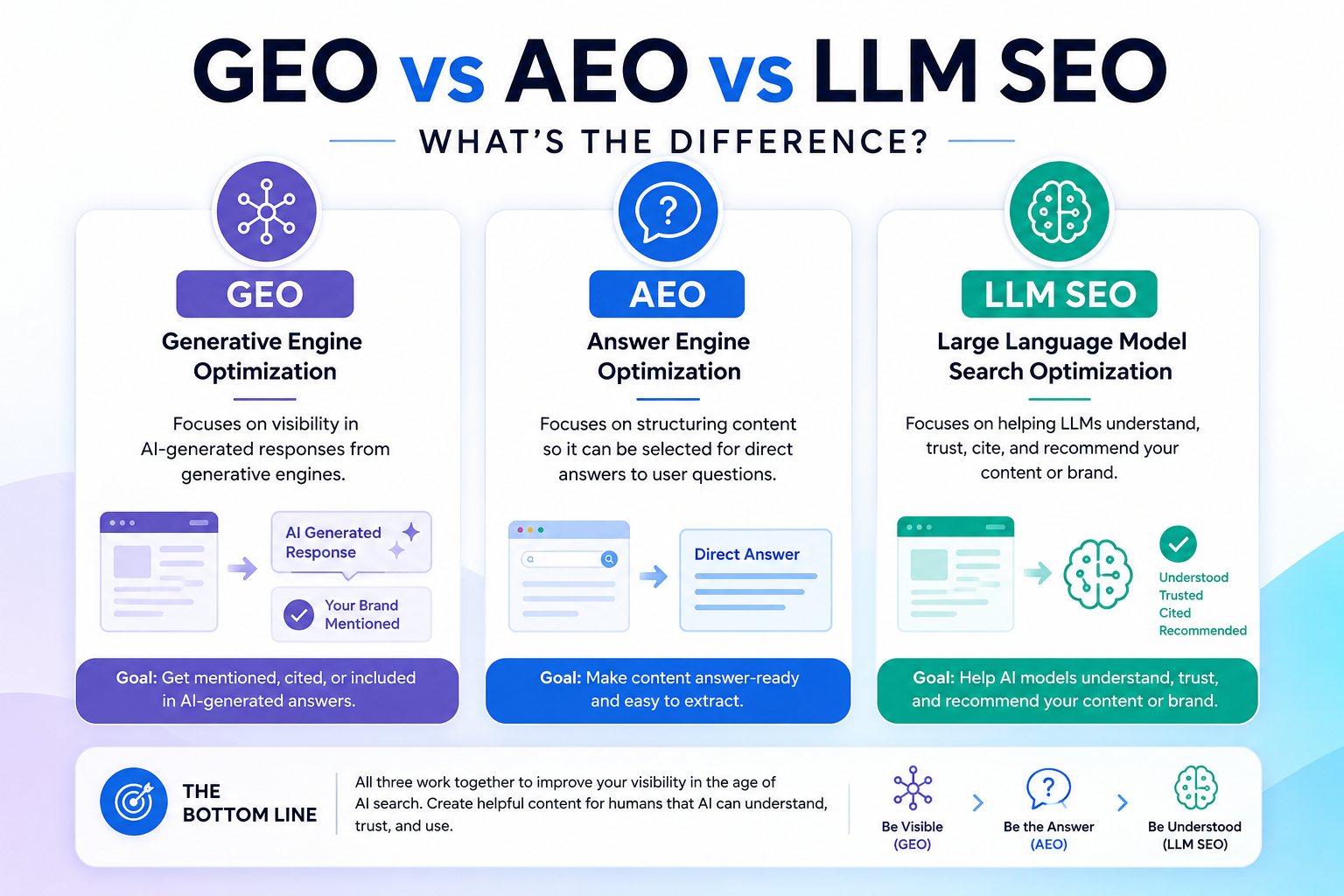
GEO, or Generative Engine Optimization, focuses on improving visibility in AI-generated responses from systems like ChatGPT, Perplexity, Gemini, Claude, Copilot, and Google AI Overviews.
AEO, or Answer Engine Optimization, focuses on structuring content so it can be selected for direct answers, featured snippets, voice search, AI summaries, and answer boxes.
LLM SEO, or Large Language Model SEO, focuses on helping large language models understand, trust, cite, and recommend your content or brand.
In simple terms:
GEO helps you appear in generative AI answers. AEO helps your content become the answer. LLM SEO helps AI systems understand and cite your brand.
These terms and their processes overlap no doubt, but there is a healthy line of differentiation as well. For most businesses, the best strategy is not to choose one and ignore the others. The best strategy is to build content that is clear, credible, structured, source-worthy, and easy for AI systems to understand.
I keep repeating this, you are now writing for a new user, AI. That doesn’t mean you aren’t writing for humans anymore, it means you will have to add new concepts and structures into your writing.
Why These Terms Matter Now
Search is changing from a list of links into a mix of links, answers, summaries, citations, and AI-generated recommendations.
Google AI Overviews provide short, AI-generated snapshots with important information and links for users to explore more on the web. ChatGPT Search can provide fast answers with links to relevant web sources (sometimes). OpenAI’s web search documentation also describes web search as a way for models to access up-to-date information and provide answers with sourced citations. So in simple terms, when you search on ChatGPT, you’ll get a quick answer from it’s database; however, it will still check online for a more recent and factual version of said answer.
That means SEO is expanding.
Traditional SEO still matters, but marketers now also need to think about:
- whether AI systems can understand their content
- whether their brand is associated with the right topics
- whether their pages are useful enough to be cited
- whether their content answers questions clearly
- whether their site has enough topical depth to be trusted
This is where GEO, AEO, and LLM SEO come in. Think of SEO as the umbrella term and everything else falls under it. Traditional SEO still works, just with a few nuances.
What Is GEO?
GEO stands for Generative Engine Optimization. It is the process of optimizing content and brand visibility for generative AI systems that produce synthesized answers.
The term became more widely known after the research paper “GEO: Generative Engine Optimization,” which introduced GEO as a framework for improving content visibility in generative engine responses. The paper’s authors describe GEO as a new optimization paradigm for helping content creators improve visibility in generative search experiences.
GEO is broader than optimizing for one platform. It can apply to several LLM results:
- ChatGPT
- Perplexity
- Gemini
- Claude
- Copilot
- Google AI Overviews
- AI Mode-style search experiences
- other generative answer engines
The goal of GEO is not only to rank. The goal is to influence whether your content, brand, ideas, or data appear in AI-generated responses. So, in short, ranking is good, but is your content good enough to appear in AI-generated responses?
GEO example
A user asks:
What are the best ways to optimize a website for AI search?
A generative engine may synthesize an answer from multiple sources. A strong GEO strategy increases the chance that your website is included, cited, mentioned, or used as supporting material.
What Is AEO?
AEO stands for Answer Engine Optimization. It is the process of structuring content so search engines, AI tools, and answer systems can use it to answer specific user questions.
AEO is not only about AI chatbots. It also connects to older answer-based search features such as:
- featured snippets
- People Also Ask
- voice search
- answer boxes
- knowledge panels
- AI-generated summaries
AEO focuses on making content answer-ready.
That means your pages should include:
- direct definitions
- concise answers
- question-based headings
- FAQ sections (questionable as on 2026 but still good to add them)
- comparison tables
- step-by-step guidance
- structured formatting
- clear explanations
AEO example
A user asks:
What is answer engine optimization?
An AEO-optimized article should answer that question immediately, preferably in the first few lines.
Example:
Answer Engine Optimization is the process of structuring content so search engines and AI tools can use it to provide direct answers to user questions.
That is the kind of sentence answer systems can easily extract. Remember they put together a short and concise answer from several sources online. With luck and correct structures, your site can be sited.
What Is LLM SEO?
LLM SEO stands for Large Language Model Search Engine Optimization. It is the process of optimizing your content and brand so large language models can understand, trust, cite, and recommend you.
LLM SEO focuses specifically on how large language models interpret content.
It includes:
- entity optimization
- topical authority
- brand clarity
- source credibility
- answer-ready content
- internal linking
- structured information
- citation potential
- crawlability and accessibility
- consistent brand descriptions
The goal is to help AI systems understand what your brand is about and when your content is relevant.
LLM SEO example
If NeuronPulse consistently publishes helpful content about LLM SEO, AEO, GEO, ChatGPT Search, Google AI Overviews, and Perplexity optimization, AI systems have a clearer reason to associate NeuronPulse with AI search optimization.
GEO vs AEO vs LLM SEO: Comparison Table
| Term | Full Name | Main Focus | Main Goal | Best For |
|---|---|---|---|---|
| GEO | Generative Engine Optimization | Visibility in generative AI responses | Get mentioned, cited, or included in AI-generated answers | AI search, generative engines, brand visibility |
| AEO | Answer Engine Optimization | Direct answers to user questions | Make content answer-ready and easy to extract | Featured snippets, AI answers, voice search, FAQs |
| LLM SEO | Large Language Model SEO | How LLMs understand and cite content | Help AI systems understand, trust, and recommend your brand | Entity clarity, topical authority, AI citations |
The easiest way to remember the difference:
AEO is about the answer. LLM SEO is about model understanding. GEO is about generative AI visibility.
The differences among the three are simple, but not easy to always understand. In general we’ll always go back to” Make great content people will want to read” but now with nuances in how data is structured. This means direct answer structure and how your content is put together.
How GEO, AEO, and LLM SEO Overlap
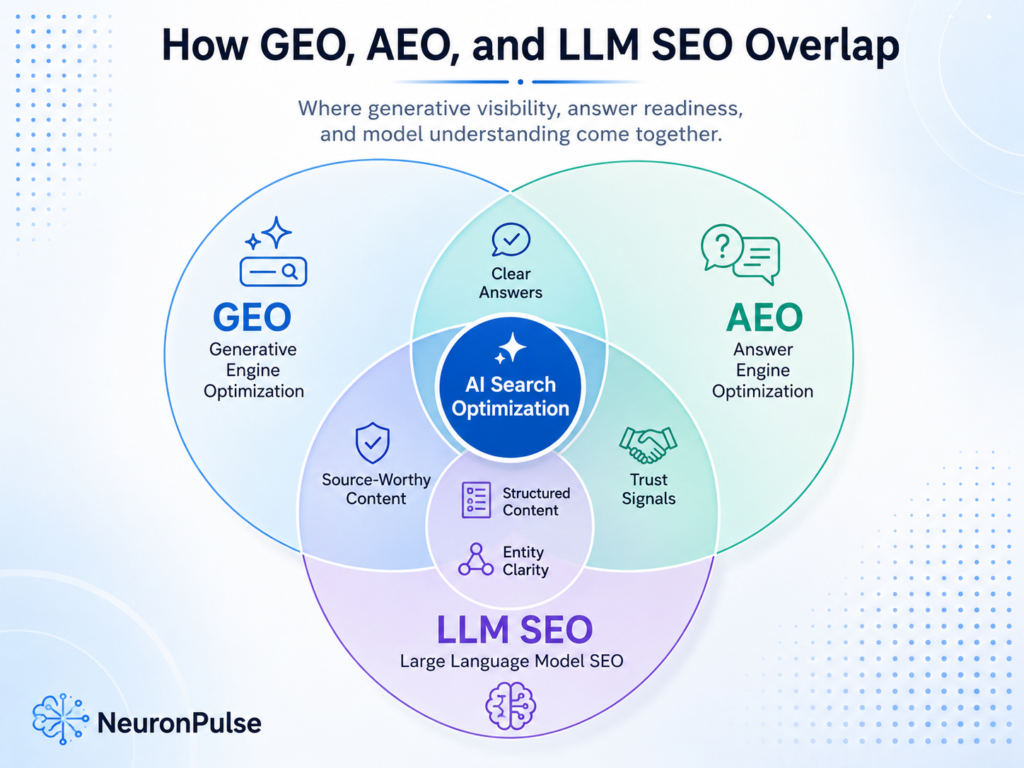
These three strategies are not separate silos. They work together and one can say that is is hard to do one without directly working on the other.
A single article can support all three.
For example, an article titled:
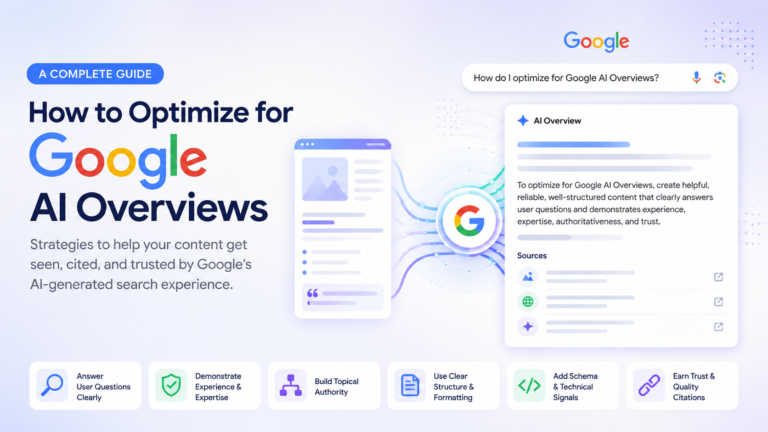
How to Optimize for Google AI Overviews
can support:
AEO by answering the main question clearly.
LLM SEO by strengthening brand and topic associations.
GEO by increasing the chance the article is used in AI-generated search summaries.
The overlap includes:
- clear answers
- trustworthy content
- useful examples
- topical authority
- structured headings
- credible sources
- internal links
- updated information
- entity consistency
- original insight
If you are doing AI search optimization well, you are usually doing some version of all three. Gone are the days of copying your competition’s article and simply “making it longer with more keywords.” Think of having laser-pointed answers to questions with some level of creativity laid out afterwards.
GEO vs SEO
SEO helps pages rank in traditional search results. GEO helps content appear in AI-generated responses.
Traditional SEO usually focuses on:
- rankings
- keywords
- backlinks
- crawlability
- page experience
- search snippets
- organic clicks
GEO focuses more on:
- AI-generated summaries
- citations
- brand mentions
- source selection
- answer inclusion
- information synthesis
- topical authority
But GEO does not replace SEO.
Google’s guidance for AI features says site owners should continue following Search essentials and make content eligible to appear in Search. Google also explains that AI features in Search use Google’s existing search systems and link to relevant content from across the web.
So traditional SEO remains the foundation. GEO builds on top of it. Again with the SEO umbrella term.
AEO vs SEO
SEO asks, “Can this page rank?” AEO asks, “Can this content answer the question?”
Traditional SEO can still drive visibility, but AEO makes your content easier to use in answer-driven formats.
For example, a traditional SEO page may be optimized around the keyword:
best time to visit Peru
An AEO-optimized page would also directly answer:
The best time to visit Peru is usually May through September for dry weather in the Andes, although shoulder months like April and October can offer fewer crowds.
AEO strengthens SEO because it improves clarity, structure, and usefulness.
LLM SEO vs SEO
SEO helps search engines crawl, index, and rank your pages. LLM SEO helps large language models understand, summarize, cite, and recommend your content.
LLM SEO includes traditional SEO fundamentals, but it adds more focus on:
- entity relationships
- brand positioning
- author credibility
- content extractability
- natural-language questions
- topical clusters
- semantic clarity
- source-worthiness
For example, if your brand is an AI search resource, your site should consistently connect your brand to terms like:
- LLM SEO
- AEO
- GEO
- AI search optimization
- ChatGPT Search
- Google AI Overviews
- Perplexity
- prompt strategy
- content strategy
That helps AI systems understand what your brand is relevant for. Reaching topical authority will take several articles; this tells the AI you are trustworthy and a good source of data for said niche.
Which Term Should You Use on Your Website?
For a general audience, you can use AI Search Optimization as your umbrella term. It is easy to understand and describes the space well.
Then use the technical terms underneath it:
- GEO for generative AI visibility
- AEO for answer-focused optimization
- LLM SEO for large language model visibility
- SEO for traditional search fundamentals
For NeuronPulse, the best hierarchy is:
AI Search Optimization
GEO
Visibility in generative AI answers.
AEO
Content structured for direct answers.
LLM SEO
Content and brand optimization for large language models.
SEO
The foundation for search visibility.
This gives you expert terminology without confusing beginner readers.
TheFramework: SEARCH
A simple way to combine GEO, AEO, and LLM SEO is the SEARCH Framework.
S — Source-worthy content
Create content that is useful enough to be cited, summarized, or recommended.
E — Entity clarity
Make your brand, author, topics, and expertise easy to understand.
A — Answer-ready structure
Use direct answers, FAQs, headings, tables, and concise explanations.
R — Reliable signals
Add authorship, citations, update dates, examples, and trust markers.
C — Content clusters
Build topical authority through connected article clusters, not isolated posts.
H — Helpful experience
Make the page useful for real readers first, with clear formatting and practical guidance.
This framework works across GEO, AEO, LLM SEO, and traditional SEO.
How to Optimize for GEO, AEO, and LLM SEO Together
1. Start with SEO fundamentals
Make sure your pages are crawlable, indexable, mobile-friendly, internally linked, and technically sound.
This is the easiest way to easy into the more difficult aspects of this space.
2. Answer the main question early
Every important article should provide a direct answer in the first few lines. Remember AI just wants to answer the questions as directly as possible. You can practice your creative writing afterwards.
3. Build topic clusters
Do not publish random one-off articles. Build connected clusters around topics like:
- AI search optimization
- LLM SEO
- AEO
- GEO
- ChatGPT Search
- Google AI Overviews
- Perplexity optimization
All of the articles should be related and interlinked to show topical authority. This doesn’t mean all of your articles ever need to be linked to each other. Creating clusters of data is easy and we can go into it in another article.
4. Strengthen entity signals
Use consistent language to describe your brand and expertise.
Example:
NeuronPulse helps marketers, founders, and businesses understand AI search, LLM SEO, AEO, GEO, prompting, and AI content strategy.
Mentioning a general description of what you do will ultimately let the AI know how you want to be recognized. Think of it as spreading your business card around an AI networking event.
5. Add original insight
Do not rely on generic AI content. Add examples, frameworks, comparisons, checklists, and practical experience.
Even if you plan to use AI to help your writing, it is crucial to always have an original thought put into the content. Create things that nobody else will, or content with original nuances.
6. Structure for extraction
Use headings, short paragraphs, summaries, tables, and FAQ sections. Be as organized as possible when creating content. The idea is to make it easy for LLMs to “extract” your information to place in their various results.
7. Support claims with sources
Use credible sources, especially when discussing AI platforms, search features, or technical recommendations.
8. Keep content updated
AI search is changing quickly. Important pages should be reviewed regularly.
Common Mistakes When Optimizing For All Three
Mistake 1: Treating GEO, AEO, and LLM SEO as completely separate strategies
They are different concepts, but the best practices overlap. It is difficult to now optimize for all three at the same time as it is.
Mistake 2: Using jargon without explaining it
Most readers do not know what GEO or LLM SEO means. Define the terms clearly. The general population still doesn’t know SEO or PPC so why would they know LLM, GEO, AEO, etc?
Mistake 3: Ignoring traditional SEO
AI search optimization still depends heavily on crawlability, content quality, authority, and technical SEO. This is your base and marketers will still have to put time into basic on page and off page SEO.
Mistake 4: Publishing generic AI-written content
Generic content is unlikely to stand out in either Google or AI-generated answers. Use AI to help you structure content, give you ideas, and generate definitions, but don’t allow it to write your articles for you. There are already so many AI-written articles out there that the person with the original thought will likely be more eligible for AI placements.
Mistake 5: Not building topical authority
One article about AI search is not enough. You need a connected library of useful resources. Think of each article idea as a base for 5-10 articles on similar interconnected topics.
Final Answer: What’s the Difference Between GEO, AEO, and LLM SEO?
GEO, AEO, and LLM SEO are all part of the new AI search optimization landscape.
GEO focuses on visibility in generative AI responses.
AEO focuses on becoming the direct answer to user questions.
LLM SEO focuses on helping large language models understand, trust, cite, and recommend your content or brand.
They overlap because AI search depends on clear, credible, structured, source-worthy content. The best strategy is not to choose one term or try to optimize for just one. Create a clear, concise content-building strategy with direct answers and good frameworks.
The best strategy is to build a website that helps humans first and gives AI systems every reason to understand, trust, and cite your content.
FAQ About GEO, AEO, and LLM SEO
GEO stands for Generative Engine Optimization. It refers to optimizing content for visibility in AI-generated responses from generative engines.
AEO stands for Answer Engine Optimization. It focuses on structuring content so answer systems can use it to answer user questions directly.
LLM SEO stands for Large Language Model Search Engine Optimization. It focuses on helping large language models understand, cite, and recommend your content or brand.
No. SEO focuses on visibility in search engine results. GEO focuses on visibility in AI-generated answers. However, GEO still depends on strong SEO fundamentals.
No. AEO focuses on direct answers. GEO focuses on generative AI visibility. They overlap because generative engines often produce direct answers.
Not exactly. LLM SEO focuses on how large language models understand and use your content. GEO focuses more broadly on visibility in generative AI responses.
For most businesses, all three matter. AEO improves answer quality, LLM SEO improves AI understanding, and GEO improves generative AI visibility.
Yes, but use them clearly. For beginner audiences, use AI Search Optimization as the umbrella term, then explain GEO, AEO, and LLM SEO as related strategies.
No. AI search optimization expands SEO. Traditional SEO fundamentals such as crawlability, helpful content, internal linking, and authority still matter.