How to Optimize for Google AI Overviews
How Do You Optimize for Google AI Overviews?
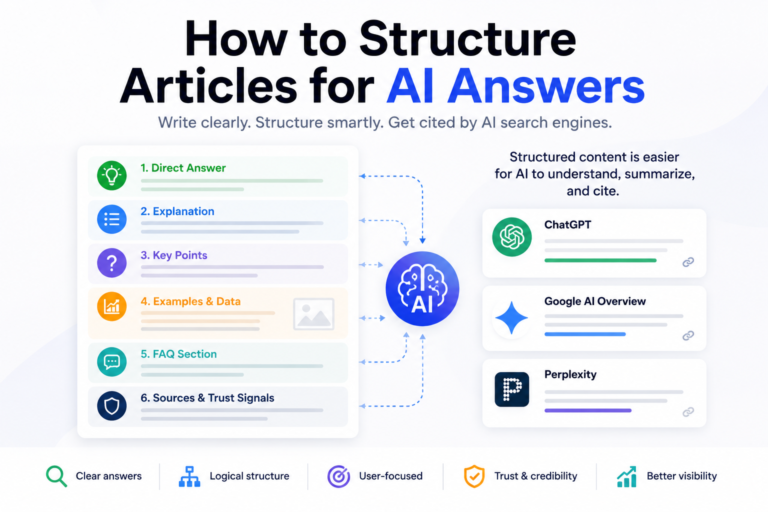
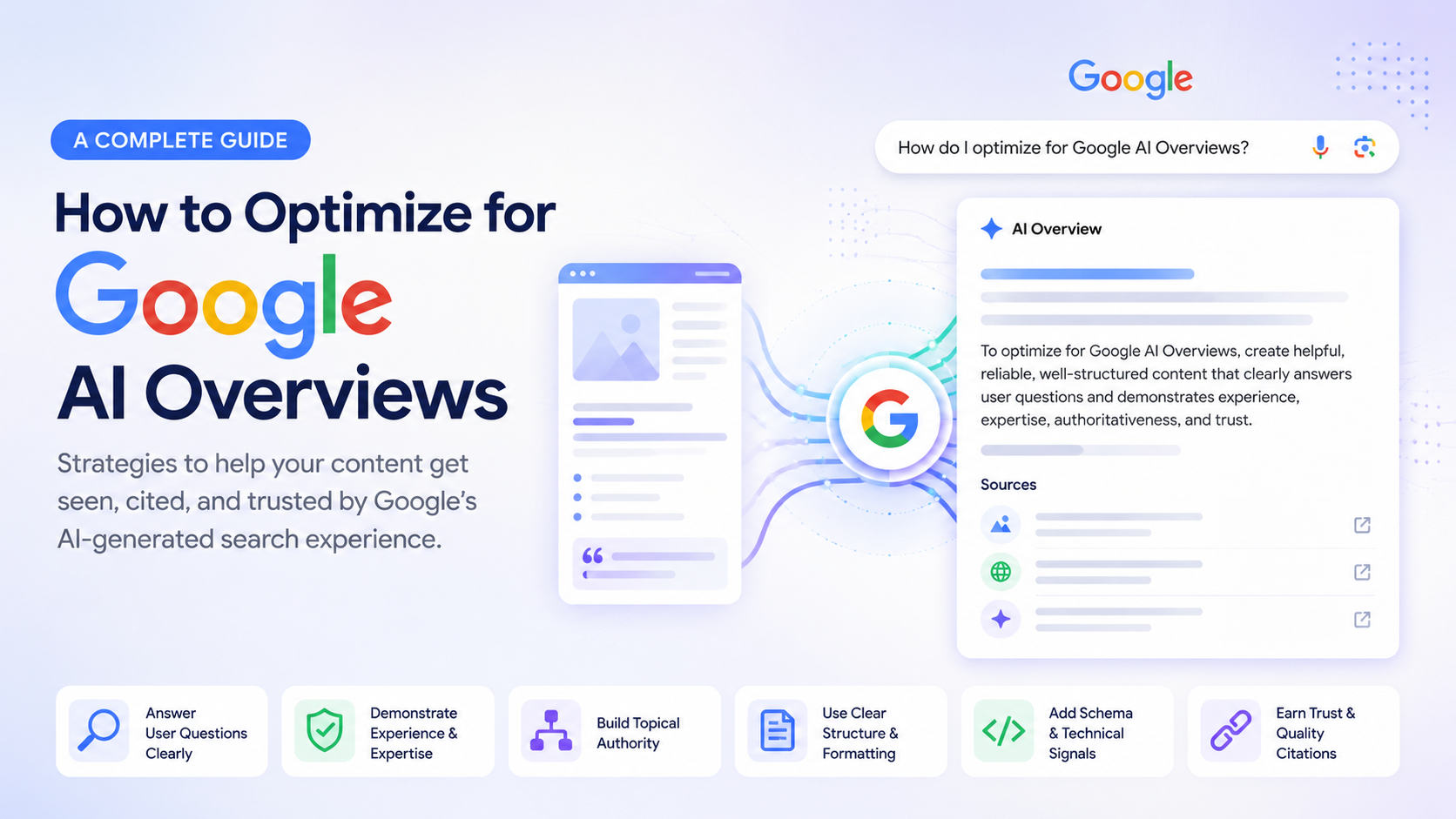
To optimize for Google AI Overviews, create helpful, reliable, well-structured content that clearly answers user questions and is strong enough for Google to use as a source in AI-generated search results.
Google AI Overviews are AI-generated snapshots that appear in some Google Search results. They summarize key information about a topic or question and include links so users can explore more on the web.
Think of them as a condensed AI-assisted version of what Google search results you obtain from Search Engine Optimization or, SEO.
In simple terms:
Traditional SEO helps your page rank. Google AI Overview optimization helps your content become source-worthy for AI-generated answers.
This does not mean you should abandon traditional SEO. In fact, Google says its AI features in Search use many of the same indexing, ranking, and serving systems as Search. Google’s guidance for site owners is clear: focus on people-first content, make pages accessible to Google, and follow Search essentials. Does that sound simple enough? That’s because it is simple but not easy. Does that make sense?
The goal is not to “hack” AI Overviews.
The goal is to make your content clear, trustworthy, useful, and easy for Google to understand. Your content should also be creative and interesting so attract and retain users on your site. We are now creating content for LLMs and for users.
What Are Google AI Overviews?
Google AI Overviews are AI-generated summaries in Google Search that provide a quick snapshot of key information, often with links to supporting sources.
They are designed to help users understand complex questions faster and explore related websites for deeper information. Google describes AI Overviews as snapshots with key information and links to dig deeper.
For example, instead of only showing a list of web pages for a query like:
how to plan a 10 day trip to Peru
Google may generate a summarized answer that includes itinerary ideas, recommended destinations, travel timing, and links to websites with more details. It is now up to the user to visit the sites or dig deeper with AI if the provided links don’t answer the query.
For businesses and publishers, this changes the SEO goal. It is no longer only about ranking in the traditional organic results. It is also about becoming one of the useful sources that Google may link to, summarize, or surface in AI-assisted search experiences.
Why Google AI Overview Optimization Matters
Google AI Overviews matter because they sit directly inside the search experience.
Google controls both spaces in Search (overviews and traditional search ranking). When they appear, users may read the AI-generated summary before clicking on any traditional result. That means visibility in AI Overviews can influence:
- brand awareness
- organic traffic
- authority perception
- content discovery
- commercial research
- comparison searches
- informational searches
Google has continued expanding AI experiences in Search, including AI Overviews and AI Mode, with updates designed to help users find relevant websites, original content, and deeper insights from across the web.
For a brands this is important because the same principles that help content appear in AI Overviews also support broader AI search visibility. So by optimizing for AI search and overviews, you are following these principles.
Those principles include:
- clear answers
- helpful content
- topical authority
- credible sourcing
- original insight
- strong internal linking
- technical accessibility
- structured content
This in theory, sounds simple but in practice tends to lean towards the difficult side. Many business owners are not well versed in 1. writing, 2. SEO writing 3. Writing for AI.
Google AI Overviews vs Traditional SEO
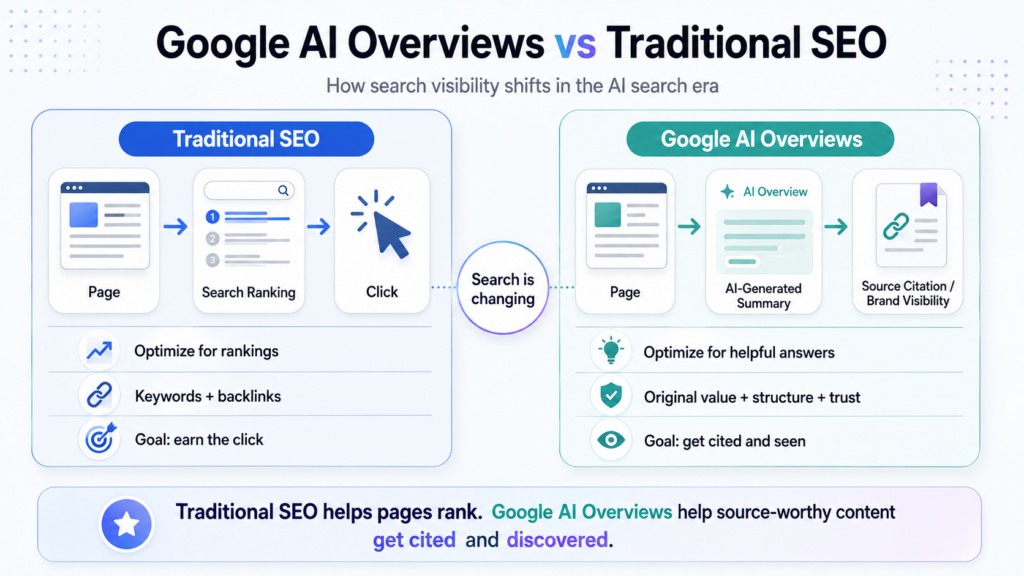
Google AI Overviews and traditional organic search results are connected, but the user experience is different.
| Traditional Google SEO | Google AI Overview Optimization |
|---|---|
| Goal is to rank pages in organic results | Goal is to become useful source material for AI-generated summaries |
| Users scan titles, snippets, and links | Users may read an AI-generated answer first |
| Keywords, backlinks, content quality, and technical SEO matter | Those still matter, but clarity, answer structure, and source-worthiness become even more important |
| Pages compete for clicks | Pages also compete for citation, mention, and inclusion |
| Content can be long-form and broad | Content must also include concise, extractable answers |
The key point:
AI Overview optimization is not separate from SEO. It is SEO adapted for AI-assisted search.
If your page is not crawlable, indexable, useful, or trustworthy, it is unlikely to perform well in either traditional search or AI-powered search. Think of traditional SEO as laying a foundation to make your site trustworthy enough for Google to consider using its data in Google AI overviews.
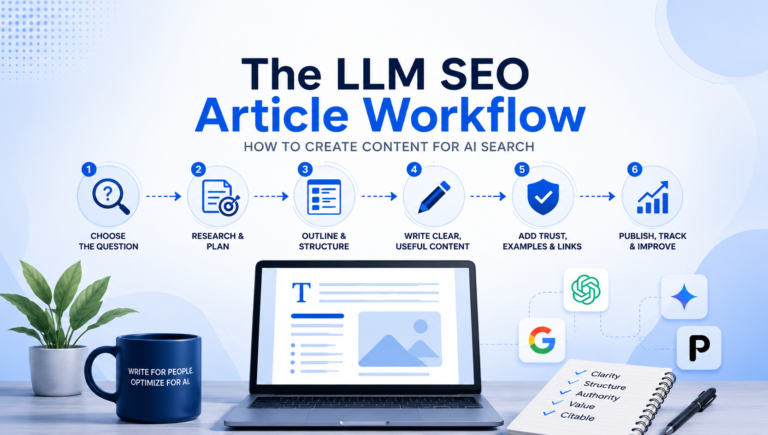
How to Optimize for Google AI Overviews: 12 Practical Steps
1. Start With Strong SEO Fundamentals
You cannot optimize for Google AI Overviews while ignoring basic SEO.
Google’s own documentation says there is nothing special for creators to do to be considered for AI features beyond following Google Search essentials and making content eligible to appear in Search. If anyone out there thinks there is a “hack” or they were done with traditional SEO they are sorely mistaken. The foundations stay the same.
That means your foundation should include:
- indexable pages
- clean site structure
- helpful content
- fast page experience
- mobile-friendly design
- descriptive titles
- clear headings
- internal links
- crawlable content
- valid canonicals
- strong author or brand signals
A weak page with poor SEO fundamentals is not a strong candidate for AI Overview visibility.
2. Answer the Main Question Immediately
AI Overviews are answer-driven.
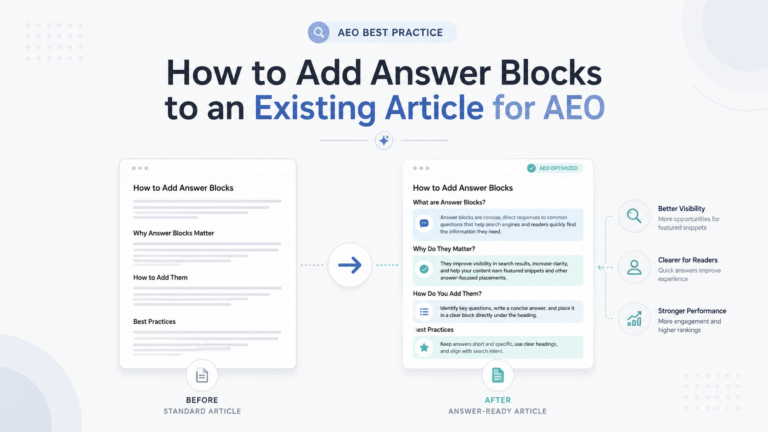
If your article targets a question, answer it near the top. I would stick to answering the questions within the first sentence to have the best chance at appearing in AI overviews.
For example, if the title is:
What is LLM SEO?
Do not begin with a vague introduction.
Weak opening:
In today’s digital world, marketers are constantly looking for new ways to adjust to emerging technology.
Better opening:
LLM SEO is the process of optimizing your website so large language models can understand, trust, cite, and recommend your content in AI-generated answers.
The second version is stronger because it gives a direct answer. You can add information after you’ve answered the main questions. I always like to think of it as writing a title. You answer the questions by writing a Google title as an answer. Then you can add “the body” of the text, which would be any additional information you want to place under the main answer.
For every page, ask:
What question is this page supposed to answer?
Then answer that question clearly in the first few lines. Then add your details to make your content more human-friendly.
3. Use Question-Based Headings
People ask Google increasingly complex questions.
AI Overviews are often triggered when Google decides an AI-generated summary may help answer a query. Google says AI Overviews can help users find information faster and easier by providing a snapshot with links to dig deeper.
So when it is possible, try to add questions as your headings. This doesn’t mean all of your sections should begin with a question, but try to add them where it makes sense. I believe if you make all of your headings questions, Google will at some point consider that content spam. Maybe not now, but sometime in the future. Again, the idea is not to “hack” anything, the idea is to make helpful content that appears in AI overviews and Google search.
Your content should reflect the way users ask questions.
Use headings like:
- What are Google AI Overviews?
- How do AI Overviews choose sources?
- How do I optimize for AI Overviews?
- Can schema help with AI Overviews?
- Does ranking on page one matter for AI Overviews?
- How do I track AI Overview traffic?
Question-based headings help make your content easier to match to search intent. Just make sure to use it where it makes sense.
4. Build Topical Authority Around a Cluster
One article is usually not enough to be an authority in any niche. If you want Google to understand that your site is a strong source for a topic, build a connected content cluster. Pick one topic and write down all of the ideas around it. Make a list of content ideas and link them to each other. This is called a content cluster.
For an AI search website like NeuronPulse, a strong Google AI Overview cluster could include:
- What Is LLM SEO?
- What Is AEO?
- How to Optimize for ChatGPT Search
- How to Optimize for Google AI Overviews
- How to Optimize for Perplexity
- AEO vs SEO
- LLM SEO vs Traditional SEO
- How to Structure Content for AI Answers
- The LLM SEO Checklist
- How AI Search Changes Content Strategy
This gives users and search systems a clearer understanding of your expertise.
For a travel website, a cluster might look like:
- Peru Vacation Packages
- How to Plan a Trip to Peru
- Best Time to Visit Peru
- How Many Days Do You Need in Peru?
- 7-Day Peru Itinerary
- 10-Day Peru Itinerary
- Machu Picchu Vacation Packages
- Cusco Travel Guide
- Sacred Valley Travel Guide
- Peru Travel Requirements for U.S. Citizens
Topical authority is about depth, consistency, and useful coverage.
5. Create Source-Worthy Content
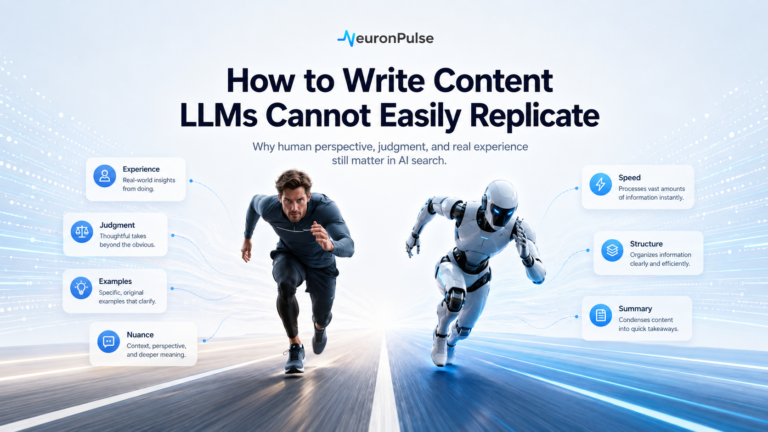
AI Overviews need information that is useful enough to summarize and link to. Make your content shine by creating something original. Cite sources, speak from first hand experience use your own writing style, etc. The more “citable” the better your chances are at appearing in Google AI overview.
A page is more source-worthy when it includes:
- original explanations
- clear definitions
- examples
- data or observations
- comparison tables
- step-by-step guidance
- firsthand experience
- expert commentary
- updated information
- citations to credible sources
A page is less source-worthy when it only repeats generic advice.
Weak content:
AI Overviews are changing SEO. Businesses should create high-quality content and use keywords.
Better content:
Google AI Overview optimization requires helpful content that answers specific questions clearly, uses strong SEO fundamentals, builds topical authority, and gives Google a reason to cite the page as a useful source.
The better version is specific, structured, and more useful.
IF you were planning on citing a definition of AI overviews to a group of people, which one would you choose to add to your presentation?
6. Add Original Insight and Experience
Generic content is easy for AI systems to summarize without citing you. Everyone and their cousins are using LLMs in some way, shape or form. Everyone is pumping out content, so you need to add whatever sets you apart. Make your content as original as possible while still sticking to the basic principles required to appear in overviews.
To stand out, add something original.
For example:
- your own framework
- your own checklist
- a real client example
- screenshots
- original tests
- a repeatable process
- expert commentary
- industry-specific examples
- Real photographs
Follow this Framework:
The SOURCE Framework for Google AI Overviews
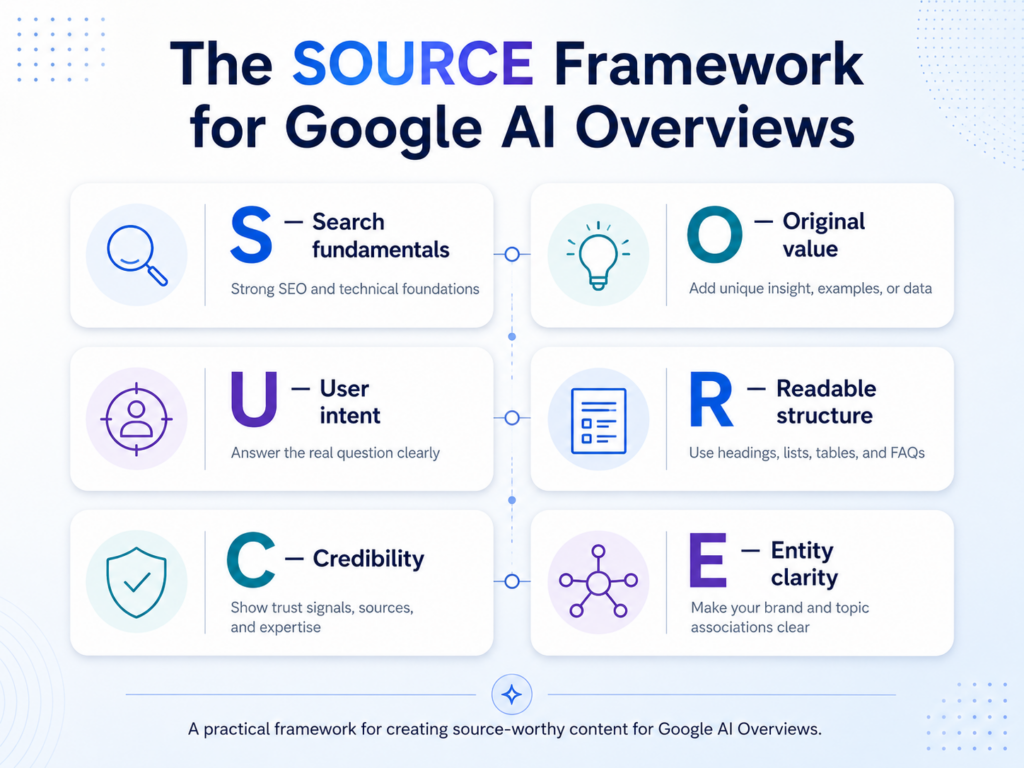
S — Search fundamentals: Make the page crawlable, indexable, and technically sound.
O — Original value: Add examples, frameworks, data, or experience.
U — User intent: Answer the actual question behind the query.
R — Readable structure: Use headings, summaries, tables, lists, and FAQs.
C — Credibility: Show authorship, sources, dates, and trust signals.
E — Entity clarity: Make your brand, topic, and related concepts easy to understand.
This gives the article something distinctive and memorable.
7. Use Clear Comparison Tables
AI Overviews often respond to comparison-style questions.
Comparison tables are useful because they organize information in a way that is easy for readers and search systems to understand. Below is a quick table I made where we can make comparisons.
Examples:
| User Question | Helpful Table Type |
|---|---|
| AEO vs SEO | Difference table |
| ChatGPT Search vs Google AI Overviews | Platform comparison |
| Best time to visit Hawaii | Month-by-month table |
| 7-day vs 10-day Italy itinerary | Itinerary comparison |
| Private tour vs group tour | Pros and cons table |
Tables make complex answers easier to scan, extract, and summarize.
Tables also make your content look more professional. Don’t just go into Gemini or ChatGPT and ask for a table. Get your information together first, check your facts, and they make the comparison table.
8. Add an FAQ Section
FAQ sections are useful for AI Overview optimization because they answer related questions directly. They are (or were) great for traditional SEO as schema markup, so many digital marketers (growth hackers?) are already versed in how to use these.
Good FAQ questions for this article include:
- What are Google AI Overviews?
- How do I optimize for Google AI Overviews?
- Can I guarantee inclusion in AI Overviews?
- Does schema help with AI Overviews?
- Can I opt out of AI Overviews?
- Do AI Overviews reduce clicks?
- Is AI Overview optimization the same as SEO?
- How do I track AI Overview performance?
Each answer should be concise and useful.
9. Use Structured Data Where It Fits
Structured data can help Google better understand certain page types.
It does not guarantee AI Overview inclusion, but it can support your overall search eligibility. Schema remains important in the ranking space and will continue to be important in the LLM results space.
Useful schema types may include:
- Article
- FAQPage
- HowTo
- Organization
- Person
- Product
- Review
- LocalBusiness
- BreadcrumbList
Google’s structured data documentation explains that structured data can help Google understand page content and make pages eligible for certain Search features, while also noting that using structured data does not guarantee a rich result.
Yes, as of late, Google seems to be downgrading the importance of scheme and rich results in Google search. However, this still remains a strong signal for AI overviews.
Use schema accurately. Do not add schema that does not match visible page content. Only use schema where it makes sense.
10. Keep Important Content Fresh
AI search topics change quickly.
If your article discusses Google AI Overviews, ChatGPT Search, Perplexity, or AI search optimization, it should be reviewed regularly.
The same applies to any niche. If you have a travel website, your posts should be updated yearly, in my opinion. Using fresh photographs, schedules, weather details, and whatever other pieces of information make sense.
Add:
- publish date
- updated date
- current platform names
- updated screenshots
- current documentation references
- recent examples
- revised FAQs
Freshness is especially important for topics where the product experience changes often.
For evergreen topics, freshness still matters, but accuracy matters more. LLMs sometimes “hallucinate” because the sources they use are posting the wrong information.
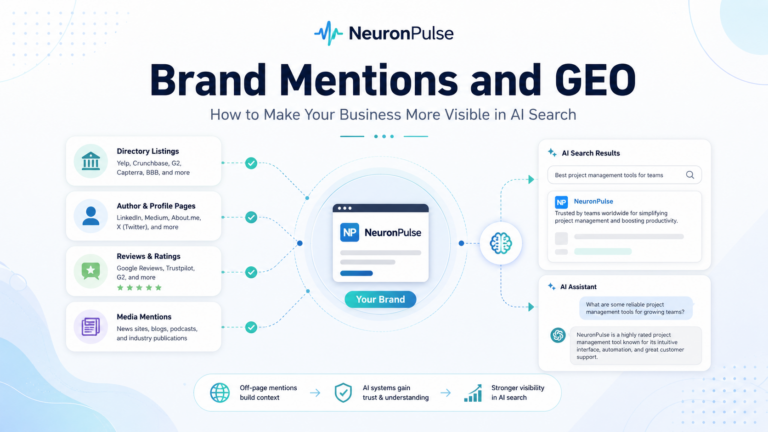
11. Improve Brand and Entity Signals
Google’s systems need to understand what your site is about.
Make your brand entity clear across your website.
For NeuronPulse, we have to use consistent language like:
NeuronPulse helps marketers, founders, and businesses understand AI search, LLM SEO, AEO, Google AI Overviews, ChatGPT Search, prompting, and AI content strategy.
Use this positioning in:
- homepage copy
- About page
- author bios
- article intros
- social profiles
- Organization schema
- internal links
Clear entity signals help search systems understand your topical focus.
12. Monitor Queries That Trigger AI Overviews
You cannot directly control when Google shows an AI Overview, but you can monitor your important queries.
Google is not fully transparent about what triggers the overview yet.
Track:
- which target keywords show AI Overviews
- which competitors are cited
- which source pages appear
- what formats Google uses
- whether your pages are included
- how results change over time
Use this research to improve your content.
For example, if Google cites competitor pages with tables, FAQs, updated statistics, or concise summaries, that is a sign your content may need more structure or better source-worthy sections. Don’t just copy your competitor, instead use them as a benchmark to make somthing better.
Google AI Overview Optimization Checklist
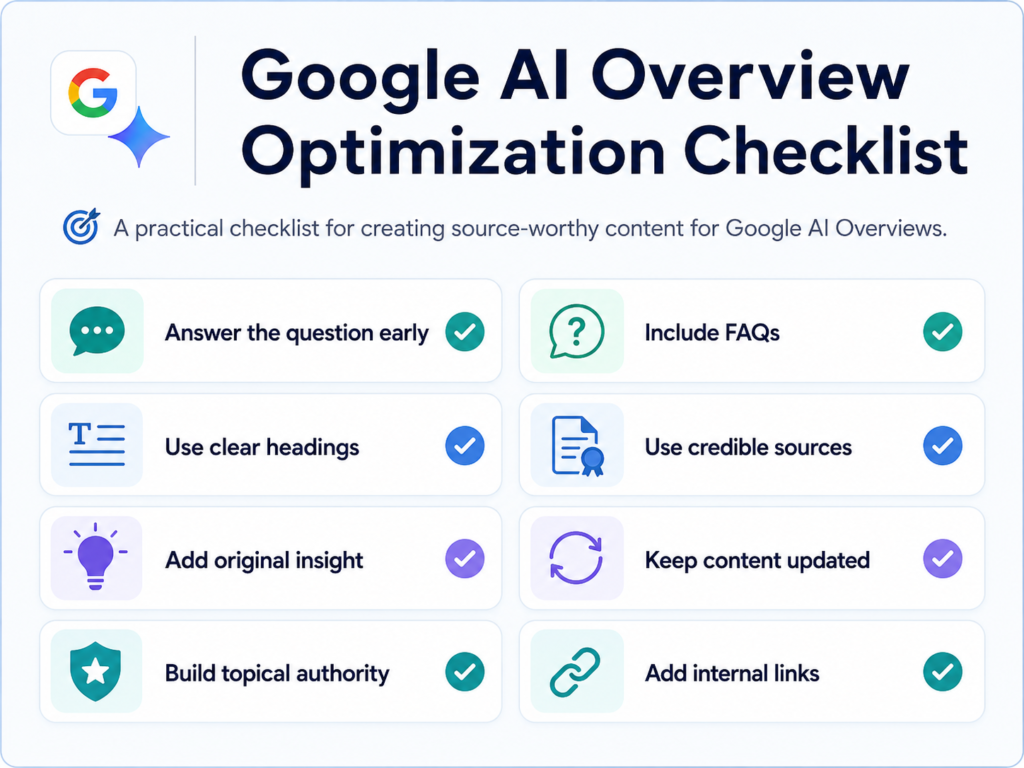
Before publishing or updating a page, review this checklist:
- Is the page indexable?
- Can Google crawl the main content?
- Does the page answer the main question early?
- Are headings clear and descriptive?
- Does the content match user intent?
- Is the article more useful than generic summaries?
- Does it include original insight or experience?
- Are important claims supported?
- Does it include examples?
- Are tables used where helpful?
- Does it have an FAQ section?
- Is structured data used accurately?
- Are internal links added to related pages?
- Is the author or brand clearly identified?
- Is there a visible updated date?
- Is the content part of a broader topic cluster?
Common Mistakes When Optimizing for Google AI Overviews
Mistake 1: Treating AI Overviews Like a Trick
AI Overviews are not something you hack with one tag or one keyword.
They are part of Google Search, so the basics still matter: helpful content, crawlability, relevance, authority, and user satisfaction.
Mistake 2: Writing Generic AI Content
If your page only repeats what everyone else says, there is little reason for Google to surface it as a useful source.
Mistake 3: Burying the Answer
If the user asks a question, answer it clearly.
Long introductions can make the page less useful for answer-driven search.
Mistake 4: Ignoring Topical Authority
One isolated article is weaker than a connected cluster of useful pages.
Mistake 5: Forgetting About Trust
For important topics, trust signals matter. Add author information, sources, dates, examples, and clear brand positioning.
Can You Guarantee Inclusion in Google AI Overviews?
No.
At this time there is no SEO strategy that can guarantee that your page will appear in Google AI Overviews.
Google decides when AI Overviews are useful and which sources to show based on its systems (sound familiar? 1000 ranking variables for Google search?). The best approach is to create helpful, reliable, accessible content that deserves to be surfaced.
A realistic goal is to improve your chances by making your content:
- clearer
- more useful
- more trustworthy
- better structured
- more comprehensive
- more connected to your topical authority
Can You Opt Out of Google AI Overviews?
Google says site owners can manage how their content appears in Search AI features using existing controls such as nosnippet, data-nosnippet, max-snippet, and noindex, but these controls can also affect how the content appears in traditional Search features.
In other words, opting out is possible in certain ways, but it may reduce your visibility in other parts of Google Search. This is just a way to tell you that trying to avoid overviews is a big mistake.
For most businesses, the better strategy is not opting out.
The better strategy is creating content that is strong enough to be used and linked to.
Does AI Overview Optimization Reduce or Increase Traffic?
It depends.
AI Overviews can answer some questions directly, which may reduce clicks for certain informational searches. But they can also expose users to new sources and create visibility for brands that are cited. If you ask most site onwers though, they’ll probably state they’ve lost traffic. It is something unavoidable at this point but the only clear route is to optimize for what Google is trying to push at this point in time.
Google continues to update AI Search experiences to include links and help users explore more of the web. Recent Google updates have emphasized making relevant websites, original content, and deeper information easier to discover through AI search experiences.
The strategic goal is not only traffic.
It is:
- visibility
- credibility
- citations
- brand recognition
- qualified clicks
- topical authority
In the AI search era, appearing as a trusted source can have value even before the click, but let’s not kid ourselves. Having a #1 ranking spot in traditional Google search was something to be proud of and usually gave us the best results when it came to ROI.
Is Google AI Overview Optimization the Same as LLM SEO?
Google AI Overview optimization is one part of LLM SEO and AI search optimization.
LLM SEO focuses on helping large language models understand, cite, and recommend your content.
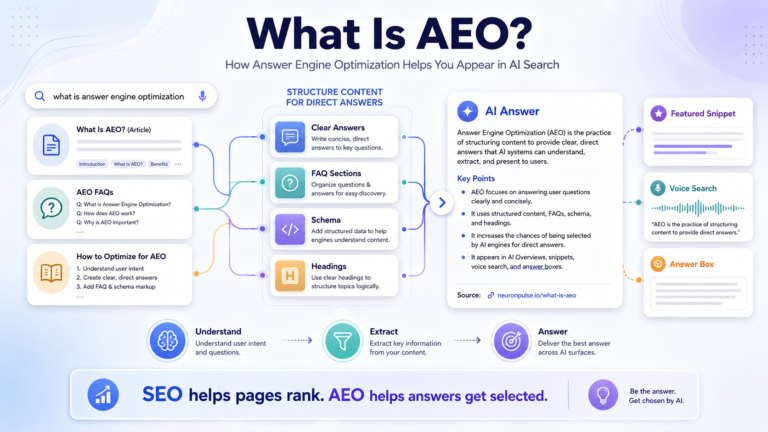
AEO focuses on structuring content so answer systems can select it.
Google AI Overview optimization focuses specifically on improving your chances of being used as a source in Google’s AI-generated search summaries.
They overlap heavily, and the same principles matter across all three, so it is not like you will have to optimize for three different things. What’s important:
- clarity
- credibility
- topical authority
- crawlability
- structured answers
- source-worthy content
- entity consistency
- helpfulness
Final Answer: How Do You Optimize for Google AI Overviews?
To optimize for Google AI Overviews, focus on helpful, reliable, well-structured content that answers user questions clearly and is easy for Google to crawl, understand, and source.
Start with strong SEO fundamentals. Then improve your pages with direct answers, question-based headings, topical clusters, original insight, comparison tables, FAQs, accurate schema, credible sources, and clear brand signals.
You cannot force Google to include your site in an AI Overview, but you can make your content much more likely to be useful, trustworthy, and source-worthy.
My personal take: Just make good, original content. There is no way around it, even if you are using AI to create your content, it will still need to be original if you want to make any type of progress online.
FAQ About Google AI Overview Optimization
Google AI Overviews are AI-generated snapshots in Google Search that provide key information about a topic or question, often with links that help users explore more on the web.
Optimize by creating helpful, reliable, well-structured content that answers user questions clearly. Make sure your pages are crawlable, indexable, source-worthy, and supported by strong SEO fundamentals.
No. Google decides when AI Overviews appear and which sources are included. You can improve your chances, but no one can guarantee inclusion.
Yes. Google’s guidance for AI features says site owners should follow Search essentials and make content eligible to appear in Search. Traditional SEO fundamentals still matter.
Schema can help Google understand certain page types, but it does not guarantee AI Overview inclusion. Use structured data accurately and only when it matches the visible page content.
Google says existing controls such as nosnippet, data-nosnippet, max-snippet, and noindex can manage how content appears in Search AI features, but these controls may also affect traditional Search visibility.
No. Featured snippets usually extract a direct passage from a single web page. AI Overviews are AI-generated summaries that may synthesize information and include links to multiple sources.
They overlap. AEO focuses on making content usable for direct answer systems. Google AI Overview optimization is a specific form of AEO focused on Google’s AI-generated search summaries.
They can reduce clicks for some informational queries, but they can also create visibility for cited sources. The impact depends on the query, topic, search layout, and whether your page is included as a source.
Start by updating your most important informational and commercial-support pages. Add direct answers, clearer headings, FAQs, examples, comparison tables, internal links, credible sources, and an updated date.