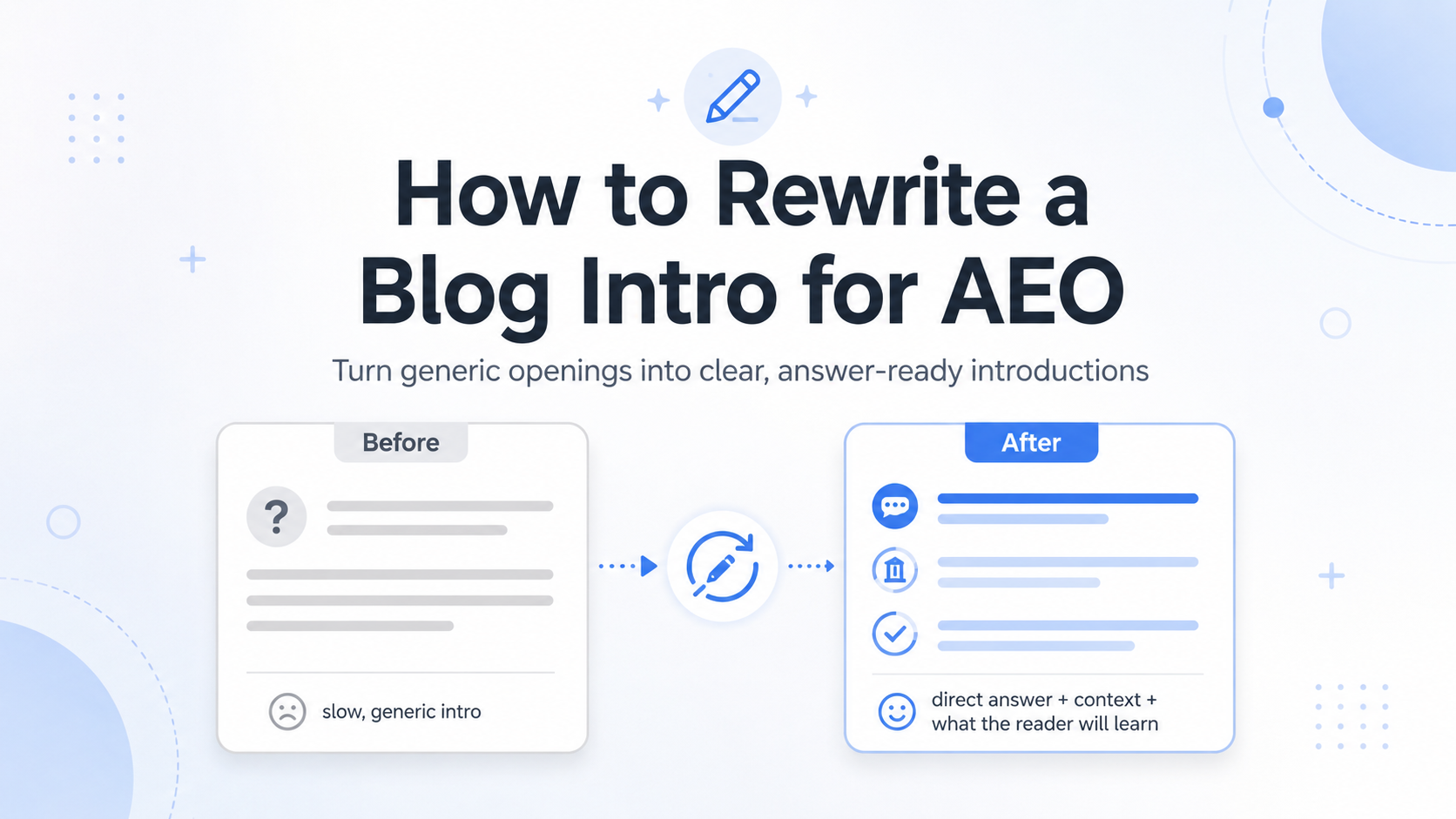
How to Rewrite a Blog Intro for AEO
A blog introduction can make or break an article. Figuring out how to rewrite a blog intro for AEO can completely revamp old content.
For years, many blog posts started with broad, familiar lines like:
“In today’s digital world, businesses need to move at light speed…”
That kind of intro may sound polished, but it usually delays the answer. In traditional SEO, a slow intro was sometimes tolerated because the goal was to rank, attract a click, and keep the reader moving down the page. It was also easy to simply make articles longer to stuff for keywords in the text. Or make the paragraph long enough to merit setting up a hyperlink to another URL.
In answer-driven search, that is not enough.
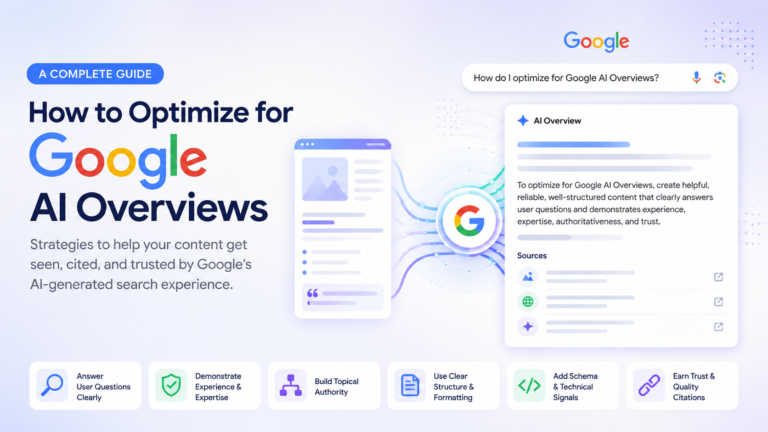
Google AI Overviews can provide AI-generated answers with links for users to explore more on the web. ChatGPT Search can provide timely answers with links to relevant web sources. Google also says its search systems prioritize helpful, reliable, people-first content. This is a great time for marketers willing to switch up how they work. Improve their writing style while also learning to feed AI the right answers to a users query.
That means your article introduction has a new job.
It should quickly show what the page answers, why the answer matters, and why the reader should keep going.
A strong AEO intro does not need to be or sound robotic. It does not need to appear like a definition straight out of a dictionary. But it does need to get to the point and answer the questions proficiently.
What Is an AEO Blog Intro?
An AEO blog intro is an introduction written to answer the reader’s main question quickly and clearly. There shouldn’t be any fluff content in the intro. IF we want to rewrite a blog intro for AEO, we fist need to go over what AEO is.
AEO stands for Answer Engine Optimization. We know It focuses on making content easier for search engines, AI tools, voice assistants, featured snippets, and answer engines to understand and use. We’re basically telling AI the answer to the users questions by making the answer easier to find, index and display.
For a blog intro, that means the first fe, very important lines should do three things:
- Identify the topic clearly.
- Answer the main question directly.
- Set up the rest of the article without unnecessary filler.
For example, if your article is titled:
What Is AEO?
A weak or traditional intro might begin with:
Digital marketing is changing rapidly, and businesses need to keep up with new trends to stay competitive online.
That is not wrong, but it is vague. To truly display search intent, we can be more direct.
A stronger AEO intro would be:
AEO, or Answer Engine Optimization, is the process of structuring content so search engines and AI tools can use it to answer user questions directly. It helps your content become clearer, easier to extract, and more useful in answer-driven search experiences like featured snippets, AI Overviews, and AI-powered search tools.
That intro works because the reader gets the answer immediately.
Why Blog Intros Matter for AEO
A blog intro is not just a warm-up. It is the first signal of whether the article you’ve put together understands the user’s intent. When someone searches for a question, they do not want a slow build-up. They want confidence that the page is going to help them. So the answer needs to appear immediately or at least not be buried until 10 lines of content. It is neither helpful for the user nor optimized for something like Google Generative AI summaries.
A strong intro can improve:
- reader trust
- content clarity
- engagement
- featured snippet potential
- AI answer readiness
- perceived expertise
- article flow
A weak intro on the other hand, creates friction.
It makes the reader think:
“Is this article actually going to answer my question?”
In AI search, that matters even more. If an article buries the answer below a long generic introduction, the page may still be useful, but the answer is harder to identify and summarize.
AEO does not mean every introduction must be two sentences long. Some topics need context. But the intro should earn the reader’s attention quickly.
Nuance and Context in Creating AEO Intros
When I’ve created content for different topics, I had to set aside time to research how the most successful pieces of content in the niche formulated intros and then apply an AEO formula. Meaning that what works for an AI article will not necessarily work for a travel blog. The formula may stay the same but there is context and nuance to each niche.
After trying to come up with good intros that fit the AEO formula for a travel site I realized that the human reader might be turned off by an answer that is straight to the point. In that particular case some fluff content made the piece more enjoyable because it made the reader “fall in love” with the travel destination.
If someone is reading an article about the best places to visit in Peru, a purely direct AEO-style intro may feel too dry:
The best places to visit in Peru include Machu Picchu, Cusco, the Sacred Valley, Lake Titicaca, the Amazon Rainforest, Arequipa, and the Colca Canyon.
That answers the question, but it does not create much desire. It gives the information, but it does not make the reader feel anything.
A better travel intro might still answer the question, but with more atmosphere:
The best places to visit in Peru usually begin with Machu Picchu, Cusco, and the Sacred Valley, but the real magic of the country is how much variety fits into one trip. In a single journey, travelers can walk through Inca ruins, watch the sunrise over Andean peaks, explore colonial cities, visit floating islands on Lake Titicaca, and step into the Amazon Rainforest. This guide breaks down the destinations worth including and how to choose the right ones for your itinerary.
This version still follows the AEO formula. It answers the question early, gives context, and tells the reader what to expect. But it also respects the emotional nature of travel content. The reader is not only looking for a list. They are imagining a trip.
That is the nuance and it can be applied to various niches and topics. So in short, before going full AEO formula on all of your content, make sure your research what users are searching for and what the writing style should be.
The AEO Intro Rewrite Formula
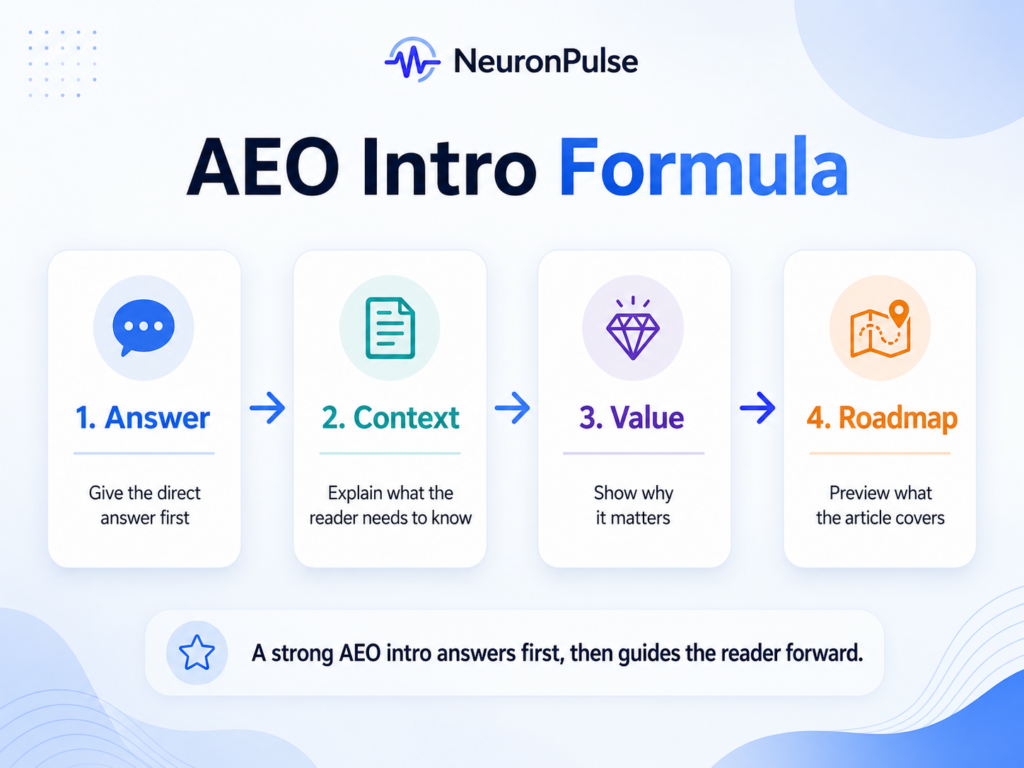
A good AEO intro usually follows this structure:
1. Direct answer
2. Brief explanation
3. Why it matters
4. What the article will cover
You can think of it as:
Answer → Context → Value → Roadmap
This structure keeps the introduction clear without making it feel robotic. You can apply your writing style to this formula.
1. Answer
Start by answering the main question. “What is AEO”?
Example:
AEO is the process of structuring content so it can be used as a direct answer in search engines, AI tools, and answer engines.
2. Context
Explain the topic in plain language.
Example:
It builds on traditional SEO, but focuses more on clear answers, question-based structure, and content that is easy to summarize.
3. Value
Tell the reader why this matters.
Example:
This matters because search experiences are becoming more answer-driven, and users often expect useful information before they click through to a full page.
4. Roadmap
Preview what the article will explain.
Example:
In this guide, you’ll learn how AEO works, how it differs from SEO, and how to update your content for answer-driven search.
That is enough information in the article’s introduction. You’ve shown what the intent is, set the tone, given value, and also given the user a roadmap for the rest of the content.
AEO Blog Intro Before and After
Let’s take a common weak introduction and rewrite it to fit the AEO formula better. For this example we’ll use a different topic: Finance
The Weak intro
Managing money is an important part of life, and in today’s uncertain economy, people are always looking for ways to make smarter financial decisions. With so many options available, it can be difficult to know where to start.
This intro is not terrible, but it is too vague. It could apply to budgeting, investing, credit cards, retirement planning, debt, or almost any finance topic. It does not answer a specific question, and it does not give the reader confidence that the article understands what they came for.
Now let’s say the article is titled:
What Is an Emergency Fund?
Stronger AEO intro
An emergency fund is money set aside to cover unexpected expenses, such as medical bills, car repairs, job loss, or urgent home costs. Most financial experts recommend keeping enough savings to cover three to six months of essential expenses, although the right amount depends on your income, responsibilities, and risk level. This guide explains how emergency funds work, how much to save, and where to keep the money.
This version is stronger because it answers the question immediately. The reader does not have to wait through a broad introduction about the importance of money management. They get a clear definition, useful context, and a preview of what the article will cover.
It also shows why AEO intros need to be created in order to match the niche.
In finance, readers usually want clarity, trust, and practical guidance. A little context is useful, but too much motivational language can feel like filler. The intro should make the topic easier to understand and help the reader make a better decision.
How to Rewrite a Blog Intro for AEO: Step-by-Step
The goal of creating an AEO introduction is to make the opening more useful. Learning to rewrite a blog intro for AEO is basically showing strong and direct answers. A strong intro should answer the reader’s main question, remove unnecessary filler, give enough context to build trust, and lead naturally into the rest of the content, one we’ve done we can move on to structuring the article for AI answers.
Use the steps below to turn a slow or generic introduction into one that is clearer, more direct, and better suited for answer-driven search.
Step 1: Identify the Main Question
Before rewriting the intro, decide what question the article should answer. This should be the main focus for the first part of the creative process.
Do not start with the keyword. Start with the reader’s question. So think for a second, what is the reader asking for in this article?
For example:
| Article Topic | Main Question |
|---|---|
| What Is AEO? | What does AEO mean and how does it work? |
| AEO vs SEO | What is the difference between AEO and SEO? |
| How to Optimize for Perplexity | How can a website become more likely to appear as a cited source in Perplexity? |
| LLM SEO Checklist | What should I check before publishing AI-search-ready content? |
| AI Search Visibility Audit | How do I know if my website is ready for AI search? |
Once you know the main question, the intro becomes easier to write.
A good intro should make it obvious that the article understands the question.
Step 2: Remove the Generic Warm-Up
Most weak intros start too broadly.
Phrases like these are usually a warning sign:
- “In today’s digital age…”
- “Now more than ever…”
- “The internet has changed everything…”
- “Businesses are constantly looking for ways…”
- “With the rise of AI…”
- “As technology continues to evolve…”
These phrases are not always wrong, but they often delay the answer. they are good for an “about us” section on the website. Sure, they sound nice and professional but it’s not what an LLM is looking for when processing data to show in overviews or AI results. It’s most likely not what the user was asking.
Before
In today’s digital age, companies are looking for smarter ways to improve their online visibility and stay ahead of the competition.
After
An AI search visibility audit helps you evaluate whether your website is clear, crawlable, trustworthy, and structured enough to appear in AI-powered search experiences.
The second version is stronger because it immediately tells the reader what the article is about.
Step 3: Write the Direct Answer First
After you identify the main question, answer it in one or two sentences. This is where the writers expertise comes into play. Can you answer the question quickly and make it look professional without having an LLM write it for you?
For example, if the article is:
How to Rewrite a Blog Intro for AEO
The direct answer could be:
To rewrite a blog intro for AEO, answer the main question in the first few lines, remove generic filler, add brief context, and make it clear what the reader will learn next.
That sentence is useful because it gives the reader a complete answer quickly.
Then the article can expand with examples, steps, and templates.
Good direct answers are:
- clear
- specific
- short enough to understand quickly
- written in plain language
- aligned with the article title
- useful even without the rest of the article
Bad direct answers are:
- vague
- stuffed with keywords
- too long
- too promotional
- written like a slogan
- disconnected from the article’s actual content
Step 4: Add Context Without Slowing the Reader Down
AEO does not mean skipping context. It means adding context after the answer, not before it. Once you answer the main question, explain why it matters. This is where many marketers tend to fail. They add the answer right away, which is good but then don’t want to or forget that it will need further context. You need to support the answer with information below it. In this case, if I simply added the answer, it would look like thin content.
Example:
This matters because AI-powered search tools often summarize answers from multiple sources. If your introduction is vague or slow, the article may be harder for readers and AI systems to interpret.
That gives the reader a reason to care.
The key is balance. You want enough context to be useful, but not so much that the intro becomes another long essay. Make sure to support your answers with backup information. This is also a great way to add context to your article.
Step 5: Show the Reader What They Will Get
The final part of the intro should tell the reader what the article covers.
Example:
In this guide, you’ll learn how to identify weak intros, rewrite them for answer-driven search, and use a simple before-and-after process to make your articles more useful.
This sets expectations and improves flow.
A roadmap is especially useful in practical articles because it tells the reader:
“Stay here. This page will solve the problem.”
AEO Intro Template
Use this structure when rewriting blog introductions:
[Direct answer to the main question.]

[Brief explanation of why the topic matters.]

[One sentence explaining what the reader will learn or be able to do.]
Example template
[TOPIC] is [simple explanation]. It matters because [why the reader should care]. In this guide, you’ll learn [specific outcome or steps].Example
AEO content optimization is the process of updating existing articles so they answer user questions more clearly and work better in answer-driven search experiences. It matters because AI search tools, featured snippets, and voice assistants often reward content that is easy to understand, summarize, and trust. In this guide, you’ll learn how to rewrite intros, improve headings, add answer blocks, and make old articles more useful for AI search.
That is a clear and practical introduction that does not seem too long. It gives an answer, supporting context and tells the reader what to expect from the rest of the article.
AEO Intro Examples by Article Type
Different articles need different kinds of introductions. Do not make every intro sound the same. For this part we’ll stick to AEO and LLM topics just to keep a constant idea going.
Definition Article Intro
Best for topics like:
- What Is LLM SEO?
- What Is AEO?
- What Is GEO?
Example
LLM SEO is the process of optimizing your website so large language models can better understand, summarize, cite, and recommend your content. It builds on traditional SEO, but places more emphasis on clear answers, entity clarity, topical authority, and source-worthy content. This guide explains what LLM SEO means, how it works, and how to prepare your content for AI-powered search.
Comparison Article Intro
Best for topics like:
- AEO vs SEO
- GEO vs AEO vs LLM SEO
- ChatGPT Search vs Perplexity
Example
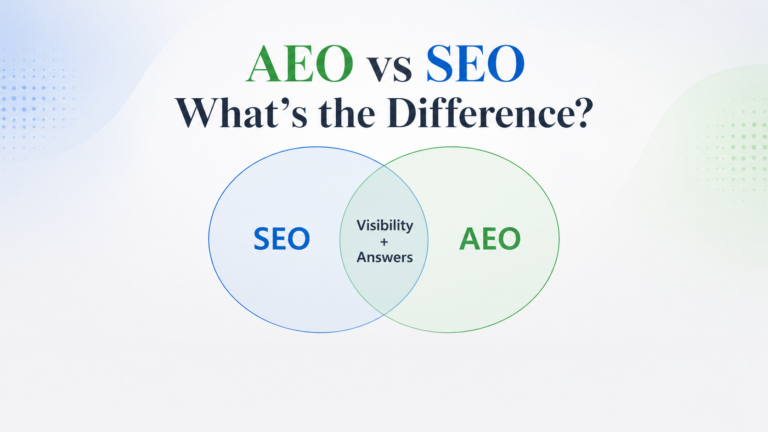
AEO and SEO both improve search visibility, but they focus on different outcomes. SEO helps pages rank in search results, while AEO helps content become a clear answer to user questions. This article explains the difference, where the two overlap, and how to use both in an AI search strategy.
How-To Article Intro
Best for topics like:
- How to Optimize for Perplexity
- How to Structure Articles for AI Answers
- How to Rewrite a Blog Intro for AEO
Example
To rewrite a blog intro for AEO, start by answering the main question directly, then add only the context needed to help the reader understand why the topic matters. This makes the article easier to scan, easier to trust, and easier for answer-driven search systems to interpret. Below, you’ll see a step-by-step process with examples and templates.
Checklist Article Intro
Best for topics like:
- The LLM SEO Checklist
- AI Search Visibility Audit Checklist
Example
An LLM SEO checklist helps you review whether your content is clear, crawlable, trustworthy, and structured for AI search. It gives you a practical way to evaluate pages before publishing or refreshing them. Use this checklist to find weak answers, missing trust signals, poor internal links, and other issues that may reduce your AI search readiness.
Workflow Article Intro
Best for topics like:
- The LLM SEO Article Workflow
- AEO Content Optimization Workflow
Example
An AEO content optimization workflow helps you turn an existing article into a clearer, more useful, answer-ready resource. Instead of simply adding keywords or updating the publish date, the workflow focuses on improving the opening answer, headings, examples, sources, internal links, and human readability.
Common Mistakes When Rewriting Blog Intros for AEO
Now Let’s go over some of the most common mistakes people make when rewriting their introductions to fit the AEO formula.
Mistake 1: Starting With a Generic Trend Statement
A broad trend statement feels safe, but it often wastes the opening.
Many blog intros begin with a sentence like:
“AI is changing the way people search online.”
or:
“In today’s fast-paced digital world, businesses need to adapt.”
The problem is that these statements are too familiar and too broad. They could appear at the beginning of almost any article about marketing, technology, SEO, content, or business strategy. They sound like the opening line for a keynote speaker at a marketing convention. But an AEO intro is not a keynote speech. It is supposed to answer the reader’s question.
For AEO, that is a missed opportunity.
The first few lines of an article should prove that the page understands the reader’s specific question. A generic trend statement does the opposite. It delays the answer and makes the article feel like it is warming up instead of helping.
For example, if someone clicks an article titled “How to Rewrite a Blog Intro for AEO,” they probably do not need to be told that AI is changing search. They already know something is changing. What they want is practical guidance on how to rewrite the intro.
Weak opening
AI is changing the way people search online, and businesses need to adapt their content strategies to stay competitive.
This is not specific enough. It does not explain what is wrong with the intro, what AEO requires, or what the reader should do differently.
Better opening
To rewrite a blog intro for AEO, start by answering the reader’s main question in the first few lines. Then remove generic filler, add only the context needed to build trust, and guide the reader into the rest of the article.
This version works better because it answers the actual question. It also gives the reader a useful direction immediately.
That does not mean you can never mention a trend. Sometimes the trend matters. But it should come after the answer, not before it.
A better structure is:
- Give the answer.
- Explain why the answer matters.
- Add the broader trend if it helps.
For example:
A strong AEO intro answers the main question quickly and gives the reader a reason to keep reading. This matters because search results, AI Overviews, and answer engines increasingly reward content that is clear, specific, and easy to understand.
That version still mentions the trend, but it connects the trend directly to the task.
The rule is simple:
Do not start with the world changing. Start with what the reader came to solve.
Mistake 2: Defining the Topic Too Slowly
Some articles spend several paragraphs approaching the definition. That is frustrating for readers. If you as a user are looking for a direct answer, wouldn’t it be problematic if what you are seraching for is several paragraphs down? I tend to click away if what I want to know. isnot in my face immediately. This is true for AEO but also for SEO and has been that way for several years now.
Weak
Many marketers are starting to talk about AEO. This is a new way of thinking about search and content. It has become more popular because of changes in technology.
Better
AEO means structuring content so it can answer user questions directly in search engines, AI tools, featured snippets, and answer engines.
Define first. Explain second.
Mistake 3: Stuffing Keywords Into the Intro
AEO intros should be clear, not stuffed.
Weak
If you want to rewrite a blog intro for AEO, this AEO blog intro guide will show you how AEO blog intro optimization helps with AEO content and AEO search results.
That sounds unnatural.
Better
To rewrite a blog intro for AEO, focus on the reader’s question first. Give the answer quickly, remove generic filler, and use the rest of the introduction to explain why the topic matters.
This is readable and still relevant.
Mistake 4: Making the Intro Too Short to Be Useful
A direct answer is good. A one-line intro is often too thin.
Too short
AEO helps content answer questions.
That is true, but it does not give enough context.
Better
AEO helps content answer user questions clearly enough to appear in answer-driven search experiences. A strong blog intro supports AEO by giving the main answer early, setting context quickly, and showing the reader what the article will cover.
This gives the reader more value.
Mistake 5: Making Every Intro Sound the Same
This is a big one.
If every article starts with the same structure, the site starts to feel mechanical.
Vary the opening depending on the article type.
You can start with:
- a direct answer
- a before-and-after example
- a common mistake
- a short scenario
- a surprising contrast
- a practical problem
For this topic, you might start with a common problem:
Most blog intros are written like warm-ups. AEO intros need to work more like answers.
That feels more human than a formulaic definition.
Before and After: Rewriting Blog Intros for AEO
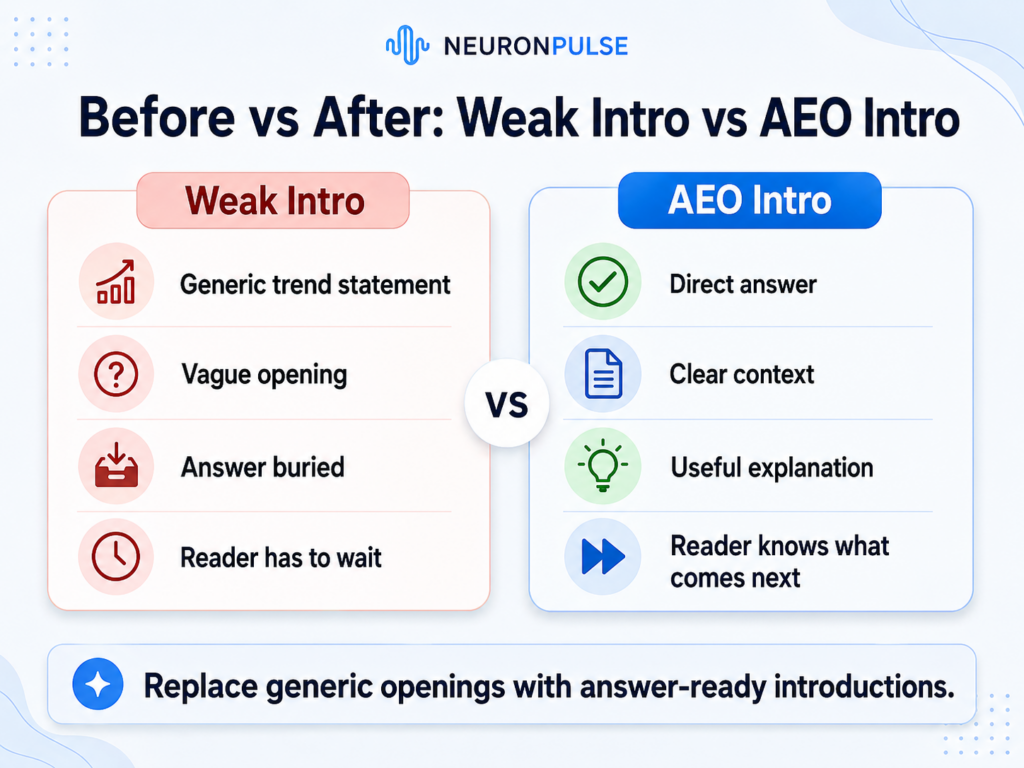
Example 1: What Is AEO?
Before
In the world of digital marketing, search engines are always changing. Businesses need to understand new strategies if they want to remain visible online and reach the right customers.
After
AEO, or Answer Engine Optimization, is the process of structuring content so search engines and AI tools can use it to answer user questions directly. It builds on SEO, but focuses more on clear answers, question-based headings, helpful formatting, and trust signals.
Example 2: How to Optimize for Perplexity
Before
Perplexity is one of the many AI tools changing how people search for information online. As more users explore AI-powered platforms, businesses need to consider how their content appears in these new environments.
After
To optimize for Perplexity, create content that is clear, current, well-structured, and useful enough to be cited as a source in an AI-generated answer. Perplexity is built around answers with citations, so your content should directly answer questions and support those answers with credible information.
Example 3: AEO vs SEO
Before
SEO has been around for many years, but now a new concept called AEO is becoming more important as search changes.
After
SEO helps pages rank in search results. AEO helps content become a direct answer to a user’s question. The two strategies work together, but they focus on different parts of the search experience.
Example 4: AI Search Visibility Audit
Before
Many websites are wondering how artificial intelligence will affect their search visibility in the years ahead.
After
An AI search visibility audit helps you evaluate whether your website is ready to be discovered, understood, summarized, cited, or recommended by AI-powered search tools. It reviews technical access, content structure, topical authority, internal links, and trust signals.
AEO Intro Rewrite Checklist
Before publishing or updating a blog intro, ask:
| Question | Why It Matters |
|---|---|
| Does the intro answer the main question quickly? | Helps readers understand the page immediately |
| Does it avoid generic filler? | Reduces friction and improves clarity |
| Does it explain why the topic matters? | Gives the reader a reason to continue |
| Does it match the article title? | Keeps the page aligned with intent |
| Does it use natural language? | Prevents keyword-stuffed or robotic writing |
| Does it set up the rest of the article? | Improves flow and expectations |
| Does it sound different from other intros on the site? | Avoids repetitive, templated content |
| Could the first two sentences stand alone? | Helps with answer-readiness |
Simple Prompt for Rewriting a Blog Intro for AEO
You can use this prompt when updating old articles:
Act as an AEO and SEO content editor. Rewrite this blog introduction so it answers the main question quickly, removes generic filler, explains why the topic matters, and sounds natural. Do not make it robotic. Keep the intro concise but useful.

Article title: [TITLE]
Main question: [MAIN QUESTION]
Target reader: [READER]
Existing intro: [PASTE INTRO]
For a stronger version, add:
Also provide:
1. A direct-answer version
2. A more conversational version
3. A version that starts with a common mistake
4. A version that starts with a before/after contrast
This helps you avoid making every intro sound the same.
Final Takeaway
A strong AEO intro gives the reader the answer faster in a very clear manner.
We should not waste the opening with generic trends, vague context, or keyword stuffing. It identifies the main question, answers it clearly, explains why the topic matters, and leads naturally into the rest of the article.
Also consider that the best intro is not always the shortest intro. It is the one that makes the reader think:
“Good. This article understands what I came here for.”
For AEO, that is the goal.
Write for the reader first, then structure the intro so answer engines can understand it too.
FAQ About Rewriting Blog Intros for AEO
An AEO blog intro is an introduction that answers the reader’s main question quickly and clearly. It is designed to help both readers and answer-driven search systems understand the purpose of the article.
Most AEO intros should be short but useful. A good range is usually 2–4 short paragraphs, depending on the topic. The key is to answer quickly without sounding abrupt.
No. Definition articles often should, but not every article needs the same opening. You can also start with a common mistake, a short scenario, a before-and-after example, or a direct answer.
Remove generic statements, vague trend language, repeated phrases, unnecessary history, and keyword-stuffed sentences. Keep only what helps the reader understand the answer and why it matters.
It can help indirectly. A clearer intro may improve user experience, relevance, engagement, and answer-readiness. It will not guarantee rankings, but it can make the article stronger.
AEO principles can help make content clearer and easier to understand, but no intro rewrite can guarantee inclusion in Google AI Overviews. Google’s AI features rely on Google Search systems and link to relevant content from across the web.
Yes, AI can help generate intro options, but a human editor should review the result for accuracy, tone, originality, and usefulness. AI-generated intros often need editing to avoid sounding generic.
Take the article title and turn it into a question. Then answer that question in the first two sentences. That alone will improve many weak blog introductions.