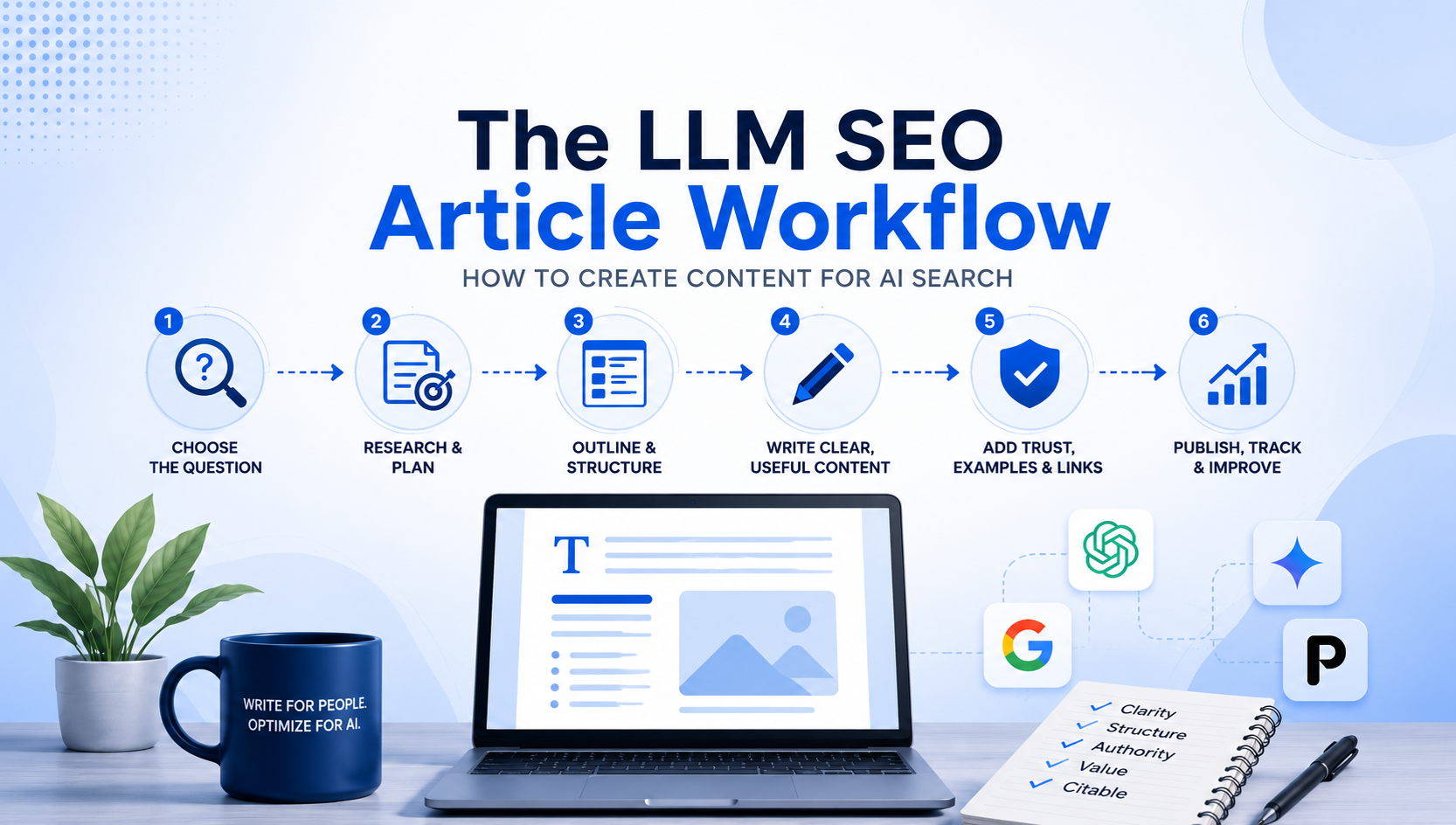
The LLM SEO Article Workflow: How to Create Content for AI Search
What Is an LLM SEO Article Workflow?
An LLM SEO article workflow is a repeatable process for creating content that is useful for readers and easier for AI search systems to understand, summarize, cite, or recommend.
Basically, it is how I personally structure my “work program” when I want to create an article focused on LLM SEO. The process is easy to repeat and focuses on getting as much as possible from AI systems regarding search and traffic. If you want to structure an article for AI overviews, the systems you use will have to be updated. Let’s start with what we know worked in the past.
A normal blog workflow might look like this:
Pick a keyword → write an outline → draft the article → publish.
That is not enough anymore. We now have to consider new factors if we want to appear in AI answers or in any LLM search result.
For AI search, the workflow needs more structure. You still care about keywords, rankings, and traditional SEO. But you also need to think about questions, entities, source-worthiness, answer clarity, examples, internal links, and how the article fits into a broader topic cluster.
A better workflow looks like this:
Choose the main question → understand the intent → research the topic → build an AI-ready outline → write the direct answer → add examples and structure → cite sources → link internally → edit for human quality → publish and track.
This matters because search is becoming more answer-driven. Google says AI Overviews and AI Mode can surface relevant links and help users explore content more quickly, while ChatGPT Search includes links to sources such as news articles and blog posts. Perplexity also positions itself as an AI answer engine that provides answers backed by sources and citations.
What is happening is that your content will be cited and used as part of an answer that was generated by the AI. They will sometimes show sources, so it is in our best interest to be part of the few sites that are used to answer queries. It all starts by having the correct article structure.
The goal is simple:
Create articles that are valuable to humans and organized well enough for AI systems to understand what they are about.
Why AI Search Content Needs a Workflow
Most weak AI search content has the same problem: it starts too fast and thinks too little.
That workflow looks something like this: The writer chooses a keyword, asks an AI tool for an outline, generates a draft, adds a few FAQs, and publishes. The result may be readable, but it often lacks originality, structure, and a clear reason to exist. It basically regurgitates what the AI is already saying. If you have thousands of people doing the same thing, where is the original content? Articles never rank because why would AI use a source to cite itself?
A proper workflow prevents that. Remember we want to publish something amazing. In order to do that, it helps to avoid the following:
- generic introductions
- repeated advice
- thin sections
- unclear search intent
- missing examples
- weak internal links
- unsupported claims
- articles that sound like every other AI-generated post
An LLM SEO workflow also helps you publish faster without lowering standards. You do not need to reinvent the process every time. You need a system that makes each article clearer, more useful, and more connected to your site’s topical authority.
This is particularly important in very competitive niches. Let’s take finance, for example. Finance and fintech are a crowded space. Plenty of sites will talk about how great a new hypothetical finance app is, and several will have AI content written talk about the app, explain what it does, and how great it is. Few will show real-world examples of how a hypothetical app will actually work. Or a human writing about his personal experience with the app.
In this scenario, if we had a good content structure for AI answers with real-world, human-proof content, the article might be more engaging and do better in traditional search as well as AI answer overviews.
The LLM SEO Article Workflow
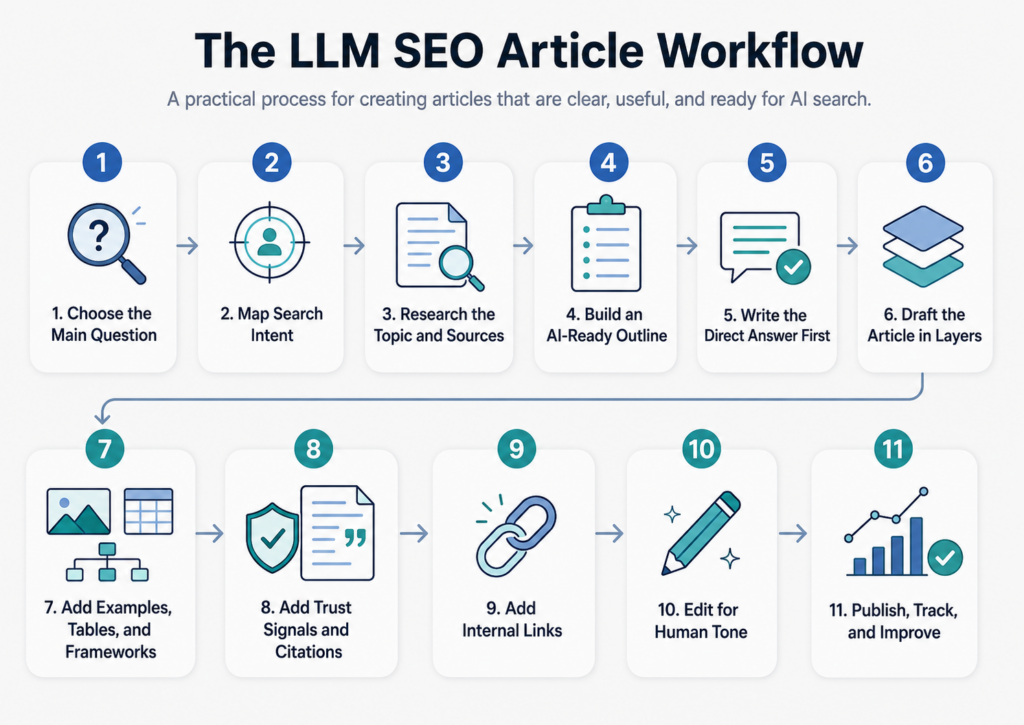
Step 1: Choose the Main Question Before the Keyword
Start with the question, not the keyword.
A keyword tells you what people type. A question tells you what they need answered.
For example:
| Keyword | Better Main Question |
|---|---|
| LLM SEO checklist | What should I check before publishing AI-search-ready content? |
| AEO vs SEO | What is the practical difference between ranking and answering? |
| ChatGPT Search optimization | How do I make my content more likely to be understood or cited by ChatGPT Search? |
| AI search visibility audit | How can I tell if my website is ready for AI-powered search? |
This shift changes how you write.
If you only target the keyword, the article may become a generic explanation. If you target the question, the article becomes more useful.
What to do
Before writing, create a short content brief with:
- target keyword
- main question
- search intent
- reader level
- reader problem
- desired outcome
- related questions
- internal links to include
Example
For this article:
Keyword: LLM SEO article workflow
Main question: How do you create an article that is ready for AI search?
Reader: marketer, founder, SEO writer, content strategist
Desired outcome: they can follow a repeatable article creation process
Internal links: LLM SEO checklist, AI Search Visibility Audit, How to Structure Articles for AI Answers, AEO vs SEO
That gives the article direction before the first sentence is written.
Step 2: Map the Search Intent
Search intent is the reason behind the query.
For AI search content, intent is often more specific than it looks.
Someone searching “LLM SEO article workflow” probably does not only want a definition. They want a process. They may be asking:
- How do I choose the topic?
- How do I structure the article?
- How do I make the content less generic?
- How do I add sources?
- How do I optimize for ChatGPT, Perplexity, and Google AI Overviews?
- How do I know if the article is ready to publish?
That tells you the article should be practical and step-by-step.
Common intent types
| Intent Type | What the Reader Wants | Best Article Format |
|---|---|---|
| Definition | Understand a term | What-is guide |
| Comparison | Understand differences | Side-by-side comparison |
| How-to | Complete a task | Step-by-step workflow |
| Audit | Evaluate something | Checklist or scorecard |
| Tool research | Choose software | Review or comparison |
| Strategy | Make a plan | Framework or roadmap |
| Troubleshooting | Fix a problem | Diagnostic guide |
This article is a workflow, so it should not feel like a glossary. It should feel like a process someone can actually follow.
Step 3: Research the Topic and Gather Sources
Do not rely only on AI-generated summaries.
For LLM SEO content, your article should be grounded in credible sources, especially when discussing platform behavior or technical recommendations.
Use sources such as:
- Google Search Central
- OpenAI documentation and product announcements
- Perplexity help resources
- official tool documentation
- reputable research papers
- first-hand tests
- your own screenshots or examples
- GSC data where relevant
Google’s guidance says the best practices for SEO remain relevant for AI features in Google Search, and that pages must be indexed and eligible to be shown in Google Search with a snippet to be eligible as supporting links in AI features. OpenAI’s ChatGPT Search announcement explains that chats can include links to sources, and Perplexity’s App Store description says it provides answers backed by sources and citations.
Those are the kinds of claims that should be sourced.
What to research before writing
- What official sources say
- What competitors cover well
- What competitors miss
- What examples would make your article more useful
- Which related NeuronPulse articles should be linked
- Whether the topic needs screenshots or graphics
- What readers are likely to ask next
Research rule
Do not just collect facts. Look for angles.
Ask:
What can this article say that is clearer, more practical, or more useful than what already exists?
That is where the content starts becoming original.
Step 4: Build an AI-Ready Outline
An AI-ready outline is not just a list of headings. It is a logic path.
The outline should move the reader from:
- the quick answer
- to the reason it matters
- to the process
- to examples
- to a checklist
- to the next step
A strong structure might look like this:
H1: The LLM SEO Article Workflow

H2: What Is an LLM SEO Article Workflow?
H2: Why AI Search Content Needs a Workflow
H2: The LLM SEO Article Workflow
  H3: Step 1: Choose the Main Question
  H3: Step 2: Map the Search Intent
  H3: Step 3: Research the Topic and Sources
  H3: Step 4: Build an AI-Ready Outline
  H3: Step 5: Write the Direct Answer First
  H3: Step 6: Add Examples, Tables, and Frameworks
  H3: Step 7: Add Trust Signals and Citations
  H3: Step 8: Add Internal Links
  H3: Step 9: Create Supporting Images
  H3: Step 10: Edit for Human Tone
  H3: Step 11: Publish and Track Performance
H2: LLM SEO Article Workflow Checklist
H2: Example Workflow
H2: FAQ
The outline should be specific enough that the draft has direction, but flexible enough that it does not feel mechanical.
Quick test
Read only the headings.
Could someone understand the article’s path?
If not, the outline needs work.
Step 5: Write the Direct Answer First
Before writing the full article, write the shortest useful answer to the main question.
For this article, the answer might be:
An LLM SEO article workflow is a process for creating content that answers a clear question, satisfies search intent, uses credible sources, includes examples, links to related content, and is structured so AI search systems can understand and summarize it.
That sentence becomes the anchor for the article.
You do not need to use it word-for-word, but you need to know it.
This helps prevent the article from drifting.
Why this works
A direct answer helps:
- readers understand the topic quickly
- editors stay focused
- AI systems identify the main idea
- the article avoid long, generic openings
The mistake is not writing long articles. Long articles can be excellent. The mistake is making readers wait too long for the point.
Step 6: Draft the Article in Layers
A good AI search article should not be one long explanation.
Write in layers:
- Short answer
- Plain-language explanation
- Example
- Deeper detail
- Practical step
Here is what that looks like.
Thin version
Add examples to your article because examples make content better.
Stronger version
Examples make AI search content more useful because they show what the advice looks like in practice. Instead of telling readers to “write clearer answers,” show a weak opening and a stronger opening. That makes the guidance easier to apply and gives the article more original value.
The stronger version does more than state the tip. It explains why it matters and how to use it.
Use this pattern
For each major section, ask:
- What is the point?
- Why does it matter?
- What does it look like?
- What should the reader do?
That keeps the article practical.
Step 7: Add Examples, Tables, and Frameworks
This is where you separate useful content from generic content.
AI search articles can easily become abstract. Terms like AEO, GEO, LLM SEO, entity clarity, and source-worthiness can sound vague unless you show examples.
Use:
- before-and-after rewrites
- comparison tables
- checklists
- simple diagrams
- named frameworks
- mini case studies
- industry examples
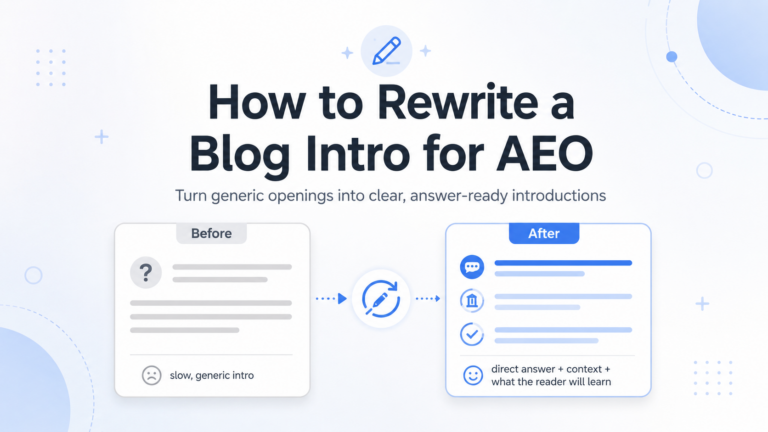
Example: before and after
Weak intro:
AI search is becoming more important, and businesses need to adapt their content strategies to stay visible online.
Stronger intro:
AI search changes content strategy because users may get an answer before they click a result. That means your article needs to answer clearly, show trust, and give AI systems enough structure to understand when your page is relevant.
The stronger version is more specific and more useful.
Example table
| Content Element | Why It Helps |
|---|---|
| Direct answer | Makes the main idea easy to find |
| Clear headings | Organizes the page around intent |
| Examples | Shows how the advice works |
| Sources | Supports trust and verification |
| Internal links | Connects the article to a broader cluster |
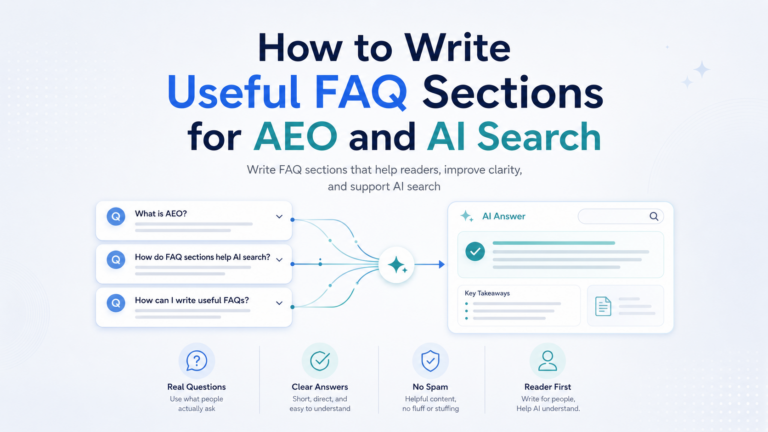
| FAQ | Answers natural follow-up questions |
A table like this makes the article easier to scan and more useful as a reference.
Step 8: Add Trust Signals and Citations
Not every sentence needs a citation. But important claims should be supported.
For AI search content, cite sources when discussing:
- platform features
- crawler behavior
- Google AI Overviews
- ChatGPT Search
- Perplexity citations
- structured data
- technical SEO requirements
- statistics or research claims
Trust signals to include
- author name
- author bio
- update date
- credible sources
- examples
- original screenshots
- internal links
- clear editorial point of view
Google’s AI features documentation says there are no additional technical requirements to appear in AI Overviews or AI Mode beyond being indexed and eligible to appear in Google Search with a snippet. That kind of claim belongs in an article about AI search because it affects what readers should actually do.
Avoid unsupported hype
Weak:
Schema guarantees better AI search visibility.
Better:
Schema can help search engines understand certain types of page content, but it does not guarantee AI search citations or AI Overview inclusion.
The second version is more trustworthy.
Step 9: Add Internal Links Before Publishing
Internal linking should not be an afterthought.
Before publishing, decide where the article fits in the cluster.
For this article, internal links should point to:
- What Is LLM SEO?
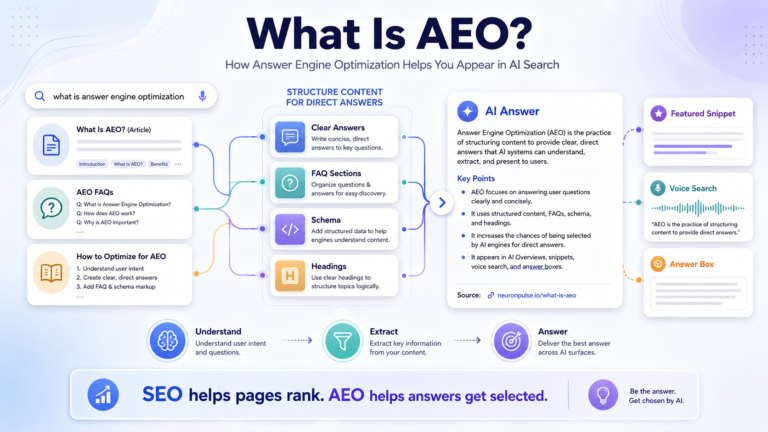
- What Is AEO?
- AEO vs SEO
- GEO vs AEO vs LLM SEO
- How to Structure Articles for AI Answers
- The LLM SEO Checklist
- AI Search Visibility Audit
- How to Optimize for ChatGPT Search
- How to Optimize for Google AI Overviews
- How to Optimize for Perplexity
Use contextual links
A good internal link appears when the reader naturally needs the next explanation.
Example:
If you are new to this topic, start with our guide to what LLM SEO means before using this workflow.
That is better than dumping a list of links at the bottom only.
Add a recommended reading block
At the end, include:
Recommended next reading:
- New to the topic? Read What Is LLM SEO?
- Ready to audit your site? Read AI Search Visibility Audit.
- Improving an existing page? Use The LLM SEO Checklist.
- Writing from scratch? Read How to Structure Articles for AI Answers.
This helps readers and strengthens the cluster.
Step 10: Create Supporting Images
Images should clarify the article, not decorate it.
For an LLM SEO workflow article, useful images might include:
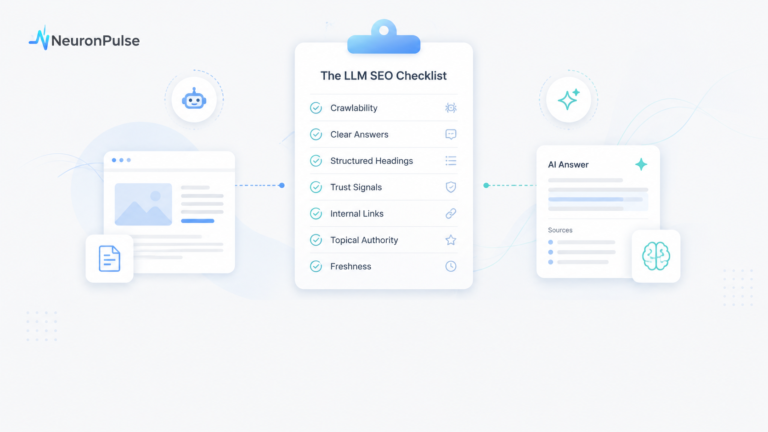
- Hero image
A simple workflow from question → outline → article → AI answer/search visibility. - Workflow diagram
A step-by-step visual of the article creation process. - AI-ready outline graphic
Shows the ideal article structure. - Before/after content example
Shows generic content vs answer-ready content. - Checklist graphic
Summarizes the publishing checklist.
Because your WordPress template uses a featured image with a title card overlay, the hero image should be simple, wide, and not too crowded. Keep important text away from the lower part of the image.
Image rule
If the image needs a paragraph of explanation to make sense, it is too complicated.
A good article image should make one idea clearer.
Step 11: Edit for Human Tone
This is the most important quality-control step.
AI-ready content does not mean robotic content.
Before publishing, read the article like a real person would.
Look for:
- repeated phrases
- generic intros
- sections that say the same thing
- robotic transitions
- bullet lists that replace explanation
- examples that feel too vague
- claims that need support
- paragraphs that could be more specific
Human editing checklist
Ask:
- Would I trust this article?
- Does it say anything useful?
- Are the examples realistic?
- Does it sound like a person with experience wrote it?
- Does each section add something new?
- Is the article too similar to other posts on the site?
- Is there a clear point of view?
This matters because AI search content is already full of repetition. The easiest way to stand out is to be clearer, more specific, and more practical.
Step 12: Publish, Track, and Improve
Publishing is not the end of the workflow.
After the article is live, track how it performs.
Use:
- Google Search Console
- analytics referral data
- manual checks in Perplexity
- manual checks in ChatGPT Search
- manual checks for Google AI Overviews
- internal link reviews
- rankings for long-tail queries
What to watch in GSC
Look for:
- impressions
- query matches
- average position
- pages getting tested
- unexpected search terms
- pages with impressions but no clicks
- pages stuck around positions 20–80
If a page gets impressions but no clicks, that is not always bad. It may mean Google is testing the page but does not yet trust it enough to rank higher.
Use that data to improve the article.
Update based on evidence
If GSC shows impressions for a query you did not target, consider adding a section that answers that query.
If competitors are being cited in Perplexity, review what their pages do better.
If the article is getting impressions but weak rankings, improve internal links, examples, sources, and title relevance.
Good LLM SEO is iterative.
LLM SEO Article Workflow Checklist
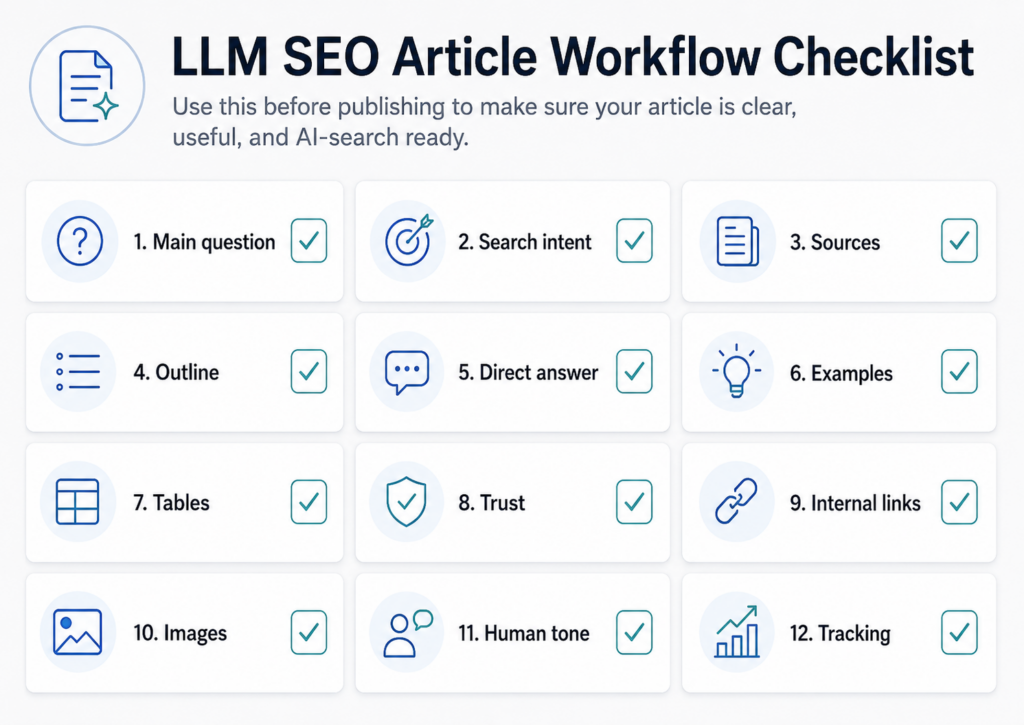
Use this before publishing.
| Step | Question |
|---|---|
| Main question | Does the article answer one clear question? |
| Search intent | Does the content match what the reader actually wants? |
| Sources | Are important claims supported by credible references? |
| Outline | Does the article flow logically from answer to application? |
| Direct answer | Is the main answer near the top? |
| Examples | Are there specific examples or before/after sections? |
| Tables | Are comparisons or processes easy to scan? |
| Trust | Is the author, brand, and update context clear? |
| Internal links | Does the page connect to related cluster articles? |
| Images | Do visuals clarify the topic? |
| Human tone | Does the article sound natural and useful? |
| Tracking | Is there a plan to review GSC and AI search visibility? |
Example: Using the Workflow for a New Article
Let’s say you want to write:
How to Optimize for Perplexity
Here is how the workflow would apply.
Create the main question
How do you make your content more likely to appear as a cited source in Perplexity?
Think of user Intent
The reader wants practical optimization steps, not just a definition of Perplexity.
USe good sources
Use Perplexity’s own descriptions of its answer engine and citation-based experience.
Create the outline
Start with a direct answer, explain why Perplexity matters, compare it to ChatGPT Search and Google AI Overviews, then give practical steps.
Examples
Show what a vague answer looks like compared with a source-worthy answer.
Internal links
Link to LLM SEO, AEO, GEO vs AEO vs LLM SEO, AI Search Visibility Audit, and the LLM SEO Checklist.
Images
Use a hero image, platform comparison graphic, and CITE framework graphic.
Follow-up
Track GSC queries such as “Perplexity SEO,” “optimize for Perplexity,” and “Perplexity search optimization.”
That is the difference between randomly writing a post and following a workflow.
Common Mistakes in LLM SEO Article Creation
Some of the most obvious mistakes people make when creating articles. The idea is easy but the execution is where people make errors.
Mistake 1: Starting with the draft instead of the intent
If you start writing before understanding the reader’s problem, the article will probably feel generic.
Mistake 2: Copying the same structure every time
Templates help, but every article should not sound identical. A comparison article should feel different from a checklist, audit guide, workflow, or tool review.
Mistake 3: Adding FAQs without improving the main article
FAQs can help, but they should not be a dumping ground for points that should have been explained in the body.
Mistake 4: Forgetting examples
Examples are what make abstract advice practical.
Mistake 5: Publishing without internal links
Internal links are part of the article, not a technical afterthought.
Mistake 6: Not updating after seeing GSC data
If Google is showing your page for a query, that is feedback. Use it.
An LLM SEO Article Workflow Will Make Creating Easier
An LLM SEO article workflow helps you create content with more purpose. It forces you to choose the main question, understand the intent, build a better outline, add examples, cite important claims, connect the article to your topic cluster, and edit for human quality.
That is what separates a useful AI search article from another generic blog post. Remember, for every good piece of content, there are thousands of crappy articles. Don’t create crappy AI articles, add some original content or at the very least your personal view on the subject.
For us at NeuronPulse, the standard should be:
Every article should answer a real question, add something useful, connect to the cluster, and be clear enough for both readers and AI systems to understand.
That is how you build authority in AI search over time, regardless of the niche, the road is the same one.
FAQ About the LLM SEO Article Workflow
An LLM SEO article workflow is a repeatable process for creating content that is useful for readers and structured so AI search systems can better understand, summarize, cite, or recommend it.
Yes. A traditional SEO workflow focuses heavily on keywords, rankings, and on-page optimization. An LLM SEO workflow also focuses on questions, answer clarity, examples, entity understanding, source-worthiness, and internal topic clusters.
No. Use the workflow as a process, not a rigid template. A checklist, comparison article, how-to guide, audit article, and tool review should each have a different rhythm.
Not every paragraph needs a source. But important claims about platforms, search features, technical requirements, or current AI tools should be supported with credible references.
Yes. AI can help with research prompts, outlines, draft sections, FAQs, summaries, and editing. But human judgment is needed to add examples, remove repetition, verify facts, and make the article sound natural.
The most important step is choosing the main question. If the article does not answer a clear question, the rest of the workflow becomes much harder.
Use the LLM SEO Checklist. At minimum, the article should answer the main question early, use clear headings, include examples, cite important claims, link to related content, and be useful to a real reader.
Track impressions, queries, rankings, and referrals. Review whether AI search tools cite or mention the article. Then update the page based on what you learn.