AI Search Visibility Audit: Is Your Website Ready for AI Search?
An AI search visibility audit is a review of how ready your website is to appear in AI-powered search experiences like ChatGPT Search, Perplexity, Google AI Overviews, Gemini, Claude, Copilot, and other answer engines.
A traditional SEO audit usually asks:
Can this website rank in Google?
An AI search visibility audit asks a slightly different question:
Can AI systems understand, trust, summarize, cite, and recommend this website?
That difference matters.
People are no longer only typing short keywords into Google and scanning a list of links. They are asking AI tools longer, more specific questions and expecting direct answers, comparisons, recommendations, and summaries.
Google says AI Overviews provide AI-generated snapshots with key information and links to explore more on the web. OpenAI describes ChatGPT Search as providing fast answers with links to relevant web sources. Perplexity describes itself as an answer engine that searches the web, identifies trusted sources, and synthesizes information into clear responses.
That means your website needs to do more than exist.
It needs to be clear enough to understand, useful enough to summarize, and trustworthy enough to cite.
My personal take is that users now search with AI as if it was a personal assistant. The questions are very specific and that is due to the user being more informed on how precise AI citations can be.
Why AI Search Visibility Matters
AI search visibility matters because the discovery journey is changing. Users have more complex questions with search intent. So our job is to create answers to these more elaborate, specific questions, also with intent.
In traditional search, a user might search:
best CRM for small business
Then they scan results, open several tabs, and compare articles.
In AI search, that same user might ask:
What is the best CRM for a small consulting business that needs simple automation, email follow-up, and low monthly costs?
Instead of only showing links, an AI system may generate a direct answer, cite a few sources, recommend a shortlist, and explain the reasoning.
That creates a new kind of competition. It makes everything more difficult for marketers and business owners. Ranking was hard enough, now you not only create a plan to rank but also to be used as a resource, and then “hope” the AI decides to cite your website in their answer. If you created a great piece of content, you obviously want that traffic to your website.
You are not only competing to rank. You are competing to become part of the answer.
For businesses, that affects:
- brand visibility
- organic discovery
- referral traffic
- expert positioning
- lead generation
- comparison searches
- product research
- service provider selection
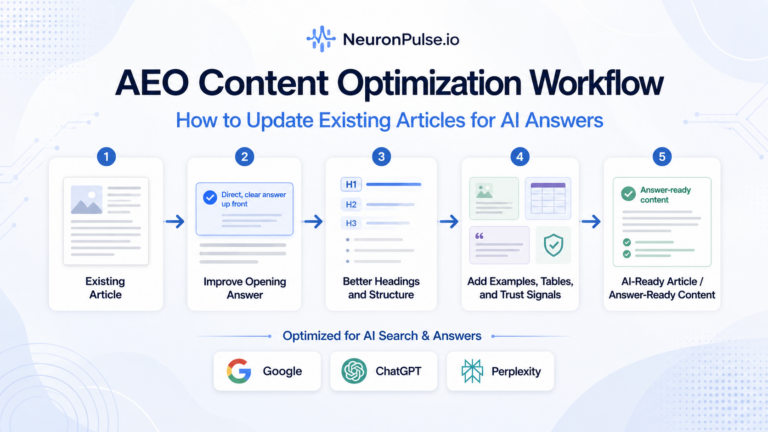
An AI search audit helps you find the gaps that may prevent your website from being included in these answer-driven experiences. It’s not just adding a few pieces of content, now its taking all of your already existing content, auditing, and then editing for Answer Engine Optimization.
What an AI Search Audit Should Measure
A good AI search visibility audit should not be vague.
It should review the parts of your website that affect whether AI search systems can discover, understand, and trust your content.
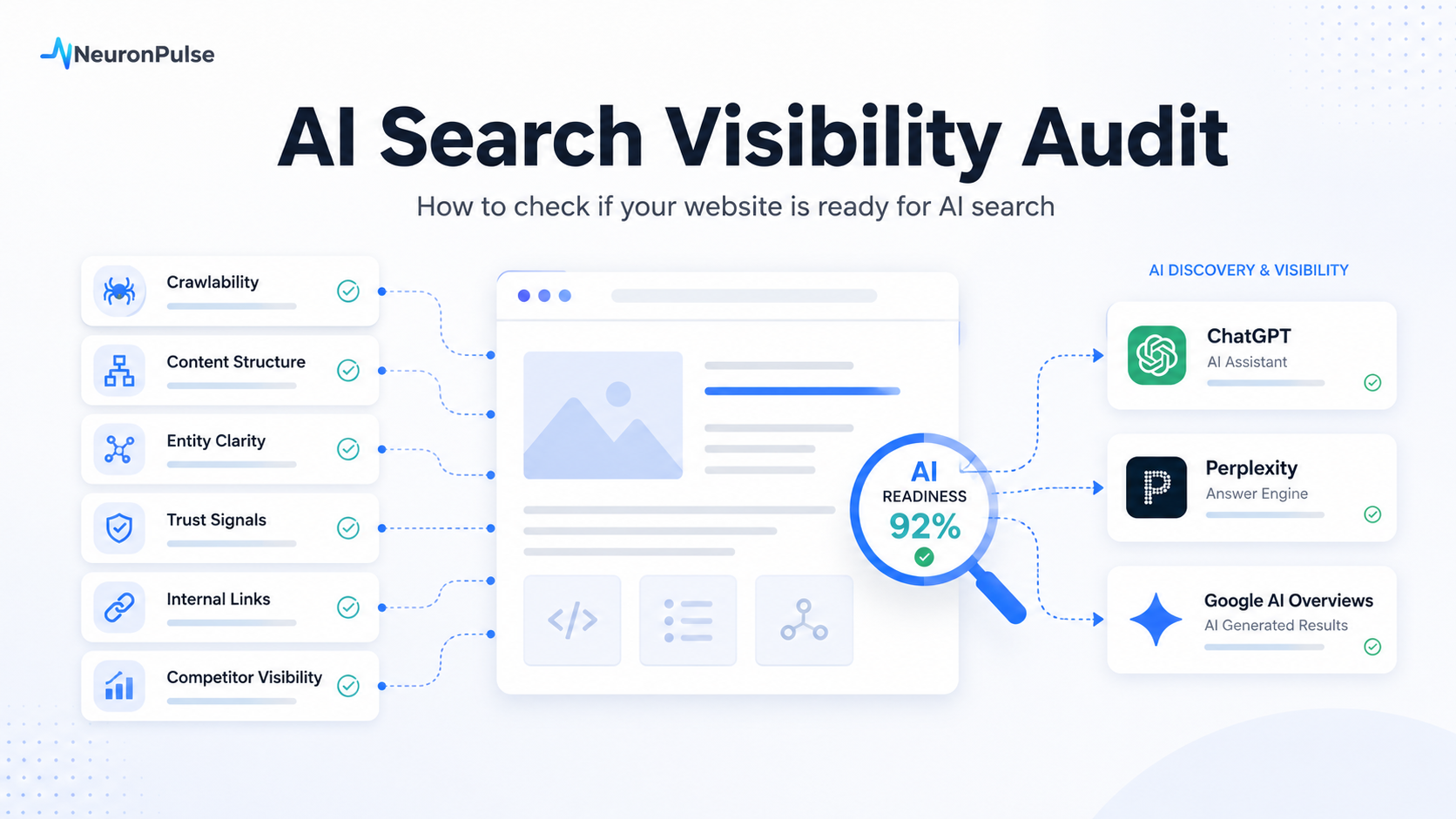
At minimum, an audit should measure:
| Audit Area | What You Are Checking |
|---|---|
| Crawlability | Can search engines and AI crawlers access important pages? |
| Indexing | Are important pages eligible to appear in search? |
| Content clarity | Does each page answer a clear question or intent? |
| AEO structure | Are answers, headings, FAQs, tables, and summaries easy to extract? |
| Topical authority | Does the site cover the topic deeply enough? |
| Entity clarity | Is the brand clearly associated with its main topics? |
| Trust signals | Are authorship, sources, dates, and credibility signals visible? |
| Internal linking | Are related pages connected into a strong cluster? |
| Competitor visibility | Which competitors appear in AI answers and why? |
| Content gaps | What questions does the site fail to answer? |
| Platform visibility | Does the brand appear in ChatGPT, Perplexity, Google AI Overviews, or Gemini? |
The point is not to “game” AI systems. The point is to remove ambiguity.
If your website is unclear to users, it is probably unclear to AI systems too. Basic on-page SEO is a good place to start optimizing on AI answers before leaning into the more challenging aspects of LLM SEO.
How to Run an AI Search Visibility Audit
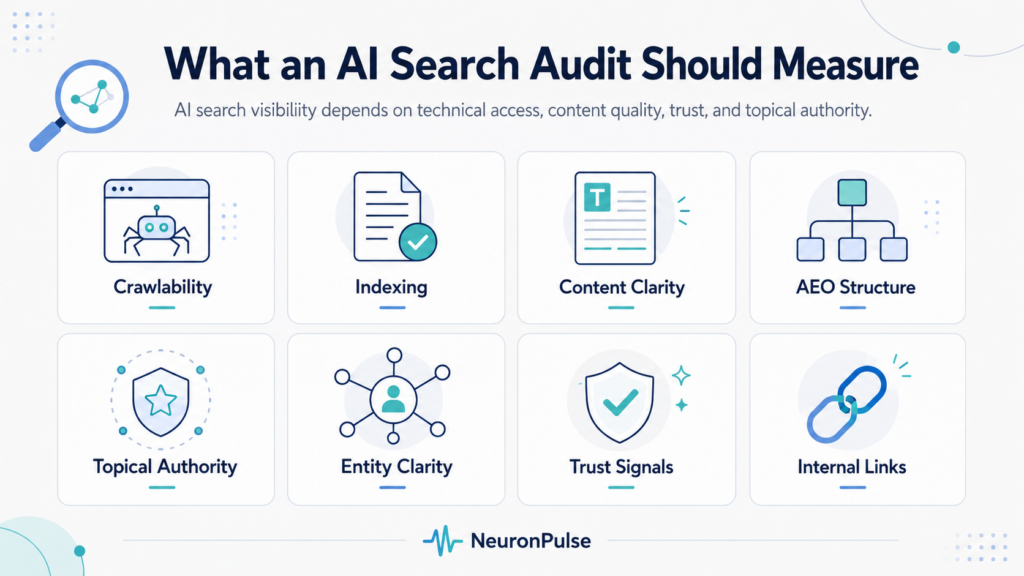
An AI search visibility audit should move from technical access to content quality, then into brand clarity, topical authority, and competitor visibility. Start with the fundamentals first: if search engines and AI systems cannot access your pages, even strong content may struggle to appear in AI-powered results.
Step 1: Check Crawlability and Indexing
Start with the basics.
If your important pages are not crawlable or indexable, they are unlikely to perform well in either traditional search or AI search.
Check whether your pages:
- are indexed in Google
- are blocked by
robots.txt - have incorrect
noindextags - have broken canonical tags
- are missing from your sitemap
- require login access
- hide important content behind scripts
- load poorly on mobile
- have broken internal links
For ChatGPT Search specifically, OpenAI says OAI-SearchBot is used to surface websites in ChatGPT’s search features. OpenAI also says that sites opted out of OAI-SearchBot will not be shown in ChatGPT search answers, although they may still appear as navigational links.
A basic robots.txt rule to allow OAI-SearchBot may look like this:
User-agent: OAI-SearchBot
Allow: /
That does not guarantee ChatGPT Search visibility. But if your site blocks important crawlers, you may be limiting your chances before content quality is even considered.
In short, ChatGPT might use your content anyway, so what is the point of blocking it? Website owners are just going to miss out on being cited and the possible traffic it generates from LLMs.
Audit questions
- Are your most important pages indexed?
- Can Google crawl the page?
- Can relevant AI crawlers access the content?
- Is the main content visible in the HTML?
- Is the site technically clean enough to be trusted?
- Are your XML sitemaps current?
Recommended tools
- Google Search Console
- Screaming Frog
- Ahrefs Site Audit
- Semrush Site Audit
- robots.txt tester
- browser Inspect tool
- PageSpeed Insights
Step 2: Review Brand and Entity Clarity
AI search systems need to understand what your brand is about.
If your homepage, About page, author bio, category pages, and article intros all describe the business differently, your entity signals become weaker. Imagine if Mcdonalds had a different slogan in every restaurant instead of the universal “I’m lovin’ it”? It would confuse the customer. The same applies in this context to your website.
A brand/entity review asks:
Is it obvious who you are, what you cover, and why your site should be trusted for this topic?
For NeuronPulse, a clear entity statement could be:
NeuronPulse helps marketers, founders, and businesses understand AI search, LLM SEO, AEO, GEO, content strategy, and AI-powered workflows.
That kind of sentence helps both users and systems understand the site’s focus.
Check these areas
- Homepage headline and subtitle
- About page
- Author bios
- Article intros
- Category descriptions
- Organization schema
- Social profiles
- Newsletter description
- Footer copy
Audit questions
- Does the site clearly state what it does?
- Are the same core topics repeated naturally across the site?
- Are author names visible?
- Is the brand connected to a specific niche?
- Are category names aligned with the site’s expertise?
- Is there an About page that supports credibility?
Common problem
Many websites are too vague.
They say things like:
We help businesses grow with innovative digital solutions.
That could mean anything. It might be enough to rank in traditional search in pages 3 or 4. It’s too weak for AI search results, though.
A stronger version would be:
We help B2B SaaS companies improve visibility in Google, ChatGPT, Perplexity, and AI-powered search through technical SEO, content strategy, and answer engine optimization.
Specificity helps.
Step 3: Test Your Brand in AI Search Tools
Next, test whether AI systems already recognize your brand.
This is not perfect science, but it gives useful directional insight.
Run tests in tools like:
- ChatGPT Search
- Perplexity
- Gemini
- Google AI Overviews
- Copilot
- Claude with web access, if available
Use prompts like:
- What is [Brand Name]?
- What does [Brand Name] do?
- Is [Brand Name] a good source for [topic]?
- Best companies for [service/category]
- Best resources to learn [topic]
- Who are experts in [topic]?
- Compare [Brand Name] vs [Competitor]
- What are the best blogs about [topic]?
For NeuronPulse, example prompts might be:
- What is NeuronPulse?
- Best resources to learn LLM SEO
- What are good websites about AI search optimization?
- Who explains GEO vs AEO vs LLM SEO clearly?
- Best guides for optimizing for ChatGPT Search
What to record
Create a simple spreadsheet with:
| Prompt | Platform | Did your brand appear? | Was your site cited? | Competitors mentioned | Notes |
|---|---|---|---|---|---|
| Best resources to learn LLM SEO | Perplexity | No | No | Competitor A, Competitor B | Competitors had stronger guides |
| What is NeuronPulse? | ChatGPT Search | Partial | No | N/A | Brand not clearly understood |
| How to optimize for Perplexity | No | No | Competitor C | Need stronger Perplexity guide |
Do not panic if your brand does not appear at first. A new site usually needs more content, links, mentions, and authority before AI systems consistently recognize it.
This step gives you a baseline.
Step 4: Check Which Competitors Are Being Cited
If your competitors are appearing in AI answers, study them.
The goal is not to copy them. The goal is to understand why they are being selected.
Look at:
- which pages are cited
- how those pages are structured
- whether they include definitions
- whether they include tables
- whether they use original data
- whether they have strong author bios
- whether they cite credible sources
- whether the page is current
- whether they have backlinks or strong brand authority
- whether they cover the topic more completely than you
For Perplexity, this is especially important because source citations are central to the experience. Perplexity says its answer engine searches the web, identifies trusted sources, and synthesizes information into clear, up-to-date responses.
Audit questions
- Which competitors show up repeatedly?
- Are they cited because of authority, content structure, freshness, or specificity?
- Do they have a better page for the query?
- Are they answering a question you missed?
- Do they have stronger examples or data?
- Can you create a more useful version of the content?
Simple competitor scorecard
| Competitor Page | Why It Might Be Cited | What We Can Improve |
|---|---|---|
| Competitor guide | Clear definition and strong table | Add better examples and updated screenshots |
| SaaS blog article | High domain authority and original data | Add practical workflow and niche examples |
| Help center page | Official source | Link to it and add interpretation for readers |
| Industry blog | Strong topical cluster | Build internal links and publish missing support articles |
This gives you a practical roadmap instead of guessing.
Step 5: Review Your Content Structure
AI search visibility depends heavily on whether your content is easy to understand. Your content needs to be created in a way that AIs want to crawl and cite content. Learning how to structure articles for AI answers is an important skill thats not difficult to learn, but can take a few tries to really get the hang of it.
Review your most important pages and ask:
- Does the page answer the main question early?
- Are headings specific?
- Are there natural follow-up questions?
- Are definitions clear?
- Are examples included?
- Are tables used where they help?
- Is there an FAQ section?
- Is the article easy to skim?
- Does each section add something new?
- Is the page written for real readers?
A page can be long and still weak if it does not answer clearly.
A page can be concise and strong if it gives the user exactly what they need.
Weak structure
- Generic introduction
- Background
- Vague benefits
- Main answer buried halfway down
- Thin conclusion
Stronger structure
- Direct answer
- Why it matters
- Step-by-step explanation
- Examples
- Table or framework
- Checklist
- FAQ
- Clear next step
This does not mean every article should use the same template. But every article should be easy to follow.
Step 6: Identify Missing Topic Clusters
AI search systems do not only evaluate one page in isolation.
They also need to understand whether your site has depth around a topic.
For example, one article about “LLM SEO” is a start. But a full cluster might include:
- What Is LLM SEO?
- What Is AEO?
- AEO vs SEO
- GEO vs AEO vs LLM SEO
- How to Optimize for ChatGPT Search
- How to Optimize for Google AI Overviews
- How to Optimize for Perplexity
- How to Structure Articles for AI Answers
- The LLM SEO Checklist
- AI Search Visibility Audit
That cluster tells users and search systems:
This site is serious about AI search optimization.
How to find cluster gaps
Start with your core service or topic.
Then ask:
- What does a beginner need to understand first?
- What comparisons are they likely to search?
- What tools or platforms matter?
- What mistakes do they make?
- What checklists would help?
- What workflows would make the topic practical?
- What case studies or examples could prove expertise?
- What commercial page should this support?
Example cluster map
| Cluster Role | Example Article |
|---|---|
| Pillar guide | AI Search & SEO |
| Definition | What Is LLM SEO? |
| Definition | What Is AEO? |
| Comparison | GEO vs AEO vs LLM SEO |
| Platform guide | How to Optimize for ChatGPT Search |
| Platform guide | How to Optimize for Google AI Overviews |
| Platform guide | How to Optimize for Perplexity |
| Practical guide | How to Structure Articles for AI Answers |
| Checklist | The LLM SEO Checklist |
| Audit/service bridge | AI Search Visibility Audit |
Your audit should identify which pieces are missing and which existing pages need better internal links.
Step 7: Check Trust Signals and Sources
Trust is a major part of AI search visibility. If an AI system is going to cite a page, it needs confidence that the page is reliable.
Trust signals include but are not limited to:
- visible author name
- author bio
- About page
- company information
- update dates
- citations to credible sources
- original examples
- screenshots
- case studies
- methodology
- external mentions
- backlinks
- clear editorial standards
Google’s guidance for AI features tells site owners to follow Search essentials and focus on helpful, reliable, people-first content. Google’s AI Overviews also include links that let users explore more deeply on the web.
That means your content should not look anonymous, outdated, or unsupported.
Audit questions
- Is the author visible?
- Does the site have a credible About page?
- Are sources used for important claims?
- Are platform-specific statements cited?
- Are update dates visible?
- Are screenshots or examples included where helpful?
- Does the content show experience or just summarize generic ideas?
- Are there trust signals above the fold or near the article?
Practical improvement
Add a short author bio to each article:
Michael writes about AI search, LLM SEO, AEO, content strategy, PPC, and practical AI workflows for marketers and business owners.
Then link that bio to an About page or author profile. Its simple but it takes a while to get all of these pieces of content ready to publish.
Step 8: Review Internal Linking
Internal links are one of the easiest things to improve.
They help users and bots move through your site, and they help search systems understand how your content is connected.
For an AI search cluster, every article should link to:
- the main hub page
- relevant definition articles
- related platform guides
- practical checklist/workflow articles
- next-step content
For example, the AI Search Visibility Audit article should link to:
- What Is LLM SEO?
- What Is AEO?
- GEO vs AEO vs LLM SEO
- How to Optimize for ChatGPT Search
- How to Optimize for Google AI Overviews
- How to Optimize for Perplexity
- How to Structure Articles for AI Answers
- The LLM SEO Checklist
Audit questions
- Does the article link to the main hub?
- Does it link to related articles naturally?
- Do older articles link to newer ones?
- Are anchor texts descriptive?
- Are important pages receiving enough internal links?
- Are there orphan pages?
- Does the article include a “Recommended next reading” section?
Example of internal link block
Recommended next reading
- New to the topic? Start with What Is LLM SEO?
- Want to understand answer optimization? Read What Is AEO?
- Comparing terms? Read GEO vs AEO vs LLM SEO
- Ready to improve a page? Use The LLM SEO Checklist
- Creating content? Read How to Structure Articles for AI Answers
This is useful for users and helps strengthen the cluster. Remember you want users to read your information and then read some more. Internal linking to relevant content helps the user find more answers to their questions.
Step 9: Audit Content Freshness
AI search topics change quickly. A page about AI search from six months ago may already need an update. A travel page might need new photographs after just a few months. A finance needs new figures and tables. There is always something you can add to a piece of content to keep it fresh. You don’t (and shouldn’t) rewrite all of your content every time something new pops up.
Review:
- platform names
- product features
- crawler documentation
- screenshots
- examples
- pricing, if relevant
- cited sources
- recommended tools
- internal links
- old statements that may no longer be true
This is especially important for articles about:
- ChatGPT Search
- Google AI Overviews
- Perplexity
- Gemini
- AI tools
- SEO platform updates
- schema or crawler guidance
Audit questions
- When was the article last updated?
- Are sources still current?
- Are screenshots outdated?
- Are there newer platform changes?
- Do newer articles need to be linked?
- Has search intent changed?
- Are competitors covering newer information?
A freshness audit is not just about changing the date. It is about making sure the article still deserves trust.
Step 10: Score Each Important Page
Once you review the page, give it a score.
A simple scoring model works well.
| Category | Score 1–5 |
|---|---|
| Crawlability and indexing | |
| Main answer clarity | |
| Content structure | |
| Topic depth | |
| Trust signals | |
| Entity clarity | |
| Internal links | |
| Freshness | |
| AI citation potential |
Then calculate the average or total.
This gives you a way to prioritize.
For example:
- 40–45: Strong AI search readiness
- 30–39: Good foundation, needs improvement
- 20–29: Weak or incomplete
- Under 20: Major rewrite or rebuild needed
This score is not a magic number. It is a practical way to compare pages and decide what to fix first.
Step 11: Create an AI Search Action Plan
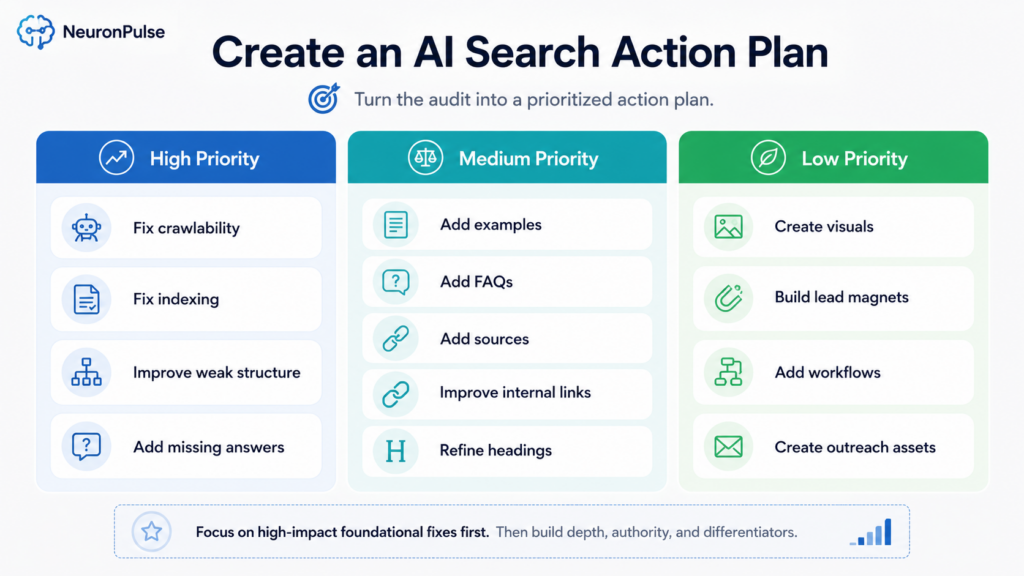
An audit is only useful if it leads to action. There would be no point in auditing a site if we aren’t going to go ahead and improve things.
Once you finish reviewing your website, organize recommendations by priority.
High priority
Fix issues that block visibility or weaken trust:
- noindex tags
- blocked crawlers
- missing main answer
- no internal links
- outdated information
- weak or missing author information
- poor content structure
- missing important topic pages
Medium priority
Improve pages that are already relevant but need more depth:
- add examples
- add FAQs
- add comparison tables
- add sources
- improve title and meta description
- add screenshots
- strengthen entity language
Low priority
Improve polish and future growth:
- create downloadable checklist
- repurpose into LinkedIn posts
- add visuals
- create related workflows
- pitch the guide for backlinks
- turn the audit into a service page
Example action plan
| Priority | Action | Page |
|---|---|---|
| High | Add direct answer near top | Existing blog post |
| High | Add internal links to AI Search hub | All cluster pages |
| Medium | Add comparison table | Platform guide |
| Medium | Update sources and screenshots | ChatGPT Search article |
| Medium | Add FAQ section | Service page |
| Low | Create downloadable checklist | LLM SEO Checklist |
This keeps the audit from becoming a long document nobody uses.
AI Search Visibility Audit Checklist
Use this checklist to review your website.
Technical access
- Are important pages indexable?
- Can Google crawl the site?
- Are relevant AI crawlers blocked?
- Is the main content accessible?
- Are canonical tags correct?
- Is the sitemap updated?
Brand and entity clarity
- Is the brand clearly described?
- Are core topics repeated consistently?
- Is there a strong About page?
- Are author bios visible?
- Are category names specific?
Content structure
- Does each page answer a clear question?
- Is the main answer near the top?
- Are headings descriptive?
- Are examples included?
- Are tables used where useful?
- Is there an FAQ section?
- Is the article easy to skim?
Trust and credibility
- Are sources cited where needed?
- Is the author visible?
- Is there an updated date?
- Are claims specific and accurate?
- Are screenshots or examples included?
- Does the page show real expertise?
Topic coverage
- Is the page part of a cluster?
- Are important subtopics missing?
- Are comparison articles included?
- Are platform-specific guides included?
- Are practical checklists or workflows included?
Internal linking
- Does the page link to the hub page?
- Does it link to related articles?
- Do older articles link to newer ones?
- Are anchor texts descriptive?
- Are any important pages orphaned?
Platform visibility
- Does the brand appear in ChatGPT Search?
- Does the site appear in Perplexity citations?
- Does the site appear for relevant Google queries with AI Overviews?
- Which competitors are cited?
- What content formats are competitors using?
Action plan
- What should be fixed first?
- Which pages need rewriting?
- Which pages need internal links?
- Which new articles should be created?
- Which pages could become linkable assets?
- Which opportunities support a future service offer?
How Often Should You Run an AI Search Visibility Audit?
For a new website or new content cluster, run a light audit every month. For an established site, run a deeper audit every quarter.
For fast-moving topics like AI search, ChatGPT, Perplexity, and Google AI Overviews, review important pages more often. Your niche might not require an audit that often, but as a good rule of thumb, let’s keep it as a light monthly report.
A good schedule:
| Audit Type | Frequency | What to Review |
|---|---|---|
| Light audit | Monthly | GSC impressions, indexing, internal links, new queries |
| Content audit | Quarterly | Structure, freshness, sources, examples, FAQs |
| Competitive audit | Quarterly | Which competitors are cited or ranking |
| Technical audit | Every 6 months | Crawlability, speed, indexation, schema, errors |
| Full AI search audit | Every 6–12 months | Whole-site readiness and strategy |
For NeuronPulse, a monthly light audit makes sense right now because the site is building a new topic cluster.
What to Do If Your Website Does Not Appear in AI Search
If your site does not appear in AI answers yet, do not assume something is broken.
For newer or smaller websites, it may simply mean the site needs more:
- content depth
- backlinks
- brand mentions
- topic coverage
- internal links
- trust signals
- time in the index
- original assets
Start with the basics:
- Make sure pages are crawlable and indexed.
- Build a focused topic cluster.
- Add direct answers and clear structure.
- Improve author and brand credibility.
- Publish useful checklists, templates, and workflows.
- Earn a few real links or mentions.
- Monitor AI search tools over time.
AI search visibility is not instant. It is built through clarity, consistency, and trust.
Final Takeaway
An AI search visibility audit helps you understand whether your website is prepared for the next layer of search.
Traditional SEO still matters. But now you also need to know whether your content is clear enough for AI systems to understand, useful enough to summarize, and credible enough to cite.
A strong AI search audit reviews:
- crawlability
- indexing
- brand clarity
- content structure
- topical authority
- trust signals
- internal links
- freshness
- competitor citations
- platform visibility
The goal is not to chase every AI trend.
The goal is to make your website the kind of source that both people and AI systems can trust.
FAQ About AI Search Visibility Audits
An AI search visibility audit is a review of how prepared your website is to appear in AI-powered search experiences such as ChatGPT Search, Perplexity, Google AI Overviews, Gemini, and other answer engines.
Yes. A traditional SEO audit focuses heavily on rankings, indexing, technical SEO, content, and links. An AI search audit includes those basics but also reviews answer structure, entity clarity, AI citation potential, topical authority, and visibility in AI search tools.
No. No audit can guarantee inclusion in AI answers. The purpose is to identify and fix issues that reduce your chances of being understood, cited, or recommended.
Review your robots.txt file and make sure you are not blocking relevant OpenAI crawlers such as OAI-SearchBot if your goal is to appear in ChatGPT Search. OpenAI says OAI-SearchBot is used to surface websites in ChatGPT search features.
Search relevant questions in Perplexity and review the cited sources. Track whether your pages appear, which competitors are cited, and what types of pages Perplexity uses for your target topics.
Search your target queries in Google and review whether an AI Overview appears, which sources are included, and how your page performs in Google Search Console. AI Overview behavior can vary by user, query, location, and timing.
The most important part is content usefulness. Technical access matters, but if the content is vague, thin, outdated, or unsupported, it is less likely to be valuable as an AI search source.
For fast-changing topics, run a light audit monthly and a deeper audit quarterly. For more stable industries, a quarterly or twice-yearly audit may be enough.
Start with crawlability, indexing, and your most important pages. Then improve direct answers, headings, examples, sources, internal links, and topical coverage.
Want help reviewing your website’s AI search visibility?
NeuronPulse can help identify gaps in crawlability, content structure, topical authority, internal linking, and AI search readiness across ChatGPT Search, Perplexity, Google AI Overviews, and traditional search.