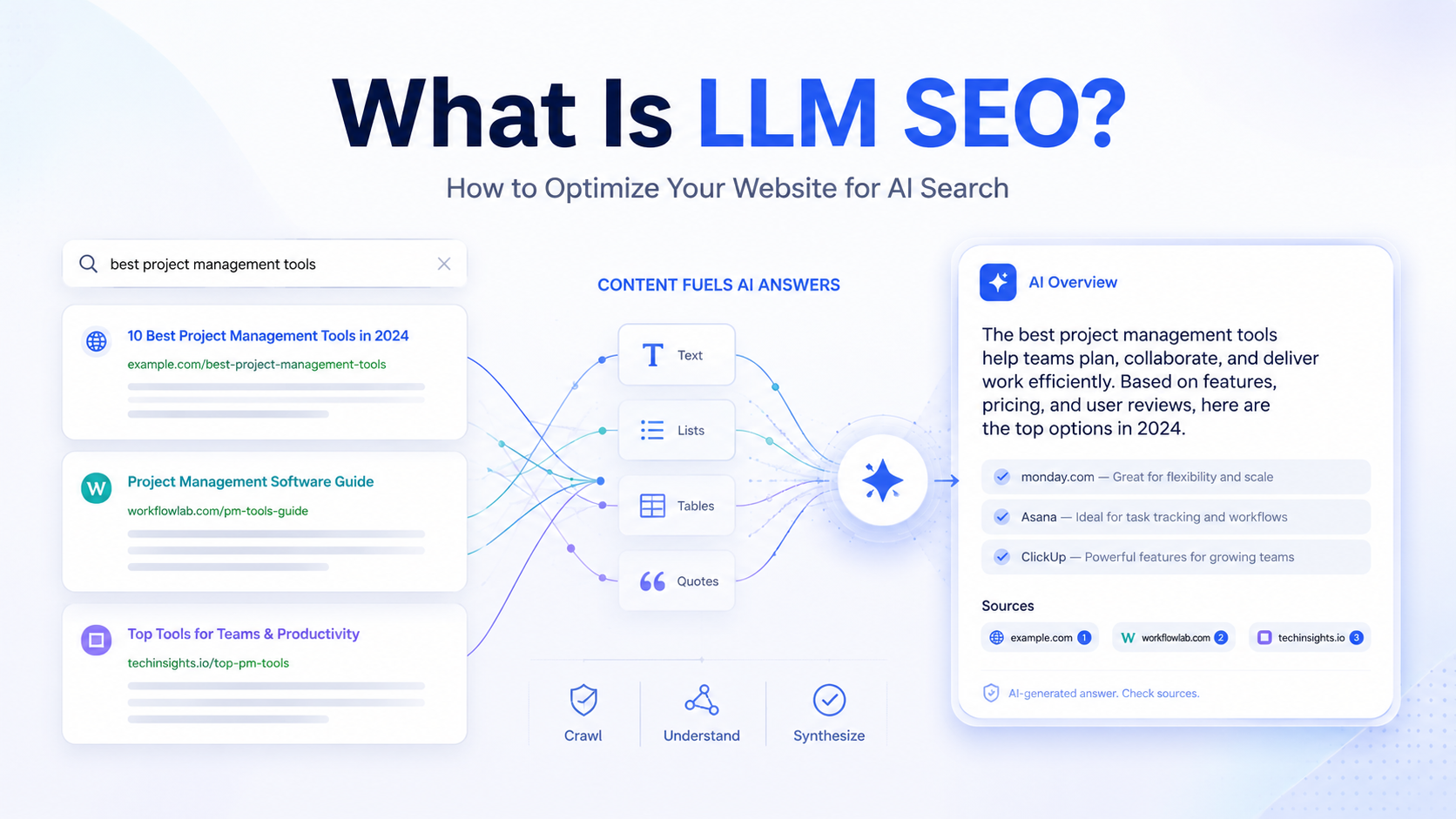
What Is LLM SEO? How to Optimize Your Website for AI Search
The Core Elements of LLM SEO
What are the core elements of LLM SEO and how can we define them?
1. Clear Definitions
AI systems need clear explanations. A lot of what goes into writing for humans is very different than what an LLM needs to index and understand data.
If your article is about LLM SEO, do not hide the definition in paragraph seven. Put it near the top.
Example:
LLM SEO is the process of optimizing digital content so large language models can understand, trust, cite, and recommend it in AI-generated answers.
This type of sentence is useful because it is direct, complete, and easy to extract. An LLM like ChatGPT will try to cite based on clear definitions. Think of it as a way to show a result with less “fluff”.
Good LLM SEO content should define the main topic early, then expand with examples, frameworks, and details.
2. Entity Optimization
In traditional SEO, people often focus on keywords. In LLM SEO, entities are just as important if not more. An entity is a clearly identifiable person, brand, product, concept, place, or organization. In other words, LLM results depend heavily on brand awareness and topical authority, rather than keyword density or positioning.
For example:
- NeuronPulse
- LLM SEO
- Answer Engine Optimization
- ChatGPT
- Perplexity
- Google AI Overviews
- Prompt engineering
- Generative Engine Optimization
AI systems try to understand how entities relate to one another. If your website consistently connects your brand with a topic, you make it easier for AI systems to understand what you are known for.
For NeuronPulse, this means repeatedly and naturally building associations like:
NeuronPulse helps businesses understand LLM SEO, AEO, AI search optimization, and prompt strategy.
Over time, this helps create a clearer topical identity.
3. Topical Authority
One article is not enough. In the old days of SEO there was a chance you could rank a single page article for competitive terms as long as it was long enough and your threw a bunch of backlinks at it.
If you want to be seen as an expert in LLMS and LLM SEO, your website should cover the topic from multiple angles. Creating something called “content clusters” is generally a good strategy to create topical authority.
For example, a strong LLM SEO content cluster could include:
- What Is LLM SEO?
- LLM SEO vs SEO
- LLM SEO vs AEO
- How to Optimize for ChatGPT Search
- How to Optimize for Perplexity
- How to Optimize for Google AI Overviews
- How to Structure Content for AI Search
- How to Build an AI Search Visibility Strategy
- Prompt Engineering for SEO
- The LLM SEO Checklist
This helps both users and AI systems understand that your website is not casually mentioning the topic. The point is to start building real expertise around it.
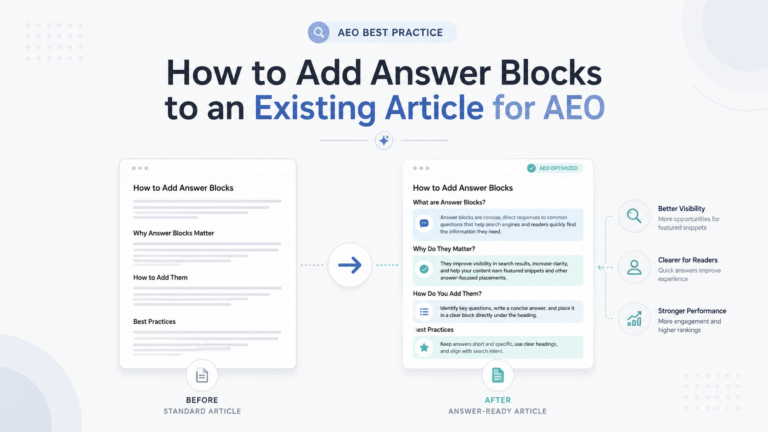
4. Answer-Ready Formatting
AI systems prefer content that is easy to parse. So it is not necessary to create very long articles or blog posts. LLMs prefer short and to-the-point data they can cite and show in their answer results.
That means your article should not be one long wall of text. It should be structured with clear sections, concise answers, and logical formatting.
Useful formats include:
- Short definitions
- Numbered steps
- Comparison tables
- FAQ sections
- Checklists
- Examples
- Summaries
- “In simple terms” explanations
For example, this is answer-ready:
The goal of LLM SEO is to increase the chances that AI systems mention, cite, summarize, or recommend your brand when users ask relevant questions.
This is weaker:
In the ever-changing world of digital innovation, many businesses are beginning to wonder about the various ways artificial intelligence may have an impact on their future content visibility strategy.
The first version gives the answer. The second version delays it. Fluff writing is to LLM results what spamming profile links was to SEO in 2017. It doesn’t work, and it looks bad to an LLM.
5. Source Credibility
AI search systems are designed to give users useful and trustworthy answers. That means your content needs credibility signals.
Credibility signals may include:
- Author names
- Author bios
- Real experience
- Original examples
- Data
- Citations
- External references
- Case studies
- Transparent methodology
- Clear update dates
- Links to related articles
- A visible company or brand identity
Google’s guidance emphasizes helpful, reliable content created to benefit people rather than content made mainly to manipulate rankings.
For LLM SEO, this is even more important. If AI systems are choosing sources to support an answer, generic content with no clear expertise is less likely to stand out.
Remember that just a couple of years ago, the top 10 results mattered. Now it is an all-or-nothing battle for the top 2 spots that will be cited by LLMs. Making people-friendly content with a minimalist writing style will be the norm for the next couple of years.
6. Original Insight
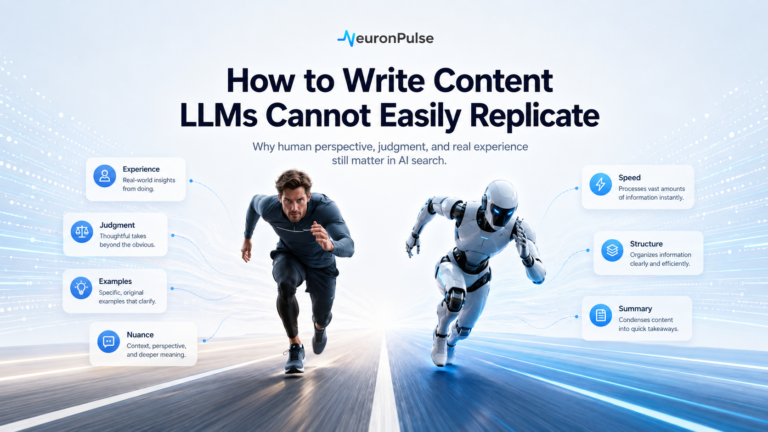
AI can already summarize generic information.
That means basic, recycled SEO content is becoming less valuable.
To compete in AI search, your content should include something original, such as:
- A unique framework
- A practical checklist
- A real-world example
- A mini case study
- A strong opinion
- A comparison based on experience
- A repeatable process
- A useful template
For example, instead of only saying “optimize for AI search,” you could introduce a framework like:
The CLEAR Framework for LLM SEO
C — Clarity: Make your content easy to understand.
L — Links: Support your claims with internal and external references.
E — Entities: Clearly connect your brand to relevant topics.
A — Authority: Show expertise, experience, and trust signals.
R — Retrieval: Structure content so AI systems can easily extract useful answers.
A named framework makes your content more memorable and more likely to be referenced. Does it look familiar? It will for everyone that knows what Google E-E-A-T (Experience, Expertise, Authoritativeness, Trustworthiness) is.
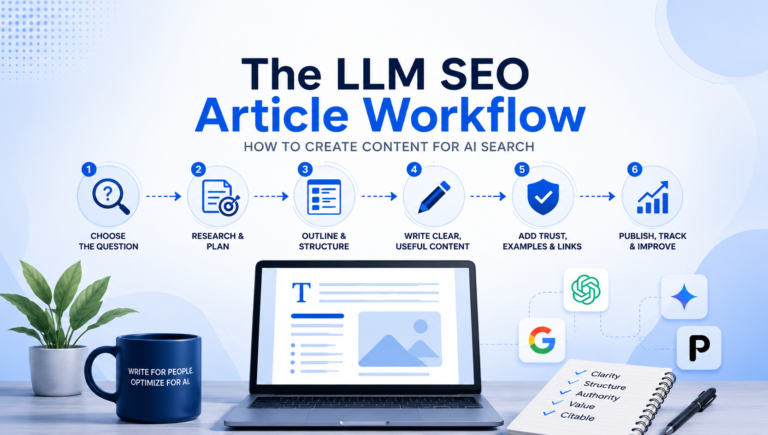
How to Optimize Your Website for LLM SEO
Step 1: Build Topic Clusters, Not Random Articles
Do not publish isolated blog posts with no clear strategy.
Instead, build content clusters around your main areas of expertise. Pick a subject and map out all the ideas that branch out from it.
For example, if your website wants to own the topic of LLM SEO, create a main pillar article called:
What Is LLM SEO?
Then support it with related articles:
How to Optimize for ChatGPT Search
How to Optimize for Perplexity
What Is AEO?
LLM SEO vs Traditional SEO
How to Structure Content for AI Answers
Each article should link to the others. This helps users navigate your site and helps search systems understand your topical authority. It might seem repetitive but remember you are trying to “negotiate” citations with an LLM that doesn’t get bored.
Step 2: Answer the Main Question Immediately
Every important article should begin with a clear answer.
If the title is “What Is LLM SEO?” the first section should answer that question directly. If your title is “Where can I buy my ticket to Machu Picchu?” Then the first section should read: “You can purchase your Machu Picchu tickets at the official https://www.machupicchu.gob.pe/ website.” See what I did there? I added a source and answered the question.
Do not start with a long history of search engines. Do not open with vague marketing language. Give the answer first, then explain.
This structure works well for both human readers and AI answer systems.
Step 3: Use Natural Language Questions
People use AI search differently from traditional search.
They often ask full questions like:
- How do I get my website mentioned by ChatGPT?
- What is the difference between SEO and LLM SEO?
- Can AI search replace Google?
- How do I optimize my content for Perplexity?
- How do I make my business show up in AI answers?
Your articles should include these natural questions as headings or FAQ items. Then answer them in short, direct sentences. The additional details and explanation should go below the main answer.
This helps your content match the way people actually search with AI tools.
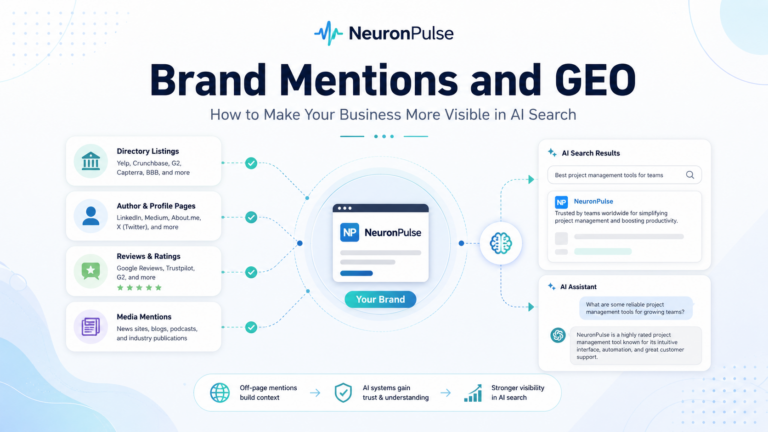
Step 4: Strengthen Your Brand Entity
Your brand should be clearly described across your website.
For example:
NeuronPulse is an AI search and LLM SEO resource that helps businesses understand how to improve visibility in ChatGPT, Perplexity, Gemini, Google AI Overviews, and other AI-powered discovery platforms.
Use consistent language on your homepage, about page, author bios, articles, and social profiles.
The goal is to make it easy for search engines and AI systems to understand who you are, what you do, and what topics you are connected to.
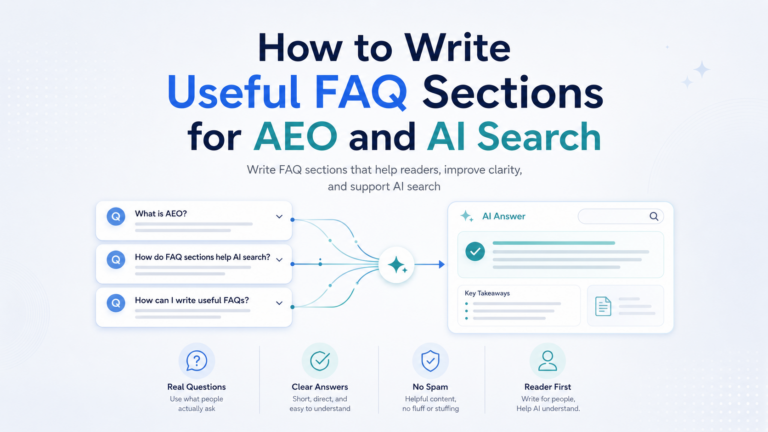
Step 5: Add FAQs to Important Articles
FAQ sections are useful for LLM SEO because they answer specific questions in a simple format.
For example:
Is LLM SEO the same as SEO?
No. LLM SEO is related to SEO, but it focuses specifically on helping content appear in AI-generated answers. Traditional SEO focuses more on ranking in search engine results.
Can LLM SEO help my website get cited by ChatGPT?
It can improve your chances, especially if your content is clear, authoritative, well-structured, and accessible to AI search systems. However, no strategy can guarantee citation in every AI platform.
Does keyword research still matter for LLM SEO?
Yes, but it is not enough by itself. LLM SEO also requires entity optimization, topical authority, structured answers, and trust signals.
Using FAQs is an easy win when it comes to getting mentioned by LLMs. Most articles need them anyway, just remember to structure them just as you would any other answer and paragraph.
Step 6: Make Your Content Easy to Verify
AI search tools often rely on sources that are easy to verify.
Add supporting details where appropriate. Link to reputable sources. Include dates when discussing current platforms or features. Avoid vague claims like “AI search is taking over everything” unless you can support the statement. Trust me, AI is not taking over everything but it is definitely here to make changes in all industries.
A better version would be:
AI search is expanding because major platforms are integrating AI-generated answers into the search experience. Google offers AI Overviews in Search, OpenAI has introduced ChatGPT Search, and Perplexity positions itself as an AI answer engine with cited sources.
That is stronger because it is specific and to the point.
LLM SEO, AEO, and GEO: What Is the Difference?
These terms are often used together, but they are slightly different.
LLM SEO
LLM SEO focuses on optimizing content so large language models can understand, cite, and recommend it.
AEO
AEO stands for Answer Engine Optimization. It focuses on getting your content used in direct answers, featured snippets, voice search, AI answers, and other answer-based search experiences.
GEO
GEO stands for Generative Engine Optimization. It focuses on optimizing content for generative AI engines that create synthesized responses from multiple sources.
In practice, these strategies overlap.
A strong AI search strategy usually includes all three:
SEO gets you found. AEO gets you answered. LLM SEO gets you understood by AI systems.
Is LLM SEO Replacing Traditional SEO?
No. LLM SEO is not replacing traditional SEO. It is expanding it.
Traditional SEO still matters because AI systems often depend on web content, search indexes, citations, and authority signals. If your website is poorly structured, not indexed, slow, thin, or unclear, it will be harder for both search engines and AI systems to use it.
The better way to think about it is this:
LLM SEO is the next layer of SEO.
You still need strong fundamentals:
- Technical SEO
- Helpful content
- Internal linking
- Clear site structure
- Fast loading pages
- Credible authorship
- Backlinks and mentions
- Schema where appropriate
- Good user experience
But now you also need to think about how AI systems interpret your content. Think of it as new users your content needs to attract.
Common LLM SEO Mistakes
Mistake 1: Writing Generic AI Content
Publishing generic AI-written articles is not a strategy. If your content says the same thing as every other article, there is no strong reason for an AI system or human reader to trust your page over another source.
Make sure to make your content original. Yes, ideas will overlap, and today it is difficult to create something that has not been mentioned before. That still does not mean you can’t put a personal spin on your content.
Mistake 2: Ignoring Brand Positioning
If your website does not clearly explain who you are and what you specialize in, AI systems may struggle to associate your brand with a topic.
Mistake 3: Chasing Keywords Without Building Authority
Keywords still matter, but they are only part of the picture. LLM SEO requires deeper topical coverage and stronger trust signals. Focus on creating a brand, not just an article.
Mistake 4: Hiding the Answer
Many websites bury the main answer under long introductions. AI search favors direct, useful responses.
We all remember (with vitriol) recipe websites and how they would add the story of the dish + origins of the person who came up with the recipe, and leave the actual recipe several paragraphs down. Don’t be a recipe website.
Mistake 5: Forgetting Human Readers
LLM SEO is not about writing for robots. The best content helps people first. Google’s guidance also emphasizes content created to benefit people rather than content created mainly for search engines.
It sounds like a contradiction, but you have to find a way to write/create for humans and AI systems alike.
A Simple LLM SEO Checklist
Use this checklist before publishing an article:
- Does the article answer the main question clearly near the top?
- Is the topic connected to your brand expertise?
- Are important entities mentioned naturally?
- Does the article include examples?
- Does it include an FAQ section?
- Is the content better than generic AI summaries?
- Are claims supported with credible sources?
- Is there internal linking to related articles?
- Is the author or brand clearly identified?
- Is the content easy to skim and extract?
- Does the article include original insight or a useful framework?
- Is the page updated when the topic changes?
If the answer is yes to most of these, your content is much better prepared for AI search.
Example: Traditional SEO Content vs LLM SEO Content
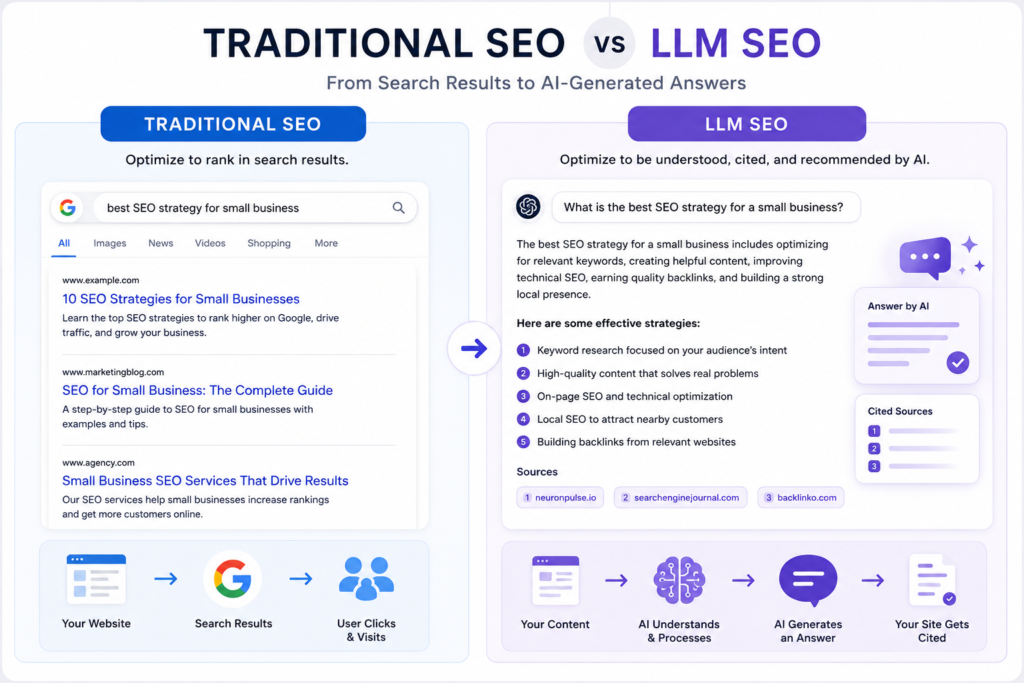
Traditional SEO-style paragraph
LLM SEO is important for businesses because AI is changing search. Companies should create high-quality content and use keywords to improve their visibility online.
This is not terrible, but it is generic.
LLM SEO-style paragraph
LLM SEO helps businesses increase the chances that AI systems like ChatGPT, Perplexity, Gemini, and Google AI Overviews can understand, cite, and recommend their content. Instead of only optimizing for rankings, businesses need to create clear, authoritative, well-structured answers that AI systems can extract and users can trust.
The second version is stronger because it is specific, clear, and answer-ready.
It can take some practice and time, but eventually, content creators understand this concept. You can try an exercise today where you come up with ten, 2 sentence long descriptions. Write them down, look at them for a while, and then try to change it to an LLM style of writing.
The Future of LLM SEO
LLM SEO will become more important as AI search becomes a normal part of how people find information.
Users will increasingly ask AI systems for:
- Product recommendations
- Service providers
- Expert explanations
- Local business suggestions
- Travel advice
- Medical information
- Legal information
- Marketing strategies
- Software comparisons
- Step-by-step tutorials
This does not mean websites disappear. It means websites need to become better sources.
The websites that win in AI search will likely be the ones that are clear, credible, specific, well-structured, and genuinely useful.
The websites that lose visibility will be the ones that publish generic content with no original insight, no clear expertise, and no reason to be trusted.
As I mentioned, it will be a winner-takes-all scenario.
Final Answer: What Is LLM SEO?
LLM SEO is the practice of optimizing your website so large language models and AI search systems can understand, trust, cite, and recommend your content.
It combines traditional SEO, answer engine optimization, entity optimization, content strategy, and trust-building. The goal is not only to rank in search results. The goal is to become a source that AI systems recognize as useful, reliable, and relevant.
In the AI search era, your website needs to do more than attract clicks. It needs to become part of the answer.
FAQ About LLM SEO
LLM SEO stands for Large Language Model Search Engine Optimization. It refers to the process of optimizing content so AI systems can understand, cite, and recommend it in generated answers.
They are closely related. AI SEO is a broad term for optimizing content for AI-powered search experiences. LLM SEO is more specific to large language models and how they interpret, summarize, and recommend information.
No. AEO, or Answer Engine Optimization, focuses on optimizing for direct answers. LLM SEO focuses specifically on how large language models understand and use your content. However, the two strategies overlap.
Yes, it can improve your chances. To appear in AI-generated answers, your content needs to be clear, credible, accessible, and relevant to the user’s question. However, no one can guarantee that a specific AI platform will cite or mention your website.
Yes. Traditional SEO still matters because AI systems often rely on web content, search results, citations, and authority signals. LLM SEO builds on top of traditional SEO rather than replacing it.
Yes. Traditional SEO still matters because AI systems often rely on web content, search results, citations, and authority signals. LLM SEO builds on top of traditional SEO rather than replacing it.
Start by creating clear, helpful content around your area of expertise. Define important topics, answer common questions, build topical authority, add trust signals, and structure your articles so both humans and AI systems can easily understand them.
The biggest mistake is publishing generic content. AI systems can already generate basic summaries. To stand out, your content needs original insight, real expertise, clear examples, and strong structure.