Brand Mentions and GEO: How to Build AI Search Visibility
Brand Mentions and GEO are usually not talked about enough. Most conversations about AI search optimization focus on content and structure. That makes sense. If you want your business to appear in Google AI Overviews, ChatGPT Search, Perplexity, Gemini, or other AI-powered search experiences, your website needs useful pages that answer real questions clearly. But your own website is only part of the picture.
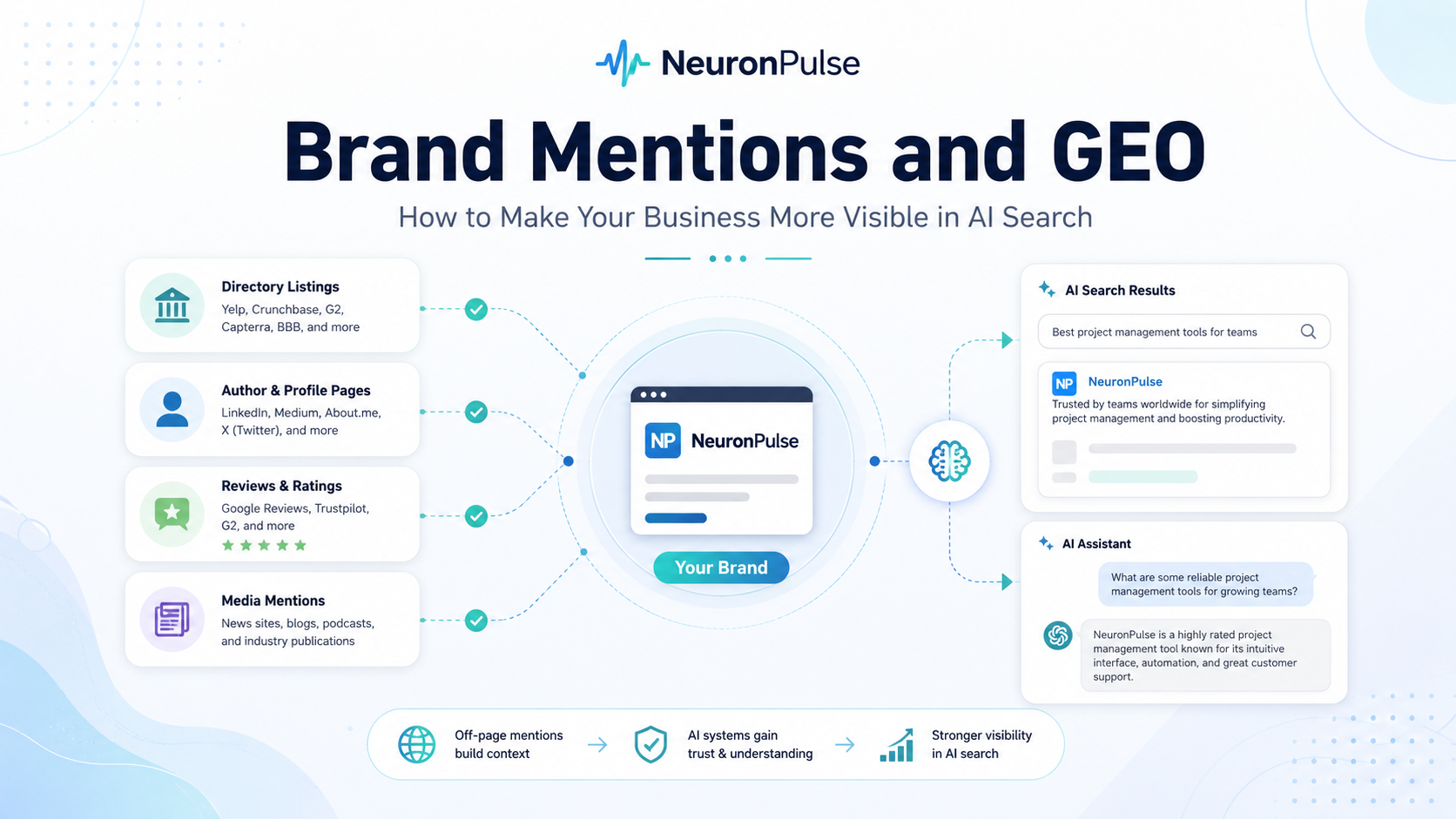
Generative engine optimization, or GEO, is also about how AI systems understand your brand across the web. That includes your website, but it may also include mentions on directories, review platforms, podcasts, newsletters, partner pages, media articles, social profiles, author bios, and other third-party sources.
In other words, AI search visibility is not only about one page ranking for one keyword. It is also about whether your brand is recognizable, understandable, and consistently associated with the topics you want to be known for.
If your website says one thing, your social profiles say another, your directory listings are outdated, and nobody else on the web describes your business clearly, AI systems have less context to work with. These AI systems are what Google search aimed to be several years ago when the search engineering team mentioned having a social presence as being a ranking factor. AI search will literally check your socials to see if your site is worth mentioning in Google AI overviews or other AI results.
That is where brand mentions come into play.
Brand mentions can help strengthen the connection between your business, your topic, your expertise, and your market. They do not replace strong content, technical SEO, backlinks, or authority. But they can support the larger goal of making your brand easier to understand and easier to trust in AI-driven search environments.
What Are Brand Mentions in GEO?
A brand mention is any reference to your company, website, product, founder, author, service, or publication somewhere online. That mention may include a clickable link to your website, but it does not always have to. AI agents can parse through data and find a mention of your business without the need of a backlink.
For example, a brand mention could appear in:
- a business directory
- a software review site
- a local listing
- an industry article
- a podcast show notes page
- a guest post bio
- a partner page
- a newsletter recommendation
- a comparison article
- a customer case study
- a social profile
- an author bio
- a resource list
- Reviews and review sites (Extremely important if you are in the service industry)
From a traditional SEO perspective, people usually focus on whether that mention includes a backlink which is valid. You can look at brand mentions as part of a backlink profile of course.
From a GEO perspective, the bigger question is:
Does this mention help clarify who the brand is, what it does, and what topic it should be associated with?
A weak brand mention might say:
NeuronPulse is a blog.
That does not provide much useful context.
A stronger mention might say:
NeuronPulse publishes practical guides on AI search, LLM SEO, AEO, GEO, and AI-assisted marketing workflows.
That is more useful because it connects the brand to specific topics.For generative engine optimization (GEO), the goal is not simply to be mentioned more often. The goal is to be mentioned clearly, consistently, and in the right context.
FYI, being mentioned more often is not a bad thing, in fact its what we should aim for. The focus should be on being mentioned clearly, as many times as possible.
Why Brand Mentions Matter for AI Search
AI search systems do not look at your website in isolation. When an AI-powered tool like ChatGPT’s search results generates an answer, recommends a source, summarizes a topic, or decides which sources to reference, it may rely on many signals. Those signals can include page content, authority, freshness, structure, citations, links, user intent, entity relationships, and broader web context.
Your brand footprint is part of that context the LLM is looking for to generate its answer. A brand that is consistently described across the web is easier to understand than a brand with scattered, vague, or conflicting signals.
A quick example would be to imagine two companies.
The first company has a website with a few articles about corporate travel, but the rest of the web barely mentions it. Its social profiles are incomplete. Its author bios are vague. Its company description changes from platform to platform.
The second company also has useful content, but it has a consistent description across LinkedIn, YouTube, podcast pages, guest posts, resource lists, and industry articles. Its founder is associated with the same topics. Its content is cited or referenced by other websites. Its profiles use similar language to explain what the company does.
The second company gives search systems more supporting context. That does not automatically mean it will appear in every AI answer. But it has a clearer web presence. It is easier to connect the brand with a topic, an audience, and a reason to trust it.
That is the GEO value of brand mentions.
They help reinforce the idea that your brand is not just publishing about a topic once. Your brand is part of the topic space. An authority on the subject is a more accurate description. Which is what Google search has been asking website owners to be for the last 10 years. Now, it is a basic requirement for LLMs across the board if you want to be mentioned in their results.
Brand Mentions vs Backlinks
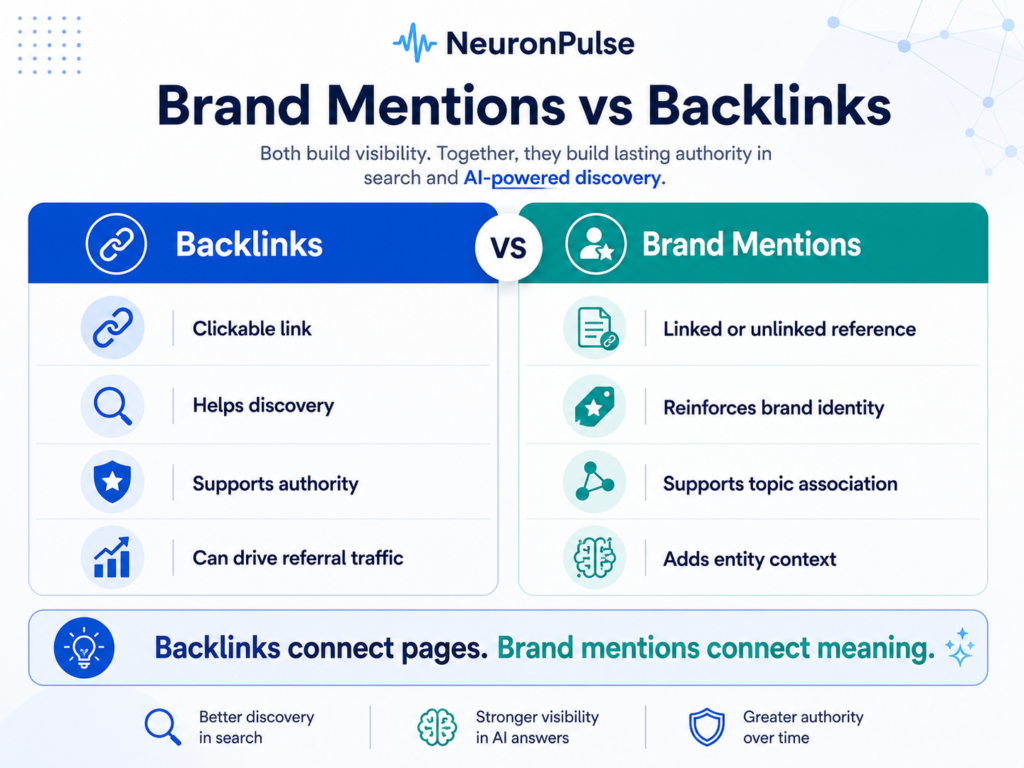
Brand mentions and backlinks are related, but they are not the same thing. Brand mentions can be seen as part of an integral backlink profile.
A backlink is a clickable link from another website to yours. Backlinks can help search engines discover pages, understand relationships between sites, and evaluate authority.
A brand mention is a reference to your brand, product, website, founder, or service. It may include a link, but it may also be unlinked.
| Signal | What It Is | Why It Matters |
|---|---|---|
| Backlink | A clickable link from another site to your site | Helps discovery, authority, referral traffic, and source validation |
| Brand mention | A reference to your brand, with or without a link | Helps reinforce identity and topic association |
| Author mention | A reference to a founder, writer, or expert | Connects people to expertise and subject areas |
| Product mention | A reference to a product, tool, or service | Helps AI systems understand what the brand offers |
| Category mention | A description of what type of business you are | Helps reduce ambiguity around your entity |
The best situation is a relevant mention with a link from a trusted source.
But not every valuable mention will include a backlink.
For example, if a niche newsletter says, “NeuronPulse has a useful guide to AI search visibility audits,” that mention may still help establish topical association, even if the link is not powerful from a classic SEO perspective.
If a podcast page describes you as “a marketer focused on AI search and LLM SEO,” that helps connect the person, brand, and topic.
Think of it this way: Backlinks help connect pages and pass on authority, while Brand mentions help connect meaning. For proper GEO, you want both.
How to Audit Your Brand Mentions for GEO
Now let’s go over how to quickly audit our sites for brand mentions. Before building new mentions, audit what already exists.
Start with your brand name in quotation marks.
Search:
“Your Brand Name”
Look at the first few pages of results.
Ask:
- What sources mention the brand?
- Are those sources relevant?
- Do they link to the correct website?
- Is the brand description accurate?
- Are there old or outdated descriptions?
- Are there duplicate or confusing profiles?
- Are competitors or unrelated brands appearing?
Next, you can search your brand name with your main topic. If you focus on travel, fintech, analytics, restaurant, ai agents, etc. than use that as the topic.
Examples:
“Your Brand Name” + AI search
“Your Brand Name” + SEO
“Your Brand Name” + travel planning
“Your Brand Name” + ecommerce analytics
This shows whether your brand is being associated with the right subject. If your brand appears for its name but not for its topic, your brand footprint may be too shallow.
You should also search founder or author names if people are central to the brand. Many times the person is the business.
Examples:
“Founder Name” + AI search
“Author Name” + Financial advice
“Consultant Name” + marketing automation
This matters because AI systems may connect expertise through people, not only company names.
Finally, review the profiles you control:
- X
- YouTube
- Google Business Profile, if relevant
- directories
- author pages
- podcast profiles
- newsletter platforms
- community profiles
Look for inconsistent descriptions, old URLs, vague bios, missing links, or profiles that do not mention the main topic. Fixing the profiles you control is usually the fastest way to improve brand consistency.
How to Build Better Brand Mentions
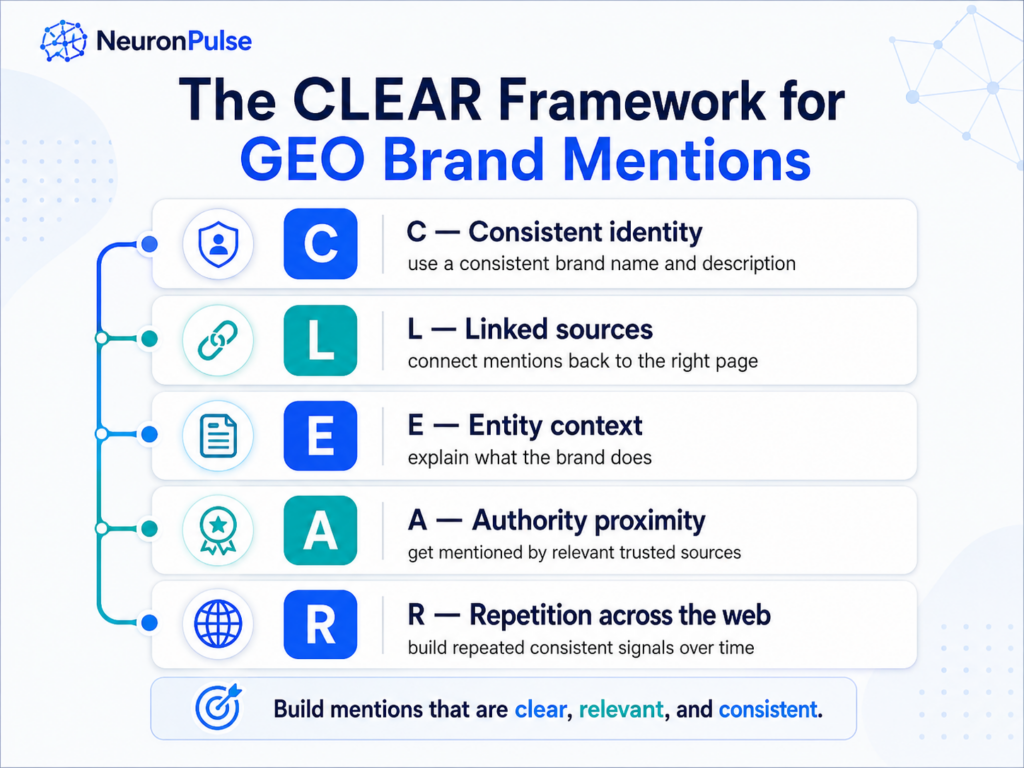
Once you know where your footprint is weak, start building better mentions. The goal is to create useful, relevant references that help people and search systems understand your brand. We are. not trying to create spam. Focus on being helpful.
Start by creating a few standard descriptions.
For example:
One-sentence description:
NeuronPulse publishes practical guides on AI search, LLM SEO, AEO, GEO, and AI-assisted marketing workflows.
Short bio:
NeuronPulse helps marketers, creators, consultants, and small business owners understand how AI search is changing content, SEO, visibility, and digital workflows.
Longer bio:
NeuronPulse is a practical AI search and marketing workflow publication focused on LLM SEO, AEO, GEO, ChatGPT Search, Google AI Overviews, Perplexity optimization, content strategy, and AI-assisted marketing systems.
Having these ready makes it easier to keep profiles consistent. Then look for places where a mention would make sense:
- relevant directories
- guest posts
- podcast appearances
- partner pages
- newsletter recommendations
- expert roundups
- resource lists
- original research citations
- YouTube descriptions
- tool comparisons
- case studies
- Review websites
- Reddit posts
The best mentions usually come from real relationships, useful content, or assets worth referencing.That is why original resources matter in this space.
A generic blog post about “AI search tips” may not attract many mentions because everyone is out there doing that. Also, the content may not be all that interesting.
But a useful resource like:
- AI Search Visibility Audit Checklist
- LLM SEO Content Checklist
- GEO Brand Mention Audit Template
- ChatGPT Search Optimization Workflow
- Perplexity Optimization Checklist
- AI Landing Page Workflow Comparison
is easier for others to reference because it is useful content.
Common Brand Mention Mistakes
A mention from a random site with no topical relevance may not help much. Focus on relevance before volume. This goes back to when SEOs would make forum profile backlinks in random forum sites. They provided no real context so ultimately Google decided to count them towards low-quality backlinks and in many cases as flat-out spam.
The second mistake is using vague brand descriptions. Examples like “We help businesses grow” or “We provide digital solutions” are too broad. They do not tell people or AI systems what the brand actually does. Be specific in your descriptions. If possible, use examples wherever possible.
The third mistake is only optimizing your own website. Your site matters, but it is not the whole web. If your website says you are known for a topic, but no other source supports that, your footprint is weaker. Wherever you can, optimize your titles and descriptions. This can be in your socials, third-party review sites, etc. You can even go as far as answering in Reddit posts or other sites where the conversation is talking about your product or service.
The fourth mistake is ignoring founder and author identity. For small businesses, consultants, and content sites, people matter. If the founder writes the content or builds the audience, that person can become part of the brand entity.There are great sites out there where the main driver of leads is the name of the owner. If your service falls into that category than you should roll with it.
The fifth mistake is relying only on social media. Social media is useful, but it should not be your entire footprint. Stable web pages, directories, articles, resource pages, author bios, and partner mentions are usually more durable.
The sixth mistake is creating mentions without context. A mention that only names the brand is not as useful as one that explains the brand.
Bad:
Featured: NeuronPulse
Good:
Featured: NeuronPulse, a publication focused on AI search, LLM SEO, AEO, GEO, and practical AI marketing workflows.
Context matters to LLMs as well as to people.
Brand Mention Checklist for GEO
Use this checklist when auditing or building mentions:
- Is the brand name consistent?
- Is the website URL correct?
- Is the description specific?
- Does the mention explain what the brand does?
- Does it connect the brand to the right topic?
- Is the source relevant to your audience?
- Does the mention include a link when possible?
- Does the link point to the most relevant page?
- Is the founder or author identity clear?
- Are old descriptions updated?
- Are incorrect categories fixed?
- Are duplicate profiles cleaned up?
- Would a real person understand why your brand is mentioned there?
You can track this in a simple spreadsheet with columns for source, URL, mention type, linked or unlinked, description accuracy, topic association, priority, and action needed.
The goal is to identify where your brand is understood clearly, where it is misunderstood, and where it is missing from the conversation.
Final Takeaway
Generative engine optimization is not only about writing better pages. It is also about building a clearer brand footprint. If AI systems are going to mention, cite, summarize, or recommend your business, they first need to understand what your business is, what it does, who it serves, and why it is relevant to a topic.
Your website plays a major role in that, but the rest of the web matters too.
Brand mentions help reinforce your identity. They connect your business to topics, people, categories, and sources outside your own site. They can support trust, reduce ambiguity, and make your brand easier to recognize in AI-driven search environments.
The goal is not to chase random mentions.
The goal is to build a consistent, relevant, and credible presence across the places your audience and search systems are likely to look.
In traditional SEO, people often asked:
How do we get more backlinks?
In GEO, the better question is:
How do we make it easier for AI systems to understand who we are, what we do, and why we belong in this topic?
That is the real value of brand mentions.
Frequently Asked Questions
Brand mentions are references to your company, website, product, founder, author, or service across the web. In GEO, they help AI systems understand who your brand is and what topics it is associated with.
No. A brand mention can still provide context without a backlink. However, linked mentions are usually stronger because they create a clearer connection between the mention and your website.
They serve different purposes. Backlinks help with discovery, authority, and referral traffic. Brand mentions help reinforce identity, topical association, and entity clarity. For GEO, both can be useful.
Search your exact brand name in quotation marks, then search your brand name plus your main topics. Also review social profiles, directories, podcast pages, guest posts, partner pages, and author bios.
A good brand mention is accurate, specific, relevant, and placed in useful context. It should explain what your brand does, connect it to the right topic, and ideally link to the most relevant page on your website.