How Do You Optimize for ChatGPT Search?
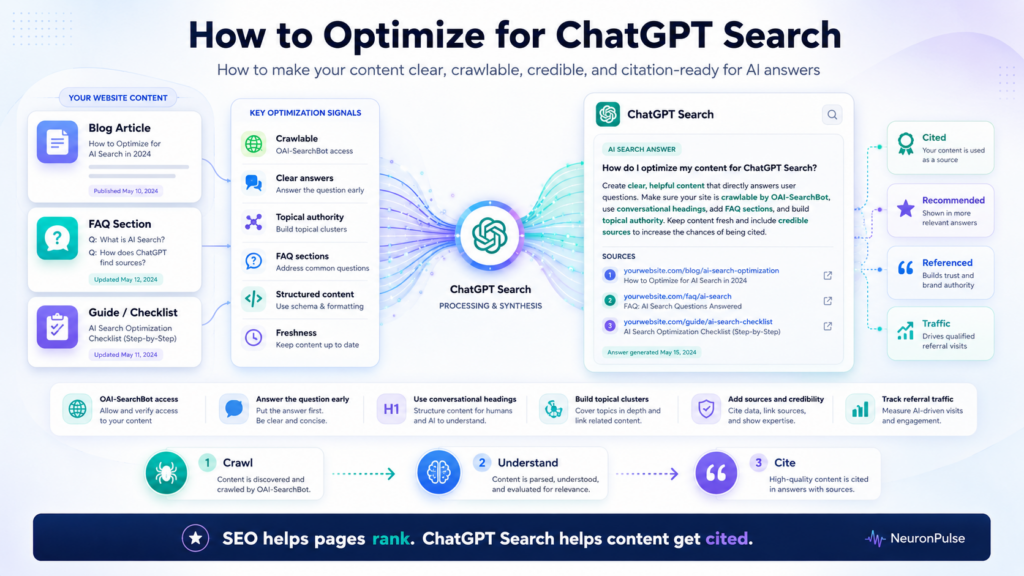
To optimize for ChatGPT Search, create clear, authoritative, well-structured content that ChatGPT can discover, understand, summarize, and cite when answering user questions.
That means your website should be:
- crawlable
- technically accessible
- structured around direct answers
- credible and source-worthy
- connected to clear topics and entities
- useful enough to be cited or recommended
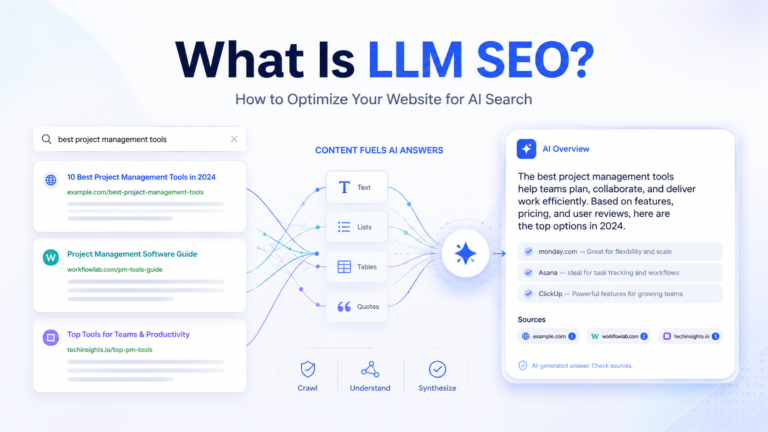
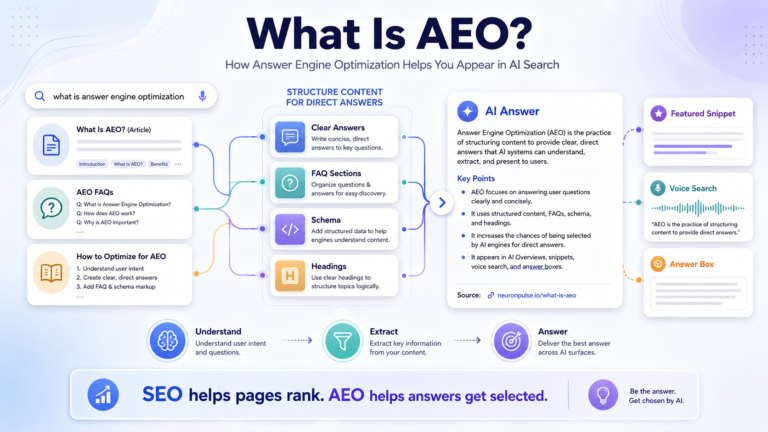
Traditional SEO focuses on ranking pages in search results. ChatGPT Search optimization, however, focuses on increasing the chances that your content appears inside AI-generated answers with source links.
OpenAI describes ChatGPT Search as a way to get fast, timely answers with links to relevant web sources, and ChatGPT responses can include links to sources such as news articles and blog posts, among others.
In simple terms:
Google SEO helps your page rank. ChatGPT Search optimization helps your content become part of the answer.
Both of those things can happen simultaneously with an integral optimization campaign. The issue pops up when someone asks why their page is number 1 or 2 in Google search, but won’t appear in ChatGPT search results. So your content is there, it ranks but maybe an LLM doesn’t necessarily like the way it is structured.
Why ChatGPT Search Matters
ChatGPT Search matters because people are changing how they look for information. Users are moving towards asking more specific questions.
Instead of searching with short keywords like:
best CRM software
Users now ask more specific questions like:
What is the best CRM for a small consulting business that needs simple automation and email follow-up?
Instead of searching:
LLM SEO guide
They ask:
How do I optimize my website so ChatGPT can understand and cite my content?
This changes the content game.
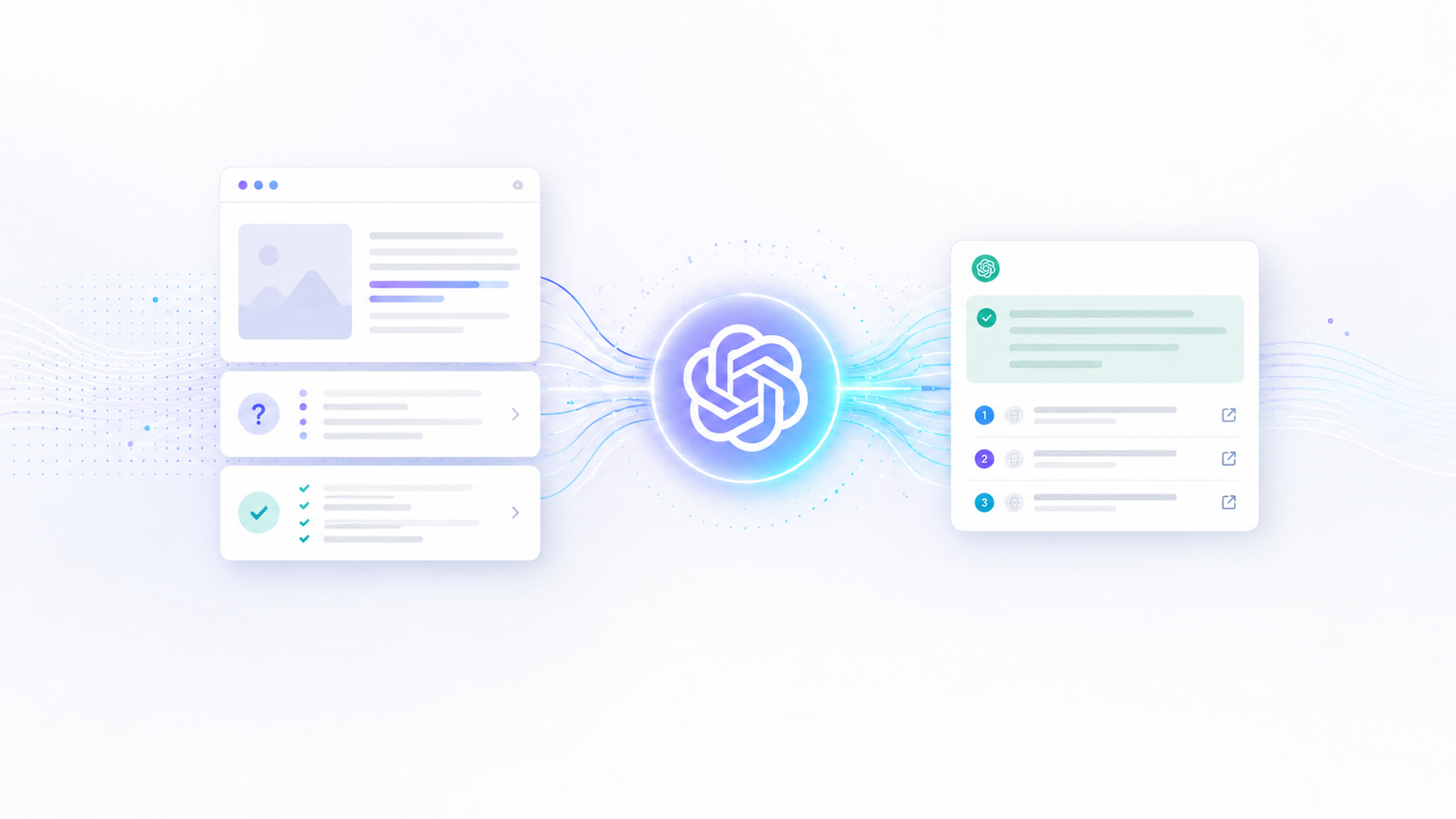
ChatGPT Search does not only return a list of blue links. It can generate a direct response, summarize information, and include source links so users can explore further.
For brands, this creates a new visibility goal:
Can ChatGPT understand your content well enough to use it as a source?
Most small businesses can take advantage of ChatGPT search when they couldn’t compete with a large competitor’s SEO budget. Yes, big brands will always have an edge, but ChatGPT search is new enough so that most people can utilize it in their favor.
ChatGPT Search vs Traditional Google Search
ChatGPT Search and Google Search are not the same experience.
| Traditional Google Search | ChatGPT Search |
|---|---|
| Shows a list of ranked results | Generates a conversational answer |
| Users scan links and choose pages | Users read a synthesized answer first |
| Ranking position is the main goal | Citation, mention, and recommendation become major goals |
| Keywords and backlinks are important | Clarity, authority, structure, and retrievability become critical |
| Users often compare multiple tabs | Users may ask follow-up questions in the same conversation |
This does not mean Google SEO is dead. It means SEO is expanding. Traditional SEO where you only depend on search results on Google or other search engines is not coming back. At least not for a long time. It is still important and will be part of the equation to have a well positioned brand.
A website that wants visibility in AI search needs both:
Traditional SEO to get crawled, indexed, and trusted.
LLM SEO/AEO to become clear, extractable, and useful inside AI-generated answers.
How ChatGPT Search Uses Web Content
ChatGPT Search can access current information from the web and provide answers with links to sources. OpenAI’s API documentation for web search also describes web search as allowing models to access up-to-date information from the internet and provide answers with sourced citations.
For publishers and website owners, one important crawler is OAI-SearchBot.
OpenAI says OAI-SearchBot is used to surface websites in search results in ChatGPT’s search features. OpenAI also says that sites opted out of OAI-SearchBot will not be shown in ChatGPT search answers, though they may still appear as navigational links.
That makes crawl access a basic requirement. For site owners who opted out, I can’t really see the use in that. You’re basically trying to compete in search with one arm tied behind your back.
If ChatGPT Search cannot access your content, your chances of appearing in ChatGPT Search answers are reduced. Not 100% but the loss of potential traffic can be significant if your site is big enough.
How to Optimize for ChatGPT Search: 12 Practical Steps
1. Allow OAI-SearchBot to Access Your Site
The first step is technical: make sure OpenAI’s search crawler can access your important pages.
OpenAI recommends allowing OAI-SearchBot in your site’s robots.txt file if you want your site to appear in ChatGPT Search results.
A simple allow rule may look like this:
User-agent: OAI-SearchBot
Allow: /
This does not guarantee that ChatGPT will cite your site. But blocking OAI-SearchBot can reduce your ability to appear in ChatGPT Search answers.
Also review your broader technical setup:
- Are important pages indexable?
- Are pages blocked by robots.txt?
- Is important content hidden behind login walls?
- Is the site fast enough?
- Can crawlers access the main content?
- Are canonicals set correctly?
- Are your sitemap and internal links clean?
Technical accessibility is the foundation.
2. Answer the Main Question Early
ChatGPT Search works well with direct, answer-ready content.
If your article is titled:
What Is LLM SEO?
The first paragraph should clearly answer that question. Again, we don’t want fluff. All of that can go after you’ve answered the question.
Weak opening:
In today’s fast-changing digital ecosystem, businesses are exploring new opportunities created by artificial intelligence and search innovation.
Better opening:
LLM SEO is the process of optimizing your website so large language models can understand, trust, cite, and recommend your content in AI-generated answers.
The second version is stronger because it gives ChatGPT a clear, concise answer to extract. Yes, it sounds somewhat robotic and maybe even a bit boring, but it does answer the question directly.
For every major page, ask:
What exact question does this page answer?
Then answer that question in the first few lines. Creative writers making content that depends on ChatGPT search results will need to adjust accordingly. Marketers who like to use flashy words to describe products and services will also need to pivot.
3. Write for Conversational Search Queries
People use ChatGPT differently from traditional search engines.
They ask full questions, describe context, and request recommendations.
Examples:
- How do I optimize my website for ChatGPT Search?
- What is the difference between AEO and LLM SEO?
- Which AI SEO tools are best for small businesses?
- How can a travel agency appear in AI search results?
- What should I include in an article so AI tools can cite it?
Your content should include natural-language questions as headings, FAQs, and subtopics.
Instead of only targeting keywords like:
ChatGPT SEO
Also answer questions like:
How do I get my website cited by ChatGPT?
Can ChatGPT Search send traffic to my website?
What is OAI-SearchBot?
Does schema help with ChatGPT Search?
This makes your content easier to match to real user prompts. Does it look familiar? It’s almost like we’re targeting long-tailed keywords in the form of questions.
4. Build Topical Authority Around a Cluster
One article is rarely enough.
If you want ChatGPT and other AI systems to associate your site with a topic, build a full content cluster. This means putting together a list of articles that all revolve around a topic.
For NeuronPulse, a strong ChatGPT Search cluster would include:
- What Is LLM SEO?
- What Is AEO?
- How to Optimize for ChatGPT Search
- How to Optimize for Google AI Overviews
- How to Optimize for Perplexity
- AEO vs SEO
- AEO vs LLM SEO
- How AI Search Changes Content Strategy
- The LLM SEO Checklist
- Prompt Engineering for SEO
This helps establish that NeuronPulse is not casually mentioning AI search. It is building a complete resource library around it.
Topical authority matters because AI systems need confidence that a source is relevant and useful for a subject area.
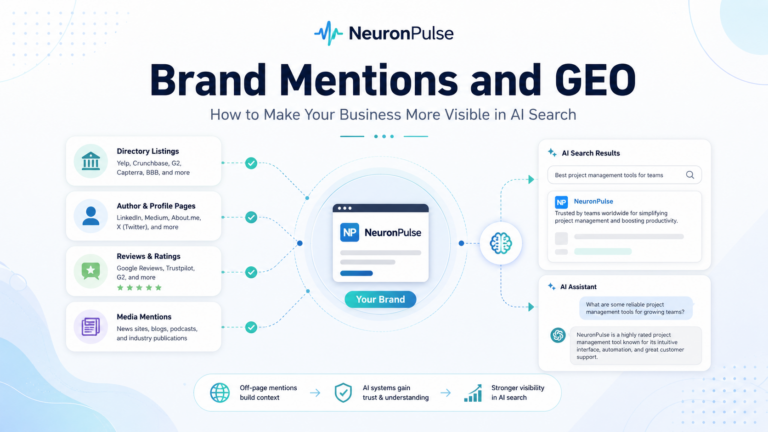
5. Make Your Brand Entity Clear
ChatGPT Search optimization is not only about individual pages. It is also about brand understanding.
Your site should make it obvious:
- who you are
- what your brand does
- what topics you cover
- who your content helps
- why your content is trustworthy
For NeuronPulse, the brand description could be:
NeuronPulse helps marketers, founders, and businesses understand AI search, LLM SEO, AEO, prompting, and AI content strategy.
Use consistent language across:
- homepage
- About page
- author bio
- article intros
- social profiles
- newsletter page
- schema/Organization markup
The goal is to make your brand easy to understand as an entity.
6. Use Clear Article Structure
ChatGPT Search is more likely to work well with content that is easy to parse. The structure follows how SEOs have generally been putting together their content for years. So nothing new here.
A good structure includes:
- clear H1 title
- direct answer near the top
- descriptive H2 and H3 headings
- short paragraphs
- bullet points where useful
- comparison tables
- FAQ sections
- examples
- summary sections
- internal links
- cited sources
For this article, the structure is:
- What ChatGPT Search optimization means
- Why it matters
- How ChatGPT Search uses content
- Practical optimization steps
- Checklist
- FAQ
That is easier to understand than one long essay.
7. Add FAQ Sections
FAQs are valuable because ChatGPT users ask questions conversationally.
A strong FAQ section helps your page match many related prompts.
For this article, useful FAQs include:
- What is ChatGPT Search optimization?
- How do I get my website to appear in ChatGPT Search?
- What is OAI-SearchBot?
- Does ChatGPT Search use citations?
- Does schema help with ChatGPT Search?
- Can ChatGPT Search send traffic?
- Is ChatGPT SEO the same as traditional SEO?
- How do I track traffic from ChatGPT?
OpenAI says publishers that allow OAI-SearchBot can track referral traffic from ChatGPT in analytics platforms such as Google Analytics, and ChatGPT automatically includes utm_source=chatgpt.com in referral URLs. Everyone can check on this now, by going into Google Analytics and checking the referrals section.
That FAQ is useful because it addresses a real business concern: measurement.
8. Support Claims With Credible Sources
ChatGPT Search cites sources to support answers. Your own content should do the same.
For AI search topics, use sources like:
- OpenAI documentation
- Google Search Central
- official product documentation
- academic studies
- reputable industry research
- first-party data
- original experiments
Avoid making unsupported claims like:
ChatGPT always prefers pages with schema.
A better version:
Schema can help search engines understand certain page types, but it does not guarantee that ChatGPT will cite your content.
Credibility matters because AI systems and human readers both need trust signals.
9. Create Original Examples and Frameworks
Generic content is easy to ignore. This is where creative writers and marketers in this space can finally shine. Write in your own style, create images, and add original thoughts to each section.
If you want your article to stand out, add original thinking.
Examples:
- a ChatGPT Search optimization checklist
- before/after content examples
- sample
robots.txtrules - a topical map example
- a brand entity checklist
- a content structure template
- your own named framework
For NeuronPulse, we can use a simple framework:
The CITE Framework for ChatGPT Search
C — Crawlable: Make sure ChatGPT Search can access your content.
I — Informative: Answer the question clearly and completely.
T — Trustworthy: Add sources, authorship, examples, and credibility signals.
E — Extractable: Structure content so AI systems can easily summarize and cite it.
This gives the article a memorable original asset.
10. Optimize for Citations, Not Just Rankings
In traditional SEO, the goal is often to rank and get the click. While this is still important, there are new ways to be found now.
In ChatGPT Search, the goal may be:
- get cited as a source
- get mentioned as a brand
- get summarized in an AI answer
- get recommended in a comparison
- earn referral traffic from source links
So your content should be source-worthy.
Ask:
- Would this page help answer a specific question?
- Is the answer clear enough to quote or summarize?
- Is the page trustworthy?
- Does it include original value?
- Does it link to related resources?
- Is the information current?
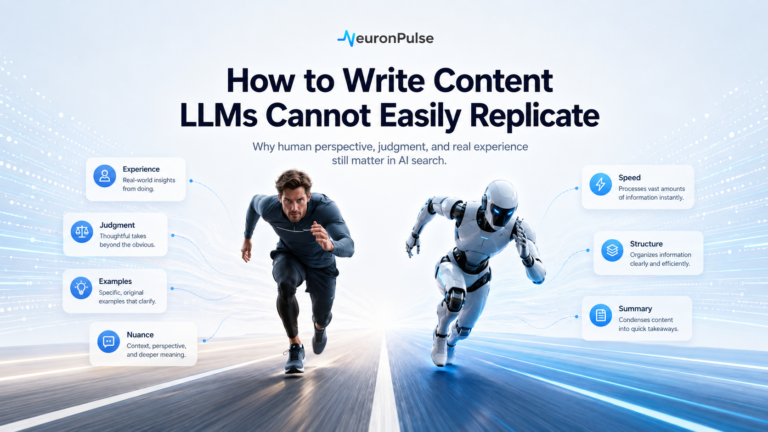
A page that only repeats generic information is less likely to be useful as a source. So basically, just pulling out an article made by AI won’t be able to compete with an article that has original thought put into it. Why would an LLM cite your content if it is what the LLM created in the first palce?
11. Keep Important Pages Updated
ChatGPT Search is especially useful for timely information. That means outdated content can become a liability.
For pages about AI search, update regularly because features, crawlers, search behavior, and platform policies change. So, just like we should be doing for Google search, the same goes for ChatGPT results. You need to go into your content and add, edit items to keep it fresh and up to date. Sometimes, just republishing is enough or making sure it states it was updated on a recent date.
Add:
- visible publish date
- visible updated date
- recent sources
- current platform names
- revised screenshots when needed
- updated FAQs
For example, if OpenAI changes how publishers appear in ChatGPT Search, an article about ChatGPT Search optimization should be reviewed.
Freshness is not the only factor, but for fast-changing AI topics, it matters.
12. Track ChatGPT Referral Traffic
If ChatGPT sends users to your site, you should measure it.
OpenAI says ChatGPT automatically includes utm_source=chatgpt.com in referral URLs, which allows publishers to track inbound traffic from ChatGPT search results in tools like Google Analytics.
In Google Analytics, monitor:
- referral traffic from ChatGPT
- landing pages receiving ChatGPT visits
- conversions from ChatGPT traffic
- engagement from ChatGPT visitors
- which articles receive AI search traffic
You can also manually test prompts related to your brand and topics to see whether ChatGPT mentions or cites your pages.
Example prompts for this site would be:
- What is LLM SEO?
- Best resources to learn AEO
- How do I optimize for ChatGPT Search?
- What is NeuronPulse?
- Best AI search optimization blogs
You can make a list now and go to ChatGPT and test your content. Track the results over time.
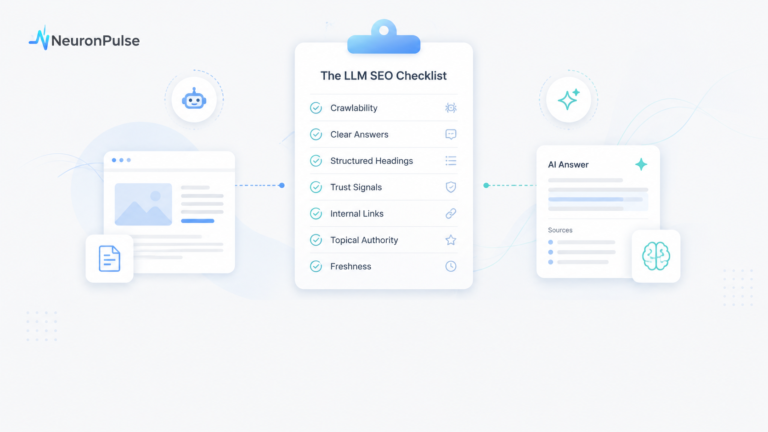
ChatGPT Search Optimization Checklist
Use this checklist before publishing an important page:
- Is the page accessible to OAI-SearchBot?
- Is the page indexable and crawlable?
- Does the article answer the main question in the first few lines?
- Does it use clear headings?
- Does it include conversational questions?
- Does it include an FAQ section?
- Does it build topical authority?
- Does it explain important entities clearly?
- Does it cite credible sources?
- Does it include original examples or frameworks?
- Does it avoid vague claims?
- Does it include internal links to related articles?
- Does it have a clear author or brand identity?
- Is the content updated regularly?
- Can referral traffic from ChatGPT be tracked?
Common Mistakes When Optimizing for ChatGPT Search
Mistake 1: Blocking OAI-SearchBot
If your site blocks OAI-SearchBot, your content may not appear in ChatGPT Search answers. OpenAI states that sites opted out of OAI-SearchBot will not be shown in ChatGPT search answers, though they can still appear as navigational links.
Mistake 2: Writing Vague Content
AI systems need clear answers. Long introductions and generic explanations make your content harder to extract.
Mistake 3: Ignoring Brand Positioning
If your website does not clearly explain what your brand is about, AI systems may struggle to associate your brand with the right topics.
Mistake 4: Publishing Thin AI-Generated Articles
ChatGPT does not need another generic summary. Your content should include examples, frameworks, firsthand experience, or practical steps.
Mistake 5: Focusing Only on Keywords
Keywords still matter, but ChatGPT Search optimization is also about questions, entities, trust, structure, and usefulness.
Is ChatGPT Search Optimization the Same as LLM SEO?
ChatGPT Search optimization is one part of LLM SEO.
LLM SEO is the broader practice of optimizing your website so large language models can understand, trust, cite, and recommend your content.
ChatGPT Search optimization focuses specifically on improving your visibility in ChatGPT’s search experience. LLM SEO can apply to other large language models like Gemini, Perplexity, etc.
The same principles often apply across AI search platforms:
- clarity
- authority
- topical coverage
- structured answers
- technical accessibility
- citations
- entity consistency
But each platform may have its own crawler behavior, interface, and source selection process.
Final Answer: How Do You Optimize for ChatGPT Search?
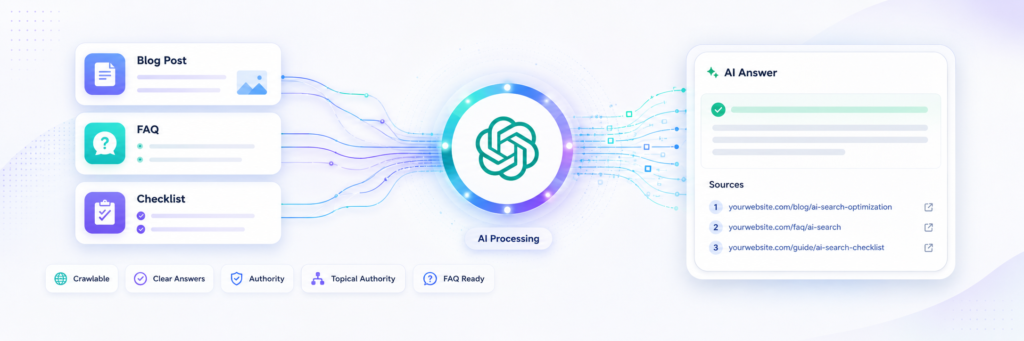
To optimize for ChatGPT Search, make your website crawlable, clear, authoritative, and answer-ready.
Start by allowing OAI-SearchBot to access your content. Then create pages that answer specific questions directly, use clear structure, build topical authority, cite credible sources, strengthen your brand entity, and track referral traffic from ChatGPT.
Remember that the goal is not only to rank.
The goal is to become a source that ChatGPT can understand, trust, and use when answering relevant questions. You want to be cited, and to be cited, you need to be an authority in your area of expertise.
FAQ About ChatGPT Search Optimization
ChatGPT Search optimization is the process of improving your website so ChatGPT can discover, understand, summarize, cite, or recommend your content in AI-generated answers.
Start by making sure your important pages are accessible to OAI-SearchBot. Then publish clear, useful, well-structured content that directly answers relevant user questions and includes strong credibility signals.
OAI-SearchBot is OpenAI’s crawler used to surface websites in ChatGPT’s search features. OpenAI says sites opted out of OAI-SearchBot will not be shown in ChatGPT search answers.
Yes, if you want your site to have the opportunity to appear in ChatGPT Search answers. OpenAI recommends allowing OAI-SearchBot in robots.txt and allowing requests from OpenAI’s published IP ranges.
Yes. OpenAI says ChatGPT responses can include links to sources, and users can click the Sources button to open references.
Yes. OpenAI says ChatGPT referral traffic can be tracked in analytics platforms, and ChatGPT includes utm_source=chatgpt.com in referral URLs.
Schema may help search engines understand your content, but it does not guarantee ChatGPT citations. Use structured data accurately, especially for articles, FAQs, products, organizations, breadcrumbs, reviews, and local businesses.
Yes, but they overlap. Google SEO focuses heavily on search rankings. ChatGPT Search optimization focuses on making your content clear, useful, accessible, and trustworthy enough to appear in AI-generated answers with citations.
No. No one can guarantee ChatGPT citations. The best strategy is to make your content crawlable, useful, clear, current, and source-worthy.