What Is AEO? Answer Engine Optimization Explained
What Is AEO?
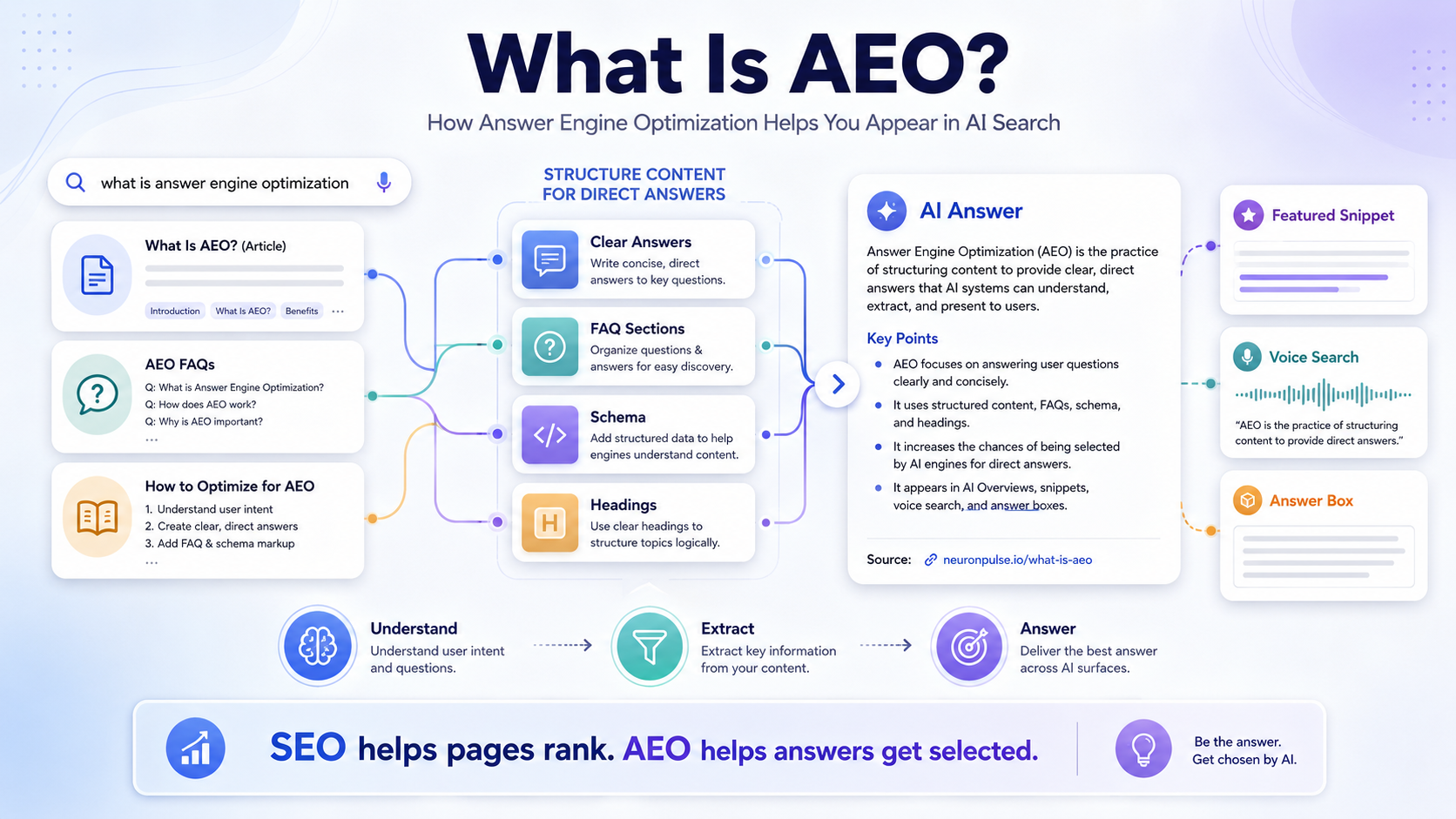
AEO stands for Answer Engine Optimization. It is the process of optimizing your content so search engines, AI tools, and answer systems can use it to provide direct answers to user questions.
Traditional SEO focuses on helping web pages rank in search results. AEO focuses on helping your content become the answer. They aren’t necessarily mutually exclusive, but it helps to know what you should be optimizing your content for. Writers who like to fluff up their content aren’t going to like this but for now, AEO is a standard for ranking sections of content in LLM results.
In simple terms:
SEO helps your page get found. AEO helps your answer get selected.
This matters because search is becoming more conversational and answer-driven. Users are no longer only typing short keywords into Google and scrolling through links. They are asking full questions in Google, ChatGPT, Perplexity, Gemini, voice assistants, and other AI-powered discovery tools.
Gone are the days when a user goes to Google and “googles” a query, selects one of the first 5 search results, and finally clicks on a page.
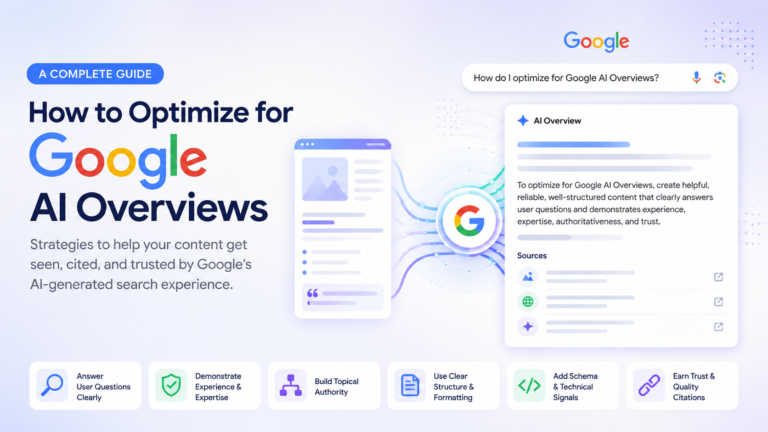
Google’s AI Overviews provide AI-generated snapshots with key information and links to explore more on the web, while ChatGPT Search can provide timely answers with links to relevant web sources.
That means your content strategy needs to answer a new question:
Is your content structured clearly enough to become the answer?
Why AEO Matters
AEO matters because people want answers faster.
Instead of searching:
LLM SEO meaning
A user might ask:
What is LLM SEO and how is it different from traditional SEO?
Instead of searching:
best CRM for small business
A user might ask:
What is the best CRM for a small service business with a small sales team?
Instead of searching:
answer engine optimization tips
A user might ask:
How do I optimize my website so AI tools and Google answer boxes can use my content?
These are not just keywords. They are questions. Knowing how your users will formulate their questions is a skill all on its own.
Answer engines are designed to respond to questions directly. They may use featured snippets, AI-generated summaries, citations, knowledge panels, People Also Ask results, voice responses, or conversational answers.
Google says featured snippets come from websites it finds and are selected based on how well they answer a user’s question and how helpful they are.
That is the heart of AEO: create content that directly answers the questions your audience is asking.
AEO vs SEO: What Is the Difference?
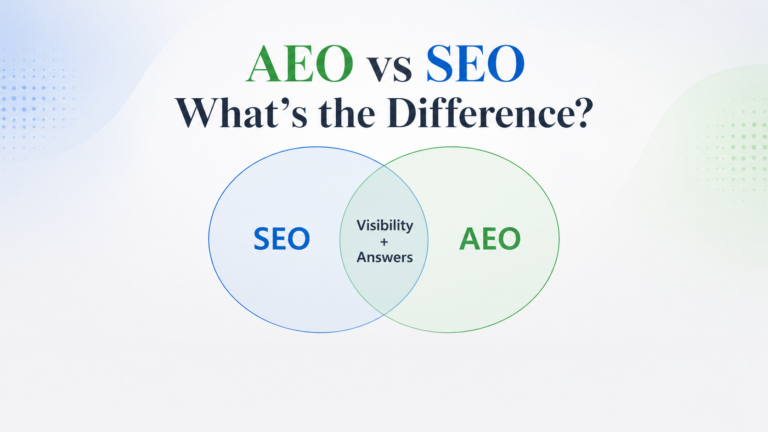
AEO and SEO are connected, but they are not the same.
| SEO | AEO |
|---|---|
| Optimizes pages for search rankings | Optimizes answers for direct response systems |
| Focuses on keywords, rankings, backlinks, and traffic | Focuses on questions, clarity, structure, and answer quality |
| Goal is to rank and earn the click | Goal is to be selected, cited, or spoken as the answer |
| Works well for traditional search results | Works for featured snippets, AI Overviews, voice search, and AI answers |
| Asks: “Can this page rank?” | Asks: “Can this content answer the question?” |
Traditional SEO is still important. AEO does not replace SEO. It builds on top of it.
A page still needs to be crawlable, useful, credible, well-structured, and relevant. But AEO adds another layer: your content must be easy for answer systems to extract, summarize, and trust.
AEO vs LLM SEO: How Are They Different?
AEO and LLM SEO overlap, but they focus on slightly different things.
AEO, or Answer Engine Optimization, is about creating content that can be used in direct answers.
LLM SEO, or Large Language Model SEO, is about optimizing your content so large language models can understand, cite, and recommend your brand in AI-generated responses.
Here is the simplest way to explain it:
AEO helps answers get selected. LLM SEO helps AI systems understand and cite your brand.
For example, an AEO strategy might focus on writing a clear answer to:
What is answer engine optimization?
An LLM SEO strategy would go further by helping AI systems understand that NeuronPulse is connected to AEO, LLM SEO, AI search optimization, prompting, and AI visibility.
So AEO is about answer selection. LLM SEO is about AI understanding, brand association, and citation potential.
They work best together, and if everything is done correctly, you won’t always need to differentiate them.
How Answer Engines Choose Content
Answer engines look for content that is useful, clear, relevant, and trustworthy.
The exact process depends on the platform, but strong answer-ready content usually has several qualities:
1. It answers the question directly
If your article is titled “What Is AEO?”, the answer should appear immediately.
Do not hide the definition under a long introduction. Give the answer first, then explain the details.
Example:
AEO is the process of optimizing your content so search engines, AI tools, and answer systems can use it to provide direct answers to user questions.
That sentence is easy for a human to understand and easy for an answer engine to extract.
2. It uses question-based headings
AEO works best when your content reflects how people actually ask questions.
Use headings like:
- What is AEO?
- How does AEO work?
- Why does AEO matter?
- Is AEO different from SEO?
- How do I optimize for answer engines?
- Can AEO help my content appear in AI search?
These headings make your article easier to scan and easier to match to specific user questions.
3. It provides concise answers before deeper explanation
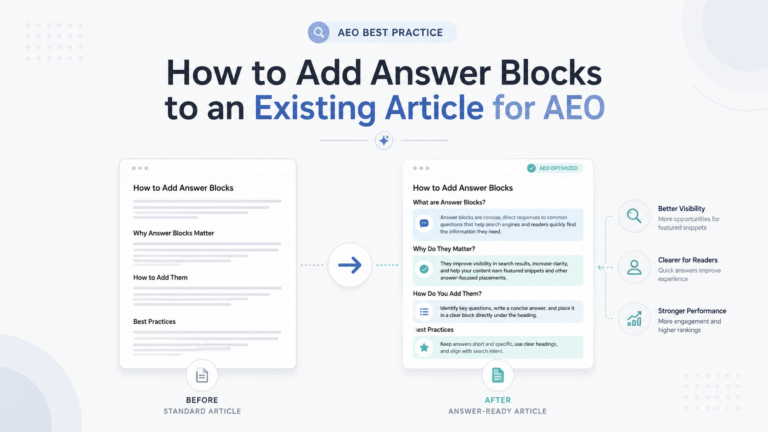
A good AEO page should use a layered structure:
First: give the short answer.
Then: explain the concept.
Then: provide examples, steps, and context.
This helps both quick readers and deeper researchers.
4. It has strong credibility signals
Answer engines are more likely to rely on content that looks reliable.
Credibility signals include:
- clear author or brand information
- accurate definitions
- supporting sources
- original examples
- internal links to related articles
- external citations to trustworthy references
- updated content
- clear formatting
- practical experience
Google’s AI features documentation says AI Overviews provide a jumping-off point to explore links and learn more, which reinforces the importance of being a useful, trustworthy source that can support deeper exploration.
5. It is technically accessible
Your content should be easy for search engines and AI systems to access.
That means:
- pages are indexable
- important content is not hidden behind scripts
- headings are clear
- internal links work
- the page loads quickly
- schema is used where appropriate
- images have descriptive alt text
- the article has a logical structure
Structured data can help search engines understand eligible content types and page information. Google’s structured data documentation explains that most Search structured data uses schema.org vocabulary and that Google Search Central documentation should be used as the source of truth for Google Search behavior.
How to Optimize for AEO
Here is a practical AEO process you can use for any article.
Step 1: Identify the Main Question
Every AEO page should start with a clear question.
For this article, the main question is:
What is AEO?
For a business article, the main question might be:
What is the best CRM for a small business?
For a service page, the main question might be:
How much does local SEO cost?
For a product comparison, the main question might be:
Which email marketing platform is better for ecommerce?
Before writing, identify the exact question your page should answer.
Step 2: Answer the Question in the First Few Lines
Once you know the main question, answer it immediately.
Weak opening:
In today’s rapidly evolving digital landscape, marketers are constantly searching for new ways to connect with audiences across multiple platforms.
Better opening:
AEO is the process of optimizing your content so search engines, AI tools, and answer systems can use it to provide direct answers to user questions.
The second version is stronger because it gives the answer right away.
Step 3: Use Clear, Descriptive Headings
Headings should not be vague.
Avoid:
- Introduction
- Background
- More Information
- Final Thoughts
Use:
- What Is AEO?
- Why AEO Matters
- AEO vs SEO
- How to Optimize for AEO
- AEO Checklist
- FAQ About AEO
Clear headings make your article easier for users and answer engines to understand.
Step 4: Structure Content Around User Intent
AEO is not just about definitions. It is about matching the reason behind the question.
For example, someone searching “what is AEO” may want:
- a definition
- a simple explanation
- examples
- how it differs from SEO
- whether it matters for AI search
- how to get started
Your article should answer all of those related questions.
That is how you build a complete answer resource instead of a thin definition page.
Step 5: Add FAQ Sections
FAQ sections are useful for AEO because they match conversational search behavior.
Good FAQ questions for this article include:
- What does AEO stand for?
- Is AEO the same as SEO?
- Is AEO the same as LLM SEO?
- Does AEO help with Google AI Overviews?
- Does AEO help with ChatGPT?
- How do I optimize content for answer engines?
- Is AEO only for blogs?
- Is AEO replacing SEO?
Each answer should be short, clear, and useful.
Step 6: Use Comparison Tables
Comparison tables help answer engines and readers understand relationships quickly.
For example:
| Term | Meaning | Main Goal |
|---|---|---|
| SEO | Search Engine Optimization | Rank pages in search results |
| AEO | Answer Engine Optimization | Get selected for direct answers |
| LLM SEO | Large Language Model SEO | Help AI systems understand, cite, and recommend your brand |
| GEO | Generative Engine Optimization | Optimize content for generative AI answer systems |
Tables are especially useful for topics where users are comparing concepts.
Step 7: Include Examples
AEO content should show examples, not just definitions.
Example of weak answer-ready content:
AEO is important because digital marketing is changing and businesses need to adapt to new technologies.
Better:
AEO helps your content appear in direct answer formats such as featured snippets, AI Overviews, People Also Ask results, voice responses, and AI-generated summaries.
The second version is more specific and useful.
Step 8: Use Schema Where Appropriate
Schema is not magic. It does not guarantee that your content will appear in answer results. But structured data can help search engines better understand certain types of content.
For AEO, relevant schema types may include:
- Article
- FAQPage
- HowTo
- Organization
- BreadcrumbList
- Product
- Review
- LocalBusiness
Use schema only when it accurately matches the content on the page. Google provides a structured data gallery showing the types of structured data-powered features it supports in Search.
Step 9: Build Topical Authority
One AEO article is not enough.
If you want to be seen as an authority in AI search, you need a content cluster.
For NeuronPulse, that cluster could include:
- What Is AEO?
- What Is LLM SEO?
- AEO vs SEO
- AEO vs LLM SEO
- How to Optimize for Google AI Overviews
- How to Optimize for ChatGPT Search
- How to Structure Articles for AI Answers
- The AI Search Optimization Checklist
- Prompt Engineering for SEO
- How AI Search Changes Content Strategy
This gives both readers and search systems a clearer understanding of what your site is about.
Step 10: Keep Content Updated
AEO is changing quickly because search platforms are changing quickly.
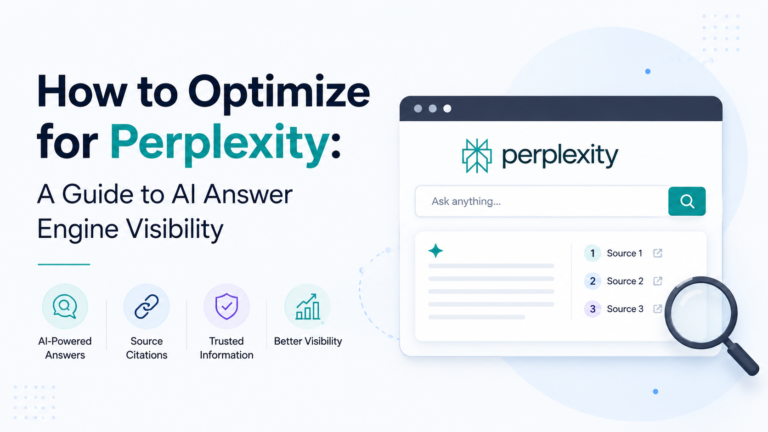
Google, OpenAI, Perplexity, and other AI search platforms continue to adjust how they generate answers, show links, cite sources, and surface web content.
For this reason, important AEO articles should include a visible update date and should be reviewed regularly.
This is especially important for articles about AI search, because outdated screenshots, old platform names, and inaccurate claims can reduce trust.
AEO Examples
Here are a few examples of how AEO changes the way you write.
Example 1: Definition Content
Weak:
Answer engine optimization is a new strategy that many marketers are using in the digital landscape.
Better:
Answer Engine Optimization is the process of structuring content so search engines and AI tools can use it to answer specific user questions.
Why it works:
The better version defines the term directly and does not waste the reader’s time.
Example 2: Service Page Content
Weak:
Our agency provides high-quality SEO services designed to help your company grow online.
Better:
Local SEO services help businesses improve visibility in Google Search, Google Maps, and local discovery results when nearby customers search for their products or services.
Why it works:
The better version answers what the service does and where it creates visibility.
Example 3: Comparison Content
Weak:
Both tools are great options, and the right one depends on your needs.
Better:
Tool A is better for small teams that want simplicity, while Tool B is better for larger teams that need advanced automation and reporting.
Why it works:
The better version gives a direct answer and explains the difference.
The CLEAR Framework for AEO
At NeuronPulse, we can use the CLEAR Framework to explain how answer-ready content works.
C — Clarity
Make the answer easy to understand.
Use direct definitions, simple explanations, and clean formatting.
L — Layout
Structure the page with headings, lists, tables, summaries, and FAQs.
A strong layout helps both humans and machines understand the page.
E — Expertise
Show why the content should be trusted.
Use real examples, experience, citations, author bios, and original insights.
A — Alignment
Match the content to user intent.
Do not only target a keyword. Answer the actual question behind the search.
R — Retrieval
Make the answer easy to extract.
Use concise answers, structured sections, internal links, and technically accessible pages.
This framework gives you a simple way to evaluate whether content is ready for answer engines.
AEO Checklist
Before publishing a page, ask these questions:
- Does the page answer the main question in the first few lines?
- Are headings written as clear questions or useful statements?
- Does the article include concise definitions?
- Does the page include examples?
- Are important terms explained simply?
- Does the content include an FAQ section?
- Are comparison tables used where helpful?
- Is the content supported by credible sources?
- Is the author, brand, or organization clearly identified?
- Is the page technically accessible and indexable?
- Is schema used where appropriate?
- Does the page link to related internal content?
- Is the content updated when the topic changes?
If most of these are covered, your page is much better prepared for AEO.
Common AEO Mistakes
Mistake 1: Writing Long Introductions Before Answering the Question
AEO rewards clarity. If your article title asks a question, answer it quickly.
Mistake 2: Optimizing Only for Keywords
Keywords matter, but AEO is about questions, intent, and answer quality.
Mistake 3: Publishing Generic AI Content
Generic content rarely stands out. If your article says the same thing as every other result, there is no strong reason for an answer engine to select it.
Mistake 4: Ignoring Trust Signals
Answer engines need confidence. Add author information, examples, sources, and clear brand positioning.
Mistake 5: Treating AEO as Separate from SEO
AEO works best when traditional SEO fundamentals are already strong. Technical SEO, internal linking, content quality, and site structure still matter.
Is AEO Replacing SEO?
No. AEO is not replacing SEO.
A better way to think about it is:
AEO is an expansion of SEO for an answer-driven search environment.
Traditional SEO helps your pages rank. AEO helps your content become usable as a direct answer.
As Google, ChatGPT, Perplexity, and other platforms continue to blend search with AI-generated answers, brands need both.
You still need:
- technical SEO
- helpful content
- topical authority
- internal links
- backlinks and mentions
- strong page experience
- credible authorship
- clear site structure
But now you also need answer-ready content that can be extracted, summarized, cited, or spoken.
Final Answer: What Is AEO?
AEO, or Answer Engine Optimization, is the process of optimizing your content so search engines, AI tools, and answer systems can use it to provide direct answers to user questions.
It helps your content become clearer, more structured, more useful, and more likely to appear in answer-driven search experiences such as featured snippets, Google AI Overviews, voice search, and AI-generated responses.
In the AI search era, ranking is still important.
But being the answer is becoming just as important.
FAQ About AEO
AEO stands for Answer Engine Optimization. It is the process of optimizing content so search engines, AI tools, and answer systems can use it to answer user questions directly.
No. SEO focuses on improving visibility in search results. AEO focuses on making content more likely to appear in direct answer formats such as featured snippets, AI answers, voice search responses, and answer boxes.
No. AEO focuses on direct answers. LLM SEO focuses on helping large language models understand, cite, and recommend your content or brand. The two strategies overlap and work well together.
AEO is important because users increasingly expect fast, direct answers. Search engines and AI tools are also presenting more summarized responses, citations, and answer-style results.
AEO can improve your chances by making your content clearer, more helpful, and easier to understand. However, no strategy can guarantee inclusion in Google AI Overviews.
Yes, AEO can help make your content more understandable and useful for AI-powered search systems. ChatGPT Search can provide answers with links to web sources, so clear and credible content may improve your chances of being discovered or cited.
No. Structured data does not guarantee that your content will appear in answer results. It can help search engines understand eligible content types, but the content still needs to be useful, relevant, and trustworthy.
Many types of pages can benefit from AEO, including blog posts, service pages, product pages, comparison articles, how-to guides, glossary pages, FAQ pages, and local business pages.
Start by identifying the main questions your audience asks. Then create clear, helpful pages that answer those questions directly, use structured headings, include examples, add FAQs, support claims with credible sources, and connect related articles with internal links.