How to Optimize for Perplexity: A Guide to AI Answer Engine Visibility
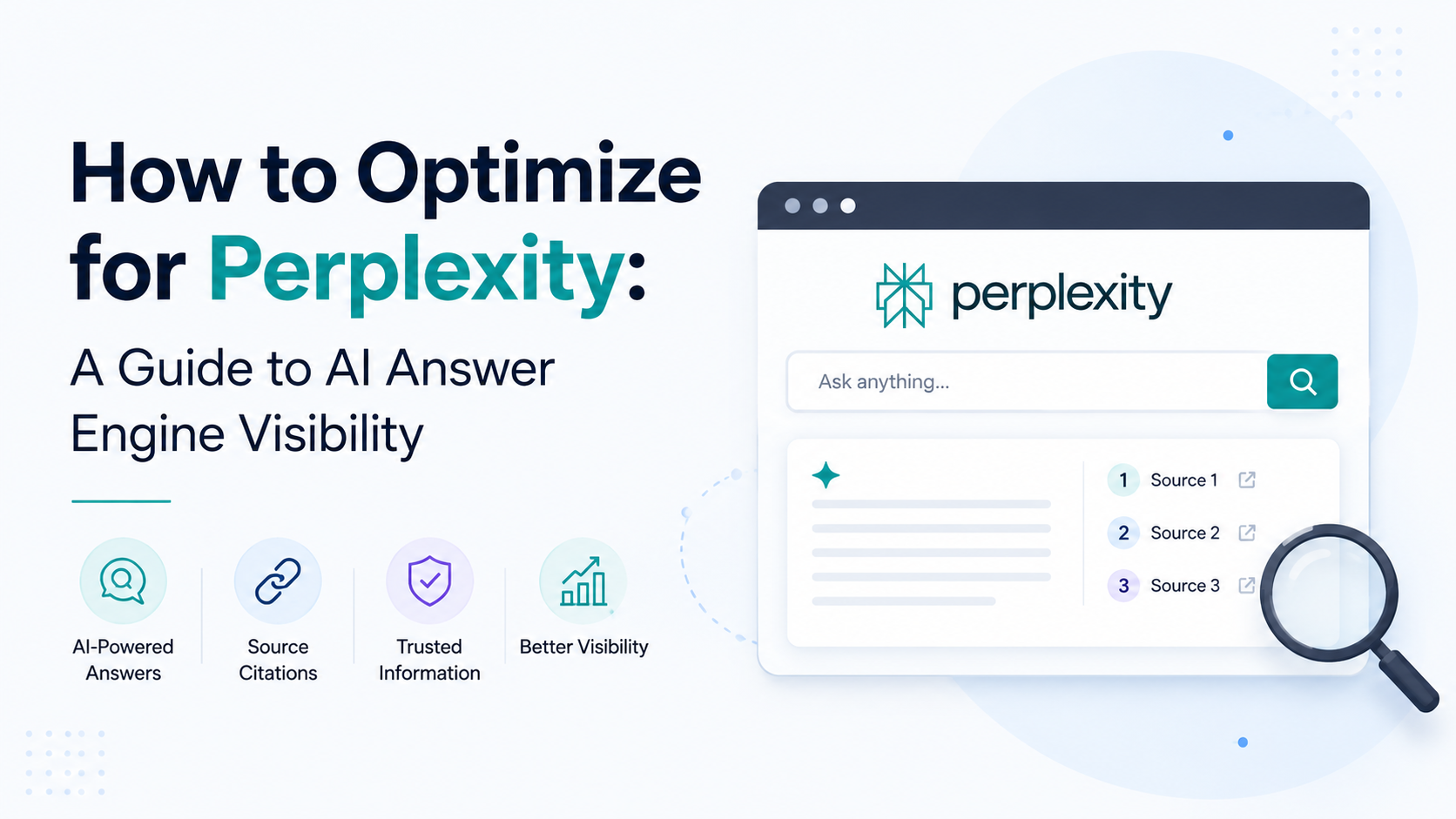
To optimize for Perplexity, create clear, credible, source-worthy content that directly answers user questions and is easy for AI answer engines to retrieve, summarize, and cite.
Perplexity is different from a traditional search engine because it does not simply show a list of links. It searches the web, synthesizes information, and provides conversational answers backed by sources and citations. Perplexity describes itself as an AI-powered search engine that delivers answers backed by verifiable sources, with citations and links to original sources so users can verify information and explore further.
In simple terms:
Traditional SEO helps your page rank. Perplexity optimization helps your content get cited in AI-generated answers in the perplexity ecosystem.
That means your website should follow the basic checklist below:
- crawlable
- clear
- useful
- current
- source-worthy
- structured for direct answers
- supported by trust signals
- connected to a broader topic cluster
The goal is never to “trick” Perplexity just like we are not “hacking” Google, or abusing schema for AI overviews or anything of the sort. The goal is to make your content so useful and easy to verify that it deserves to be used as a source.
Sometimes the best way to go about it, is to have a real person read your content to make sure it is something they enjoy. Typically, if a human finds the content helpful, the AI will do the same, with nuances of course.
What Is Perplexity?
Perplexity is an AI-powered answer engine that searches the web in real time, gathers information from sources, and turns that information into a clear conversational answer with citations.
Perplexity’s own help center explains that when you ask a question, it searches the internet in real time, gathers insights from sources, and distills that information into a concise summary. Another Perplexity help article describes an answer engine as a tool designed to give direct, detailed answers, and says Perplexity works by searching the web, identifying trusted sources, and synthesizing information into up-to-date responses.
This makes Perplexity especially important for AI search visibility because citations are an important part of the user experience.
If your page is cited, users may:
- see your brand inside the answer
- click through to your website
- trust your content more
- discover your brand during research
- compare your information with other sources
For brands, this creates a new SEO objective:
Can your content become a trusted source inside an AI answer?
If the AI trusts your content than more of your articles will appear in AI search results like Perplexity.
Why Perplexity Matters for AI Search Visibility
Perplexity matters because it represents where search is going: direct answers, source links, follow-up questions, and AI-assisted research.
A user might ask Perplexity:
What is the best way to optimize a website for AI search?
Instead of showing ten blue links like in traditional search results in Google. Perplexity can provide a summarized answer with cited sources. That means a user may encounter your brand not as a traditional search result, but as one of the sources the AI used, attached to an AI-generated answer.
Basically, it will condense everything it knows about your search, give you a direct answer, and tell you what sources it used.
This matters for:
- informational content
- product research
- service comparisons
- software reviews
- travel planning
- medical and legal research
- local business discovery
- B2B buying decisions
- marketing and SEO education
For NeuronPulse, Perplexity is especially relevant because the platform rewards the same qualities that strong LLM SEO and AEO content should already have: clarity, credibility, structure, freshness, and source-worthiness.
Perplexity vs ChatGPT Search vs Google AI Overviews
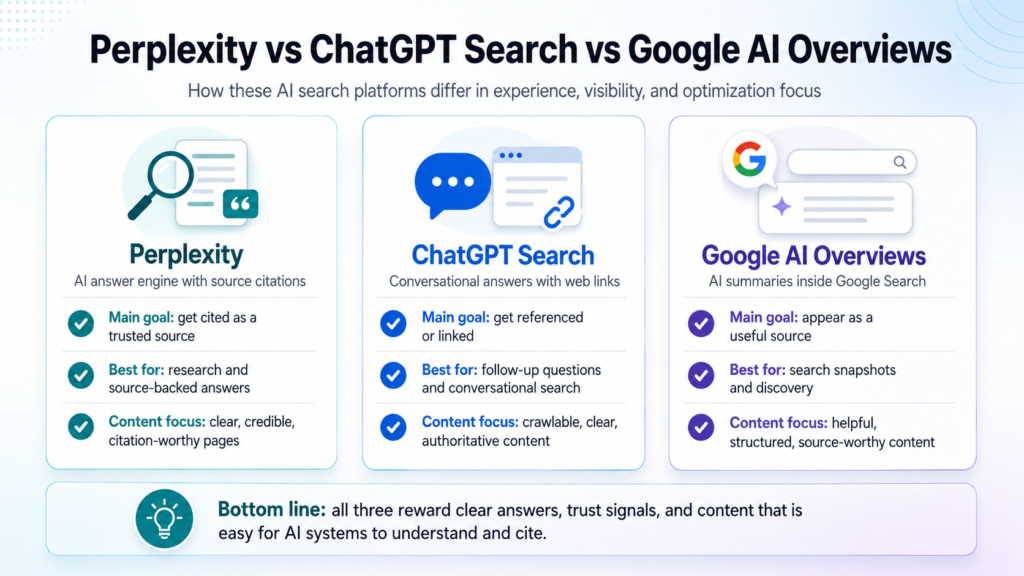
Perplexity, ChatGPT Search, and Google AI Overviews all belong to the broader AI search ecosystem, but they are not identical.
| Platform | Search Experience | Main Visibility Goal | Content Strategy |
|---|---|---|---|
| Perplexity | AI answer engine with source citations | Get cited as a trusted source in answers | Create concise, credible, source-worthy content |
| ChatGPT Search | Conversational answers with links to web sources | Get referenced or linked in ChatGPT answers | Make content crawlable, clear, authoritative, and citation-ready |
| Google AI Overviews | AI-generated summaries inside Google Search | Be included as a useful source in Google’s AI search experience | Follow SEO fundamentals and create helpful, structured answers |
The overlap is clear:
If your content is useful, trustworthy, well-structured, and easy to cite, it is better prepared for Perplexity, ChatGPT Search, Google AI Overviews, and other AI search platforms.
How Perplexity Uses Sources and Citations
Perplexity’s product is built around answers with sources.
Its app store description emphasizes “accurate answers” backed by sources and citations. Its help center also notes that each response includes citations and links to original sources so users can verify information.
This does not mean every page has an equal chance of being cited. Perplexity still has to decide which sources are useful for the query.
A page is more likely to be useful as a source when it:
- answers the question directly
- covers the topic clearly
- includes verifiable information
- avoids vague filler
- uses current information
- has strong topical relevance
- includes original insight
- is technically accessible
- comes from a credible brand or author
- is part of a broader topic cluster
For publishers, this means Perplexity optimization is less about old-school keyword stuffing and more about building content that an AI answer engine can confidently use.
How to Optimize for Perplexity: 12 Practical Steps
1. Create Direct Answers Near the Top
Perplexity is answer-driven, so your content should be answer-ready.
Just like with Google AI overviews, Gemini, and ChatGPT, we need the answer at the top and it needs to be clear and concise.
If your article is titled:
What is AEO?
The answer should appear immediately, not two paragraphs down. It should be visible as soon as someone enters your page. The same applies for Perplexity. The answer should be obvious, early in the text, and be direct.
Weak opening:
In the modern digital marketing environment, many brands are exploring new ways to use artificial intelligence as part of their visibility strategy.
Better opening:
AEO, or Answer Engine Optimization, is the process of structuring your content so search engines, AI tools, and answer systems can use it to provide direct answers to user questions.
The second version works better because it is direct, clear, and easy to summarize.
For every article, ask:
What question does this page answer?
Then answer it clearly in the first few lines. It is visible, clear, concise, and easy to find/cite.
2. Build Content Around Real Questions
People use Perplexity like an answer engine, not just a keyword box. If you want to be cited than you should think as your users would.
They ask questions such as:
- How do I optimize for Perplexity?
- What is the difference between GEO and AEO?
- What are the best AI SEO tools?
- How does ChatGPT Search choose sources?
- What is the best itinerary for 10 days in Peru?
- Which CRM is best for a small service business?
Your content should reflect those natural questions.
Use question-based headings like:
- What Is Perplexity?
- How Does Perplexity Use Sources?
- How Do You Optimize for Perplexity?
- Can Perplexity Send Traffic to Websites?
- Is Perplexity SEO Different from Google SEO?
This improves readability for humans and makes your content easier for AI systems to match to user intent. Make sure it is easy to find and that it is written in a way that humans would want to read it as well. This way you kill two birds with one stone.
3. Make Pages Source-Worthy
To get cited, your page needs to deserve the citation.
Source-worthy pages usually include:
- clear definitions
- concise explanations
- original examples
- step-by-step guidance
- comparison tables
- expert commentary
- recent updates
- credible sources
- helpful formatting
- internal links to deeper resources
A generic article is less likely to stand out.
Weak content:
Perplexity is changing search and businesses should optimize for AI.
Better content:
Perplexity optimization means creating content that directly answers user questions, includes credible support, and is structured so AI answer engines can summarize and cite it.
Specificity matters.
4. Use Credible Sources and External References
Perplexity is source-oriented, so your own article should demonstrate that it understands sourcing.
When discussing current AI platforms, cite official documentation, help center pages, reputable research, or first-party sources.
For example, if you say Perplexity provides answers with citations, support that statement with Perplexity’s own help documentation. Perplexity says its answers include citations and links to original sources so users can verify information.
This adds trust for both human readers and search systems.
5. Build Topical Authority Around a Cluster
One article is rarely enough.
If you want to become a visible source for AI search topics, publish a connected cluster of articles.
For NeuronPulse, a Perplexity/AI search cluster could include:
- What Is LLM SEO?
- What Is AEO?
- GEO vs AEO vs LLM SEO
- How to Optimize for ChatGPT Search
- How to Optimize for Google AI Overviews
- How to Optimize for Perplexity
- Perplexity vs ChatGPT Search
- Best AI Search Engines
- How to Structure Articles for AI Answers
- The LLM SEO Checklist
This helps establish the site as a consistent authority in AI search optimization, not just a site with one random Perplexity article.
6. Use Comparison Tables
Perplexity is often used for research and comparison-style questions.
That means comparison tables can be especially useful.
Examples:
| User Question | Helpful Content Format |
|---|---|
| Perplexity vs ChatGPT | Comparison table |
| Best AI search tools | Ranked list with criteria |
| GEO vs AEO vs LLM SEO | Definition and difference table |
| Best time to visit Peru | Month-by-month table |
| Private tour vs group tour | Pros and cons table |
Tables make information easier to scan, summarize, and cite.
7. Add FAQ Sections
FAQs are a natural fit for Perplexity optimization because they match conversational search behavior.
A useful FAQ section can answer related questions such as:
- What is Perplexity SEO?
- How do I optimize for Perplexity?
- Can Perplexity cite my website?
- Does Perplexity send traffic?
- Is Perplexity better than Google?
- Is Perplexity optimization the same as AEO?
- What types of content get cited in Perplexity?
Keep each answer concise, useful, and specific.
8. Keep Content Fresh
Perplexity is useful for real-time research, so outdated content can weaken your chances of being useful.
For fast-changing topics like AI search, update your articles regularly.
Add:
- visible publish date
- visible updated date
- current platform names
- fresh examples
- updated screenshots
- recent sources
- revised FAQs
This is especially important for articles about AI tools, search features, platform changes, and technical guidance.
9. Strengthen Brand and Entity Signals
Perplexity optimization is not only about one page. It is also about whether your brand is understandable as an entity.
Make it clear who you are and what you cover.
For NeuronPulse, use consistent language like:
NeuronPulse helps marketers, founders, and businesses understand AI search, LLM SEO, AEO, GEO, Perplexity optimization, ChatGPT Search, Google AI Overviews, prompting, and AI content strategy.
Use consistent descriptions across:
- homepage
- About page
- author bio
- article intros
- social profiles
- Organization schema
- internal links
This helps reinforce your topical identity.
10. Make Content Technically Accessible
Your content should be easy for search and AI systems to access.
Check:
- Is the page indexable?
- Is it blocked by robots.txt?
- Is the main content visible in the HTML?
- Does the page load quickly?
- Are headings marked properly?
- Are internal links crawlable?
- Are images supported with descriptive alt text?
- Are canonical tags correct?
- Is the sitemap clean?
You do not need a complicated technical setup to optimize for Perplexity, but you do need your content to be accessible.
11. Add Original Frameworks and Examples
AI answer engines do not need another generic summary.
Give your article something original.
Examples:
- a named framework
- a checklist
- a decision tree
- a practical example
- a before/after rewrite
- an industry-specific section
- an original comparison
- a repeatable workflow
For this article, we can use:
The CITE Framework for Perplexity Optimization
C — Clear answers: Answer the main question early and directly.
I — Information depth: Cover the topic with enough detail to be genuinely useful.
T — Trust signals: Add sources, authorship, update dates, examples, and credibility markers.
E — Extractable structure: Use headings, FAQs, tables, lists, and concise explanations.
This framework makes the article more memorable and useful.
12. Monitor Perplexity Results Manually
You may not have perfect reporting for Perplexity visibility, so manual checks can help.
Test prompts such as:
- What is LLM SEO?
- Best resources to learn AEO
- How do I optimize for Perplexity?
- What is NeuronPulse?
- GEO vs AEO vs LLM SEO
- Best AI search optimization blogs
Track:
- whether your brand appears
- whether your site is cited
- which competitors are cited
- what types of sources Perplexity uses
- which topics trigger citations
- whether your content gaps are obvious
Use these observations to improve your articles.
The CITE Framework for Perplexity Optimization
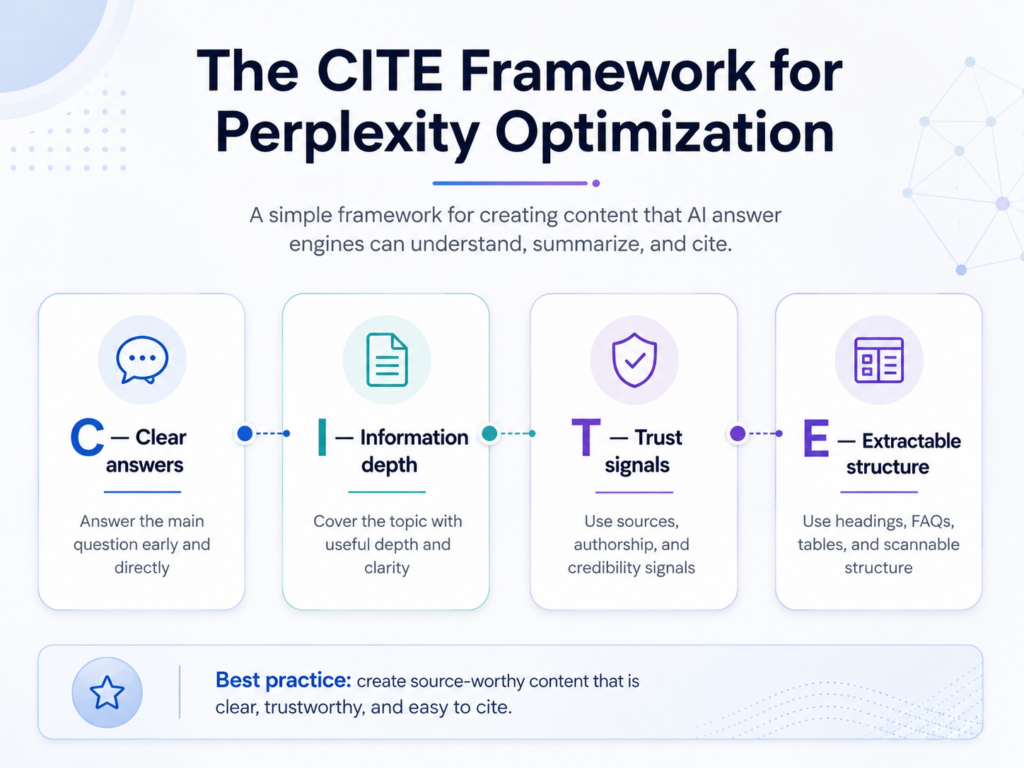
A simple way to remember Perplexity optimization is the CITE Framework.
C — Clear Answers
Perplexity is designed to answer questions. Your content should do the same.
Use clear definitions, direct introductions, and concise summaries.
I — Information Depth
Thin content is less useful. Cover the topic completely enough that a reader can understand the answer without needing five other pages.
T — Trust Signals
Add credibility through sources, author information, update dates, examples, and transparent reasoning.
E — Extractable Structure
Use formatting that makes your content easy to summarize:
- H2/H3 headings
- short paragraphs
- tables
- lists
- FAQs
- step-by-step sections
- clear conclusions
The stronger your CITE score, the more prepared your content is for Perplexity and other AI answer engines.
Perplexity Optimization Checklist
Before publishing or updating an article, review this checklist:
- Does the page answer the main question early?
- Is the article built around real user questions?
- Does it include clear definitions?
- Does it include credible sources?
- Is the content better than a generic AI summary?
- Does it include examples or original insight?
- Does it use comparison tables where helpful?
- Does it include an FAQ section?
- Is the content current?
- Is the author or brand clearly identified?
- Is the page technically accessible?
- Are headings clear and descriptive?
- Are related articles internally linked?
- Does it support your broader topical authority?
- Can the page be summarized and cited easily?
Common Perplexity SEO Mistakes
Mistake 1: Writing Generic Content
Generic AI content is unlikely to stand out. Perplexity users want clear, useful answers backed by sources.
Mistake 2: Ignoring Citations and Trust
If your article makes claims without support, it is less source-worthy. Always make sure to cite your sources in the article and post proof for whatever your are writing about. If this is about travel by train add train schedules. If you are writing about finance, add tables. There is always something the writer can add to make their work more credible and in turn, citable.
Mistake 3: Burying the Answer
Answer engines reward clarity. Do not make readers or AI systems dig through long intros.
Mistake 4: Publishing One-Off Articles
Topical authority matters. A single article is weaker than a connected cluster.
Mistake 5: Forgetting Updates
AI search changes quickly. Old information can reduce trust.
Is Perplexity Optimization the Same as AEO?
Perplexity optimization is closely related to AEO, but they are not exactly the same.
AEO, or Answer Engine Optimization, focuses broadly on making content usable for direct answers across search engines, voice search, featured snippets, AI answers, and answer boxes.
Perplexity optimization focuses specifically on improving visibility inside Perplexity’s AI answer engine. You really can’t do one without having an outcome in the other. It’s like trying to only do SEO to appear in Google and not in Yahoo, Bing search. You can obviously focus on details that allow you to appear on one more than the other but you would still be optimizing for search engines.
The overlap includes:
- direct answers
- FAQs
- credible sources
- clear structure
- topical authority
- citation-worthy content
So Perplexity optimization is best understood as a platform-specific form of AEO and AI search optimization.
Is Perplexity Optimization the Same as LLM SEO?
Perplexity optimization is one part of LLM SEO.
LLM SEO focuses on helping large language models understand, cite, and recommend your content or brand.
Perplexity optimization focuses on whether your content can be useful inside Perplexity’s answer experience. You are basically using LLM SEO to be cited in AI search like Perplexity.
The same principles often apply:
- clarity
- trust
- source-worthiness
- entity consistency
- structured answers
- internal linking
- topical depth
Final Answer: How Do You Optimize for Perplexity?
To optimize for Perplexity, create content that is clear, credible, current, and easy to cite.
Start by answering the main question early. Build pages around real user questions. Add credible sources, FAQs, comparison tables, original examples, and strong internal links. Keep content updated and make sure your brand is clearly associated with the topics you want to be known for.
Perplexity is an answer engine. So the best way to optimize for it is simple:
Create content that deserves to be the source behind the answer.
FAQ About Perplexity SEO
Perplexity SEO is the practice of optimizing your content so it has a better chance of being used, cited, or recommended in Perplexity’s AI-generated answers.
Create clear, source-worthy content that answers specific questions directly. Use credible sources, structured headings, FAQs, comparison tables, original insight, and updated information.
Yes, Perplexity responses include citations and links to original sources, which can give websites visibility inside AI-generated answers.
It can. Because Perplexity includes citations and links to original sources, users can click through to verify information or explore further.
Yes. Perplexity describes an answer engine as a tool that gives direct, detailed answers, and says Perplexity works by searching the web, identifying trusted sources, and synthesizing information into clear responses.
No. Google SEO focuses heavily on ranking in search results. Perplexity SEO focuses more on becoming a cited source in AI-generated answers. However, strong SEO fundamentals still help.
Schema can help search systems understand page content, but it does not guarantee that Perplexity will cite your page. Use schema accurately as part of broader technical and content quality best practices.
Useful content types include definitions, comparison guides, how-to articles, checklists, research summaries, product comparisons, expert explainers, FAQ pages, and updated guides.
No. No one can guarantee citation in Perplexity. The best strategy is to create content that is useful, trustworthy, accessible, and clearly relevant to the question.