The LLM SEO Checklist: How to Make Your Content Ready for AI Search
What Is an LLM SEO Checklist?
An LLM SEO checklist is a practical review process for making sure your content is ready for AI-powered search.
Traditional SEO checklists usually focus on things like keywords, title tags, internal links, page speed, and backlinks. Those are still relevant and have their place. But AI search adds another layer we also need to consider.
Now your content also needs to be easy for large language models and answer engines to:
- understand
- summarize
- verify
- cite
- recommend
- connect to your brand or topic
That matters because people are no longer only using search engines to scan links. They are asking ChatGPT, Perplexity, Gemini, Google AI Overviews, and other AI-powered tools for direct answers, comparisons, recommendations, and summaries.
OpenAI describes ChatGPT Search as a way to get fast, timely answers with links to relevant web sources. Google says AI Overviews provide an AI-generated snapshot with key information and links to explore more. Perplexity describes its experience as answers backed by sources and citations.
So the question is no longer only:
“Is this page optimized for Google?”
It is also:
“Is this page clear, credible, and structured enough for AI systems to use?”
That is what this LLM SEO checklist is designed to answer. We want to appear in as many AI-powered tools and search results as possible. With how users have changed their online search behavior, business owners must optimize their content.
Why You Need an AI Search Readiness Checklist
Most websites were not written for AI search.
Most sites were simply created for older search behavior: target a keyword, write a blog post, add headings, optimize metadata, some link building, and hope the page ranks. Now that I write out the process it seems simple enough, but anyone who’s been in this space knows how hard it can be to do all of that.
Learning how to structure articles for AI answers for example is an equally important skill that marketers will have to understand.
That approach can still work, but it is not enough by itself. We now have to contiue with out basic SEO and add more layers.
AI search changes the way content is discovered and evaluated. A user might ask:
“What is the best way to optimize a website for ChatGPT Search?”
Or:
“Which type of content is more likely to appear in Google AI Overviews?”
Or:
“What should a small business do to improve visibility in AI answers?”
Those are not simple keyword searches. They are full questions with context and intent.
A checklist helps because it turns a vague goal — “optimize for AI search” — into specific actions.
Instead of asking:
“Is this article good?”
You can ask:
- Does it answer the main question clearly?
- Does it include examples?
- Does it show trust?
- Does it have a logical structure?
- Does it link to related content?
- Is it current?
- Would this be useful as a cited source?
That is a much better way to evaluate content.
The LLM SEO Checklist
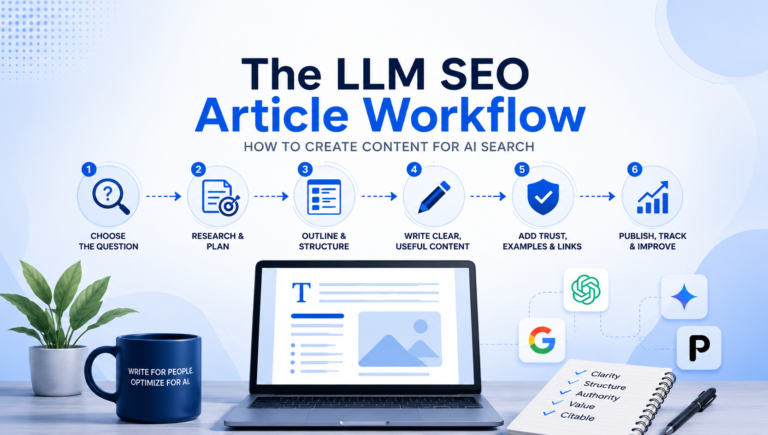
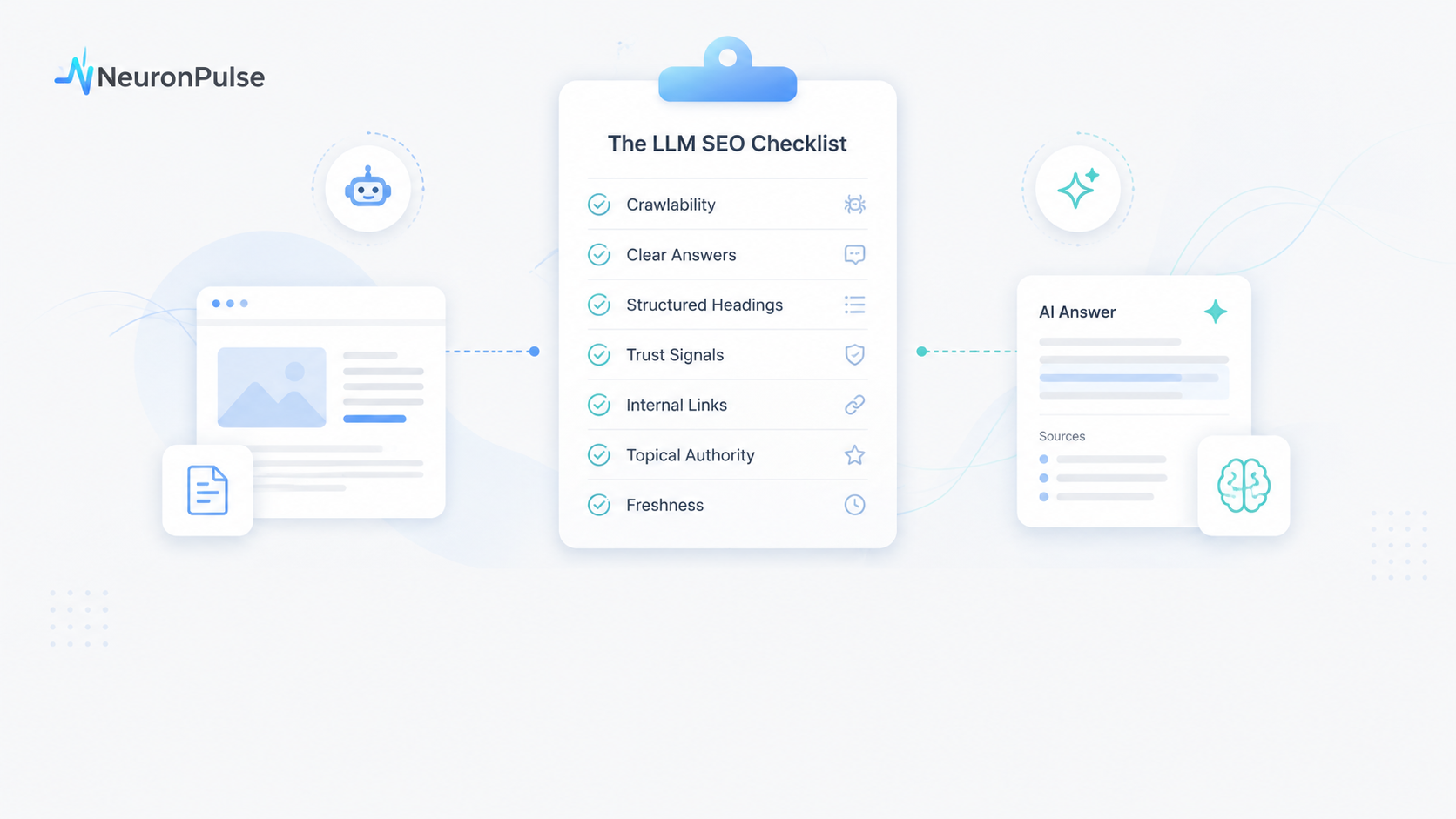
Use this checklist when creating a new article, updating an old post, or reviewing a service page for AI search readiness.
There are ways to make content building easier and having a good check list of items to cross off is usually very helpful.
1. Make Sure the Page Is Crawlable and Accessible
Before worrying about AI citations, make sure your page can actually be accessed.
If search systems and AI crawlers cannot reach your content, the rest of the optimization does not matter much.
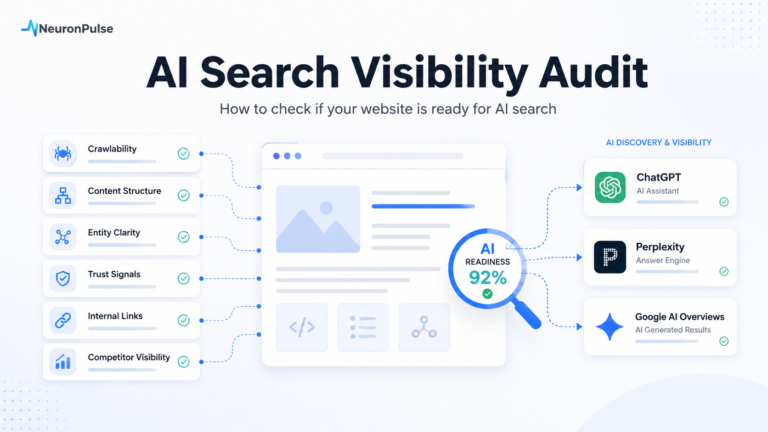
For ChatGPT Search specifically, OpenAI says OAI-SearchBot is used to surface websites in ChatGPT’s search features, and OpenAI recommends allowing it in robots.txt if you want your site to appear in search results. Basically, we are saying to make sure you follow basic on-page SEO rules and to make sure you aren’t blocking any bots AI systems might send you index and site your piece of content.
Check this:
- Is the page indexable?
- Is it blocked by
robots.txt? - Is the main content visible without requiring a login?
- Is important text rendered in a way crawlers can access?
- Is the page included in your sitemap?
- Are canonical tags correct?
- Does the page load properly on mobile?
- Are internal links crawlable?
- Are important images supported with descriptive alt text?
Simple action:
Check your page in Google Search Console and make sure Google can crawl and index it. Then review your robots.txt file to make sure you are not accidentally blocking important AI or search crawlers.
For ChatGPT Search visibility, a basic rule may look like this:
User-agent: OAI-SearchBot
Allow: /
This does not guarantee visibility, but blocking access can limit your chances. So, think of allowing the AI bot to enter your site is just to look around. If it finds somehting lit likes, andcertain parameters are met it will possible cite your content.
2. Answer the Main Question Early
This is one of the easiest improvements you can make.
If your article title asks a question, answer it near the top. The most relevant piece of information in the article is the answer to the questions the user asked, so naturally, the answer should be placed at the initial part of the content.
For example, if the article is:
What Is LLM SEO?
Do not start with five paragraphs about how technology is changing.
Start with the answer:
LLM SEO is the process of optimizing your website so large language models can understand, trust, cite, and recommend your content in AI-generated answers.
That does not mean every article needs to sound like a dictionary entry. But the reader should not have to hunt for the point. They should see the answer they searched for right away. The informational add-on section can go underneath.
Check this:
- Does the article answer the title question in the first few lines?
- Is the answer specific enough to be useful?
- Could someone understand the basic idea without reading the full article?
- Does the intro avoid generic filler?
- Does the opening match the search intent?
Weak opening:
In today’s fast-changing digital world, businesses are looking for new ways to improve online visibility as artificial intelligence continues to transform the way people search.
Stronger opening:
LLM SEO helps your content become easier for AI systems to understand, summarize, cite, and recommend. It builds on traditional SEO, but focuses more on clarity, structure, trust, and topical authority.
The stronger version is still readable, but it gets to the point faster.
3. Make the Article Easy to Skim
AI-ready content should be easy for people to scan.
That does not mean writing only bullet points. It means using structure to guide the reader.
A well-structured page usually has:
- a clear H1
- descriptive H2s and H3s
- short paragraphs
- examples
- tables where helpful
- summaries
- FAQ sections
- internal links
- a clear final takeaway
If the article looks like a wall of text, it is harder for both readers and systems to understand.
Check this:
- Can a reader understand the article by scanning the headings?
- Does each section have a clear purpose?
- Are headings specific instead of vague?
- Are long paragraphs broken up?
- Are lists used only when they improve clarity?
- Is the page visually organized?
Weak headings:
- Introduction
- Overview
- Important Information
- More Details
- Conclusion
Better headings:
- Why LLM SEO Matters
- How AI Search Uses Content
- How to Make Content Easier to Cite
- Common LLM SEO Mistakes
- LLM SEO Checklist
Good headings act like a map.
4. Use Question-Based Sections
AI search is conversational. Your content should reflect that.
People do not only search for short keywords anymore. They ask complete questions.
Examples:
- How do I optimize for ChatGPT Search?
- What is the difference between AEO and SEO?
- Can Perplexity cite my website?
- Does schema help with Google AI Overviews?
- How should I structure an article for AI answers?
When your headings match real questions, your content becomes easier to align with user intent.
Check this:
- Does the article include the main question?
- Does it answer natural follow-up questions?
- Are FAQ questions specific?
- Do the questions sound like something a real person would ask?
- Are related questions answered in the body, not only at the end?
Example:
Instead of:
Perplexity Optimization
Use:
How Do You Optimize for Perplexity?
Instead of:
AI Overview Strategy
Use:
How Can You Improve Your Chances of Appearing in Google AI Overviews?
Question-based headings are not always required, but they are useful when the topic is educational or comparison-based.
5. Add Clear Definitions and Answer Blocks
Some topics need clean definitions.
This is especially true for AI search terms such as:
- LLM SEO
- AEO
- GEO
- answer engine
- AI Overview
- ChatGPT Search
- Perplexity SEO
- entity optimization
- topical authority
A definition does not have to be dry. It just has to be clear.
Check this:
- Are important terms defined?
- Are definitions written in plain language?
- Are key ideas explained before advanced details?
- Does the article include short answer blocks that can stand alone?
- Would a beginner understand the explanation?
Example answer block:
AEO is the process of structuring content so search engines, AI tools, and answer systems can use it to answer user questions directly.
Answer blocks are useful because they help readers quickly understand the page. They can also make your content easier to summarize.
But use them naturally. If every paragraph is written like a glossary, the article will feel robotic.
6. Add Examples That Make the Advice Real
Examples are one of the fastest ways to make an article more useful.
Without examples, LLM SEO advice can sound abstract:
Make your content clear and structured.
That is true, but it is not very actionable.
A better approach is to show what “clear and structured” looks like.
Example: vague vs useful
Weak:
AI search is changing SEO and businesses need to adapt their content strategies.
Stronger:
AI search changes SEO because users may receive a direct answer before they ever click a result. That means content needs to be clear enough to summarize, trustworthy enough to cite, and useful enough to make the user want to learn more.
The second version gives the reader something concrete.
Check this:
- Does the article show examples?
- Are there before-and-after rewrites?
- Are examples specific to the reader’s situation?
- Does the article include practical use cases?
- Are examples spread throughout the article, not only placed at the end?
Examples also help make your content feel less generic. AI tools can generate basic explanations very easily. Your edge is in judgment, context, and practical demonstration.
7. Include Original Insight
This is where many AI-generated articles fail.
They are clear enough, but they do not add anything new.
If your article says the same thing as every other page on the topic, there is little reason for a reader, search engine, or AI answer system to prefer your page.
Original insight does not always mean original research. It can also mean:
- a named framework
- a practical checklist
- a better explanation
- a specific workflow
- a first-hand example
- a unique comparison
- a clear opinion
- a useful template
- a niche-specific application
For example, NeuronPulse has used frameworks like:
- SOURCE Framework
- CITE Framework
- RANK + ANSWER Model
- AI-Ready Article Template
Those frameworks give the content a point of view.
Check this:
- Does the article include something original?
- Is there a framework, checklist, workflow, or useful example?
- Does the article make a clear recommendation?
- Does it avoid generic statements that could appear anywhere?
- Would a reader remember anything from this page?
A good test is this:
If someone removed your brand name from the article, would anything still feel uniquely yours?
If the answer is no, add more original thinking.
8. Use Tables When They Improve the Answer
Tables are excellent for comparison, decision-making, and quick reference.
They work especially well for topics like:
- AEO vs SEO
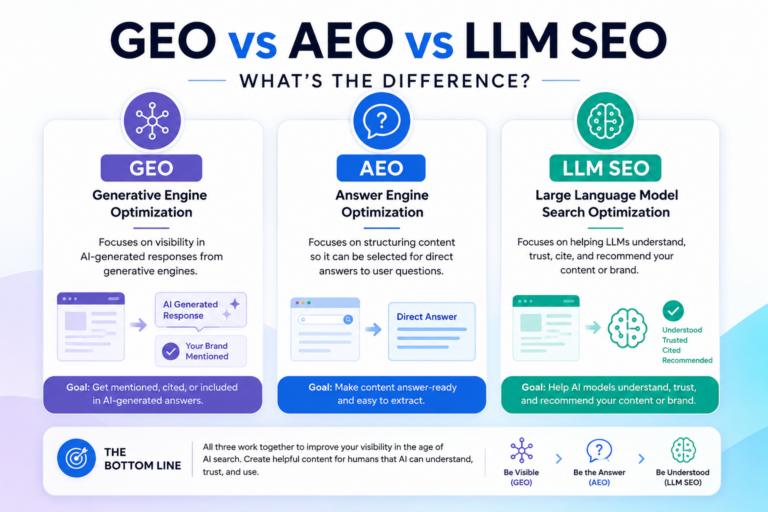
- GEO vs AEO vs LLM SEO
- ChatGPT Search vs Perplexity vs Google AI Overviews
- content structure before vs after
- checklist items
- tool comparisons
- workflow steps
A table helps readers understand differences faster than paragraphs alone.
Check this:
- Is the article comparing terms, tools, options, or processes?
- Would a table make the comparison easier?
- Is the table simple enough to read on mobile?
- Are the columns useful?
- Does the table reduce confusion?
Example table:
| Content Element | Why It Helps AI Search |
|---|---|
| Direct answer | Makes the main idea easy to identify |
| Clear headings | Helps organize the page by intent |
| Examples | Makes the advice more specific and useful |
| FAQs | Answers natural follow-up questions |
| Sources | Builds trust and supports verification |
| Internal links | Connects the page to a broader topic cluster |
Tables should clarify. Do not add them just to make the page look optimized.
9. Add Sources and Trust Signals
AI search visibility depends heavily on trust.
If your content makes claims about platforms, tools, search features, or technical recommendations, support those claims when appropriate.
For example:
- cite OpenAI when discussing ChatGPT Search
- cite Google Search Central when discussing AI Overviews or structured data
- cite Perplexity when discussing its source-based answer experience
- cite official documentation when discussing crawlers, robots.txt, or schema
Google’s AI features documentation says site owners should follow Search essentials and make sure content is eligible to appear in Search. Google also explains that AI Overviews provide snapshots with links to explore more on the web.
Check this:
- Are platform-specific claims cited?
- Does the article include author information?
- Is there a visible publish or update date?
- Are examples realistic?
- Is the content accurate?
- Does the page avoid unsupported hype?
- Are external sources credible?
Trust signals are not just citations. They also include:
- author bio
- clear About page
- real examples
- updated content
- internal links
- transparent methodology
- screenshots
- original observations
If you want to be cited, you need to look like a source worth citing.
10. Strengthen Entity and Brand Clarity
LLM SEO is not only about individual pages. It is also about how AI systems understand your brand.
Your site should make it clear:
- who you are
- what you cover
- who you help
- what topics you are associated with
- why your content should be trusted
For NeuronPulse, a clear brand description might be:
NeuronPulse helps marketers, founders, and businesses understand AI search, LLM SEO, AEO, GEO, content strategy, and AI-powered workflows.
Use consistent descriptions across:
- homepage
- About page
- author bio
- article intros
- category pages
- social profiles
- schema markup where appropriate
Check this:
- Is the brand clearly described?
- Is the author or publisher identifiable?
- Are important topics repeated naturally across the site?
- Do related articles link to one another?
- Does the site have a clear topical focus?
- Are category names aligned with your expertise?
Entity clarity helps AI systems connect your content to the right subject areas.
11. Build Internal Links Around Topic Clusters
One article rarely builds authority by itself.
Internal links help connect related pages into a topic cluster.
For example, an LLM SEO cluster might include:
- What Is LLM SEO?
- What Is AEO?
- AEO vs SEO
- GEO vs AEO vs LLM SEO
- How to Optimize for ChatGPT Search
- How to Optimize for Google AI Overviews
- How to Optimize for Perplexity
- How to Structure Articles for AI Answers
- The LLM SEO Checklist
Each page should link to the others where it makes sense.
Check this:
- Does the page link to related articles?
- Does it link back to a pillar page?
- Are anchor texts descriptive?
- Are internal links useful to the reader?
- Is the page part of a clear content cluster?
- Are older articles updated to link to the new one?
Internal links help readers continue learning. They also help search systems understand which topics your site covers deeply.
12. Add an FAQ Section That Solves Real Doubts
FAQs are useful when they answer questions the article did not fully address in the main body.
They should not feel like filler.
Good FAQs usually answer:
- beginner questions
- objections
- edge cases
- platform-specific questions
- “does this matter?” questions
- “how do I start?” questions
For this article, useful FAQs might include:
- What is LLM SEO?
- Is LLM SEO the same as AEO?
- Can I guarantee AI search citations?
- Does schema help with LLM SEO?
- How often should I update content?
- Can small websites compete in AI search?
- What is the first thing I should fix?
Check this:
- Are the questions real?
- Does each answer add something useful?
- Are FAQs short but complete?
- Do they avoid repeating entire sections?
- Are they written in natural language?
A good FAQ section should feel like a helpful follow-up conversation.
13. Keep Content Updated
AI search changes quickly.
Platform behavior, crawler documentation, AI search layouts, citation patterns, and best practices can change over time.
That means important AI search pages should not sit untouched for years.
Update these regularly:
- articles about ChatGPT Search
- Google AI Overviews guides
- Perplexity optimization guides
- tool reviews
- platform comparisons
- technical crawler guidance
- schema recommendations
- AI search case studies
Check this:
- Does the page show an updated date?
- Are platform names still current?
- Are sources still accurate?
- Are screenshots outdated?
- Are examples still relevant?
- Are internal links current?
- Are new related articles linked?
A simple quarterly review can keep important content fresh.
For fast-changing topics, review more often.
14. Make the Page Useful for Humans First
This may sound obvious, but it is the most important point.
LLM SEO is not about making weird content for robots. It is about making content clearer, more useful, and easier to understand.
Before publishing, ask:
- Would a real person find this helpful?
- Does it solve a specific problem?
- Does it avoid fluff?
- Does it explain the topic better than competing pages?
- Does it give the reader a next step?
- Does it sound like a human wrote it?
Google’s guidance on AI-generated content says its focus is on the quality of content rather than how it is produced, and that helpful content should be created primarily for people.
That is a good standard for LLM SEO too.
If the article is only optimized for machines, it probably is not optimized well.
Full LLM SEO Checklist
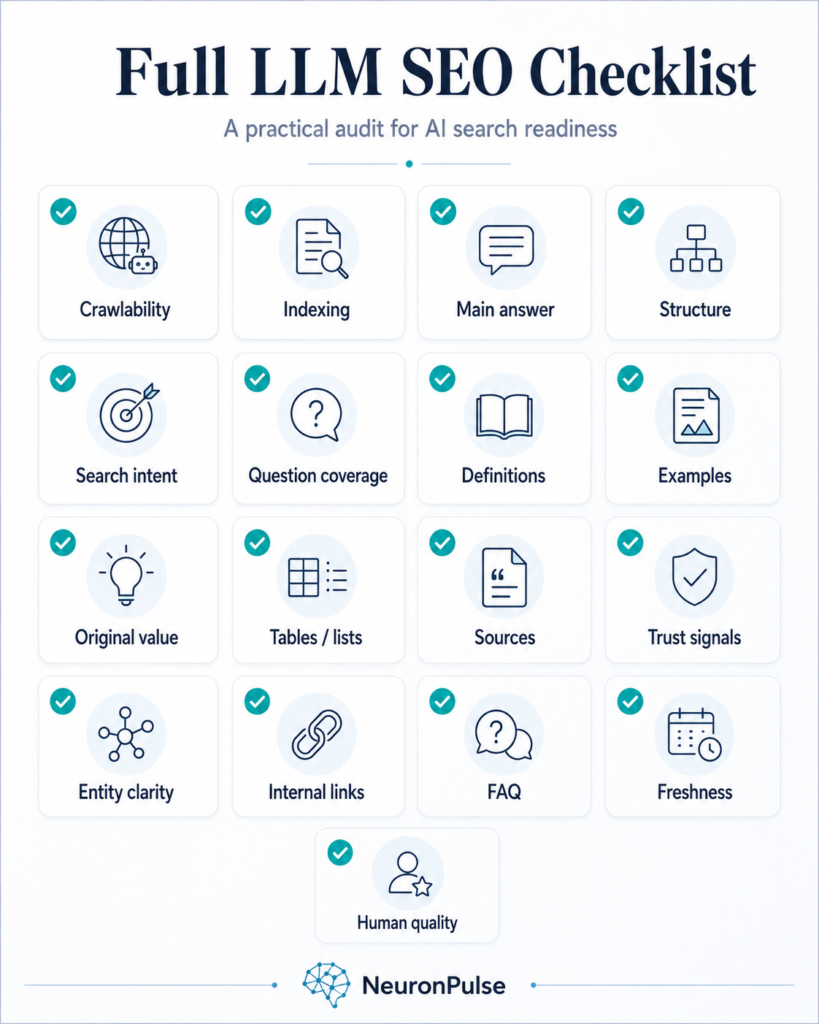
Use this as a quick audit before publishing or updating a page. The list below is both helpful and battle proven when ti comes to SEO for large language models.
| Area | Checklist Question |
|---|---|
| Crawlability | Can search engines and relevant AI crawlers access the page? |
| Indexing | Is the page indexable and included in your sitemap? |
| Main answer | Does the article answer the main question early? |
| Structure | Are headings clear, specific, and logically ordered? |
| Search intent | Does the page match what the reader actually wants? |
| Question coverage | Does it answer natural follow-up questions? |
| Definitions | Are important terms explained clearly? |
| Examples | Does the page include practical examples or before/after sections? |
| Original value | Does it include a unique framework, checklist, opinion, or workflow? |
| Tables/lists | Are tables or lists used where they make the answer clearer? |
| Sources | Are important claims supported with credible references? |
| Trust signals | Is there an author, updated date, and clear brand identity? |
| Entity clarity | Is the topic and brand positioning easy to understand? |
| Internal links | Does the page link to related articles in the cluster? |
| FAQ | Does the FAQ section answer real follow-up questions? |
| Freshness | Is the content current and reviewed regularly? |
| Human quality | Does the article sound useful, natural, and specific? |
How to Use This Checklist
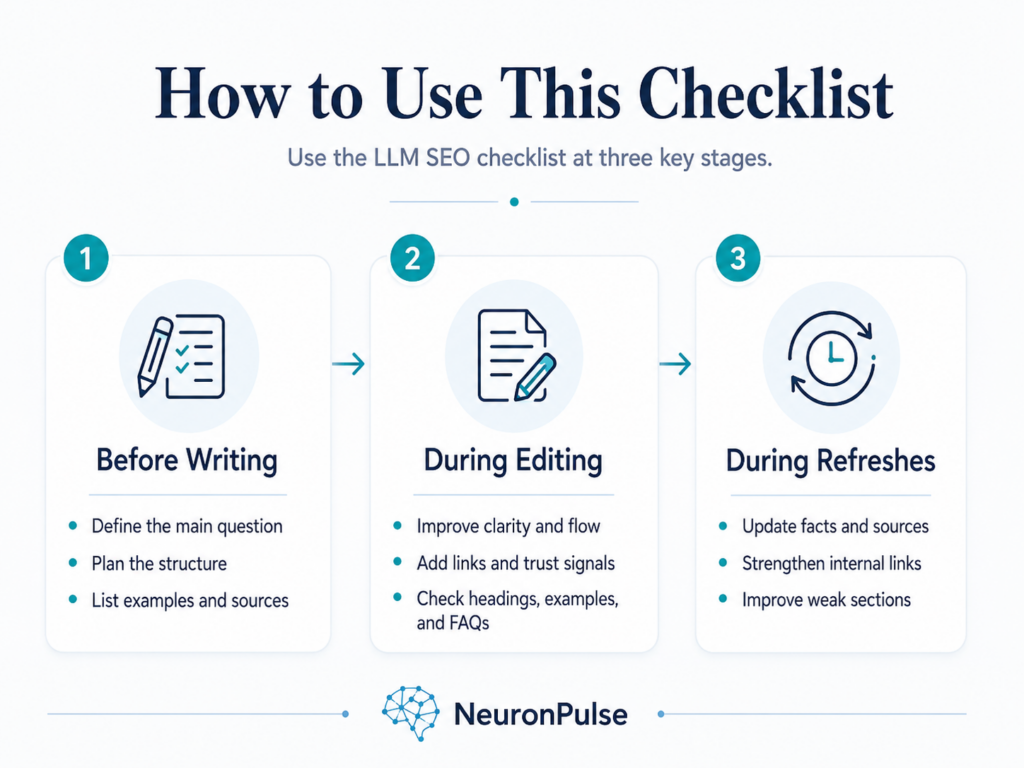
Do not treat this checklist as a one-time publishing step. There are various steps in writing for LLM SEO where you can use this list.
In general, you can use it in three places:
Before writing
Use the checklist to plan the article.
Decide:
- what question the page answers
- what related questions it should cover
- which examples you need
- which internal links should be included
- which sources you may need to cite
During editing
Use the checklist to improve the draft.
Look for:
- vague intros
- weak headings
- missing examples
- repetitive sections
- unsupported claims
- thin FAQs
- poor flow
During content refreshes
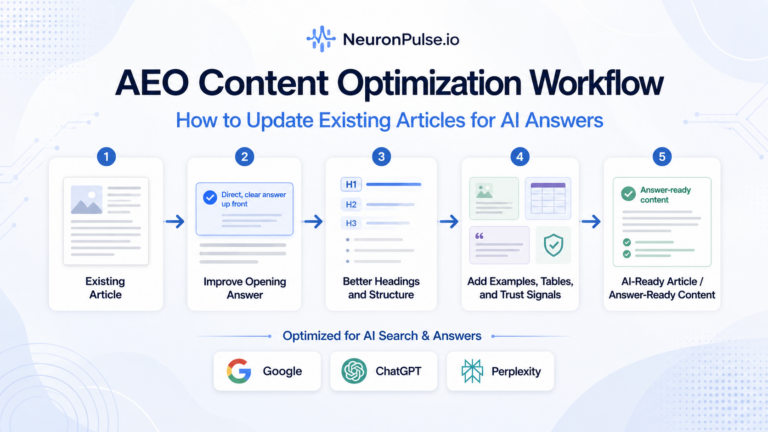
Use the checklist to update old articles.
This is especially useful for content that used to perform well but has lost traffic.
Ask:
- Is the article still accurate?
- Does it answer quickly enough?
- Are better examples needed?
- Are newer sources available?
- Should it link to newer articles?
- Can it be improved for AI search?
A checklist is most valuable when it becomes part of your workflow. This list can be applied when coming up with concepts, writing your first draft and editing articles later on. The more you check off the list the better your content will be at appearing in LLMs.
Example: Applying the Checklist to an Old Article
Imagine you have an old article titled:
Best AI SEO Tools
It might have ranked well in traditional search, but now it needs to be improved for AI search.
Using this checklist, you might update it by adding:
- a direct answer near the top
- a comparison table
- “best for” recommendations
- recent screenshots
- pricing update notes
- clear definitions of AI SEO, AEO, and LLM SEO
- FAQs about tool selection
- internal links to your AI search guides
- a visible updated date
- a short methodology explaining how tools were chosen
That turns a generic list article into a more source-worthy guide. With those changes, it should be more likely to appear in LLM search and citations. It’s not a “hack”, you are just editing and adding more information to make the article better. Using the checklist is a way to cross off as many “requirements” as possible.
The same approach works for travel, local services, ecommerce, SaaS, and professional services.
Common LLM SEO Checklist Mistakes
Mistake 1: Treating the checklist like a formula
A checklist helps you improve quality. It should not make every article sound the same.
Use the checklist as a review tool, not a writing template.
Mistake 2: Adding FAQs without improving the article
FAQs are useful only when they answer real questions. Do not add them just because “AI search likes FAQs.”
Mistake 3: Confusing length with depth
A long article is not automatically better. Depth means usefulness, examples, clarity, and coverage of the right questions.
Mistake 4: Ignoring traditional SEO
LLM SEO does not replace technical SEO, keyword research, internal linking, or content quality. It builds on them.
Mistake 5: Publishing generic AI content
AI-assisted content can be useful, but generic content is easy to spot. Add human editing, examples, judgment, and original insight.
Final Takeaway
An LLM SEO checklist helps you create content that is easier to understand, easier to trust, and easier to use as a source.
The best AI search content is not robotic. It is clear, structured, practical, and genuinely helpful.
If your page answers the question early, explains the topic well, includes useful examples, shows credibility, and connects to a broader content cluster, it is much better prepared for ChatGPT Search, Perplexity, Google AI Overviews, Gemini, and other AI-powered discovery experiences.
The goal is simple:
Make your content useful enough for people and clear enough for AI systems to understand, summarize, and cite.
FAQ About the LLM SEO Checklist
LLM SEO is the process of optimizing content so large language models can understand, summarize, cite, and recommend it in AI-powered search experiences.
Yes, but they overlap. Traditional SEO focuses on crawlability, rankings, keywords, links, and organic visibility. LLM SEO adds more emphasis on clarity, structure, source-worthiness, topical authority, and AI citation potential.
Yes, but they overlap. Traditional SEO focuses on crawlability, rankings, keywords, links, and organic visibility. LLM SEO adds more emphasis on clarity, structure, source-worthiness, topical authority, and AI citation potential.
No. No checklist can guarantee that ChatGPT, Perplexity, Google AI Overviews, or any other platform will cite your content. The goal is to improve your chances by making your content more useful, accessible, and trustworthy.
For fast-changing AI search topics, review important articles at least every few months. For evergreen topics, review them when facts, tools, platform behavior, or search intent changes.
Schema can help search engines understand certain types of content, but it does not guarantee AI visibility. Use structured data when it accurately matches the visible page content.
No. FAQs are useful when they answer real follow-up questions. If the FAQ section feels repetitive or forced, keep it shorter or remove it.
Yes. Smaller websites can compete by being clearer, more specific, more useful, and more focused than larger generic sites. Strong niche expertise can be an advantage.
Start with the opening. Make sure the page answers the main question clearly in the first few lines. Then improve headings, examples, internal links, and trust signals.