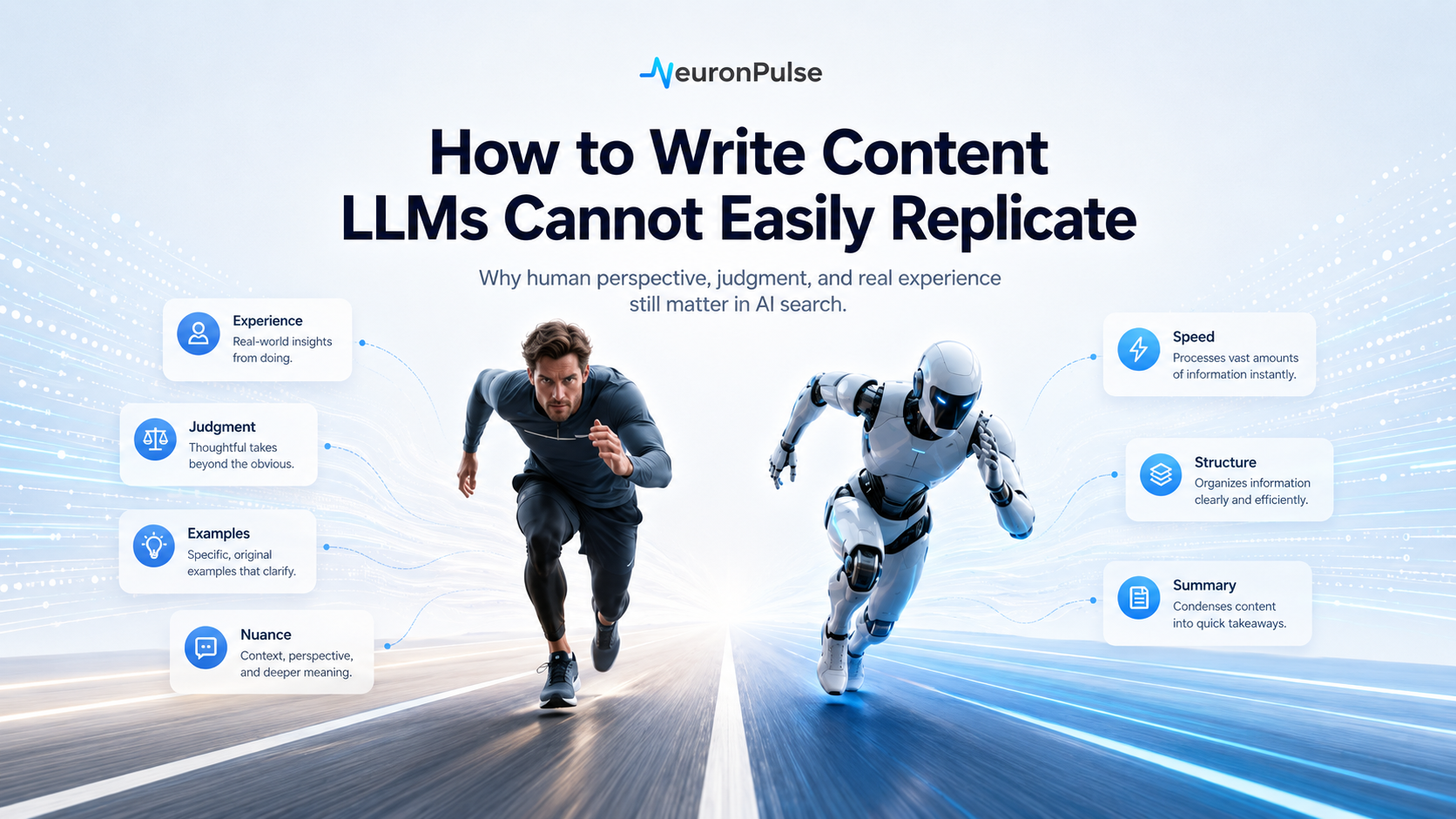
How to Write Content LLMs Cannot Easily Replicate
AI has made it easier to create clear, structured content. That is useful. It can help with outlines, summaries, rewrites, examples, FAQs, and first drafts. But it also creates a new problem: a lot of content is starting to sound the same. You can pretty much just have an LLM like ChatGPT create a great piece of content with near-perfect structure, full of important facts, data, etc.
Many articles now have the same structure, the same advice, the same polished tone, and the same safe conclusions. This makes them boring and not very relatable.
The next advantage is not just structure, it is creating and adding the human perspective to your content.
If you want to learn how to write content LLMs cannot easily replicate, you need to add the parts that come from experience: real examples, judgment calls, niche context, mistakes, opinions with reasoning, practical warnings, and specific observations. Bascially any experience that comes from actually “doing the thing” and placing that in your content will make it better. As we speak Google is rolling out more updates that focus on the aspect of “human proof” in content.
In other words, do not just answer the question. Show that you understand the situation behind the question. Write your answers from a first-hand, first-person perspective when possible.
Why Clear Content Is No Longer Enough
For a long time, being clear was a competitive advantage. A lot of websites were confusing, overstuffed with keywords, or written mainly for search engines. If you could write a clean article with good headings, simple explanations, and useful examples, you were already ahead of many competitors.
Clarity in your writing is still very relevant but that alone is not enough. Clarity is easy to copy with LLMs now.
An AI tool can generate a reasonable explanation of most common topics. It can define terms, create a list of best practices, summarize pros and cons, and produce a polite conclusion. If you don’t think that’s the case, you can try it out right now with your favorite AI tool.
For example, ask an AI tool to write about:
- how to improve blog introductions
- what AEO means
- how to build an emergency fund
- best time to visit Peru
- how to choose a project management tool
- how to optimize a service page
The output will often be readable and even useful as a starting point. Once you’ve done that, congratulations, you have created (in a way) some amazing content. However, it will usually lack something important: lived judgment.
It may tell the reader what is generally true, but not what matters most in a specific situation. It may give best practices, but not tell you which best practices are overrated. It may summarize advice, but not reveal what someone with experience would notice. The AI tool has all the information in the world, but none of the lived experience. The human perspective becomes the difference now.
What LLMs Are Good At
Before talking about what LLMs struggle with, it is worth being fair about what they do well. LLMs are good at producing organized, general-purpose content. They can help with:
- definitions
- summaries
- outlines
- basic comparisons
- simple examples
- standard FAQs
- rewriting for clarity
- turning notes into paragraphs
- formatting ideas into tables
- brainstorming angles
- generating first drafts
That can save a lot of time. For years many marketers struggled to organize content, today any AI tool can help you put that together. A few prompts into ChatGPT or Google Gemini and we’re on our way.
If you are starting with a blank page, AI can help you get moving. It can give structure to messy thoughts. It can help you see obvious subtopics you may have missed.
But that strength also creates a weakness. Because LLMs are good at summarizing common patterns, their content often reflects common patterns. It tends to produce the average version of an answer unless you guide it carefully and add something original. If you specialize in prompt engineering you understand what I’m talking about.
That is why AI-assisted content needs human editing. Not just grammar editing. Editorial editing.
The question should not be:
Is this article readable?
The better question is:
Does this article say anything that a generic summary would not?
What LLMs Struggle to Replicate
LLMs can imitate style, but they do not truly have your experience.They can produce an article that sounds confident, but they do not know what you have seen, tested, sold, fixed, planned, or learned the hard way. I’ve tried using various AI tools for writing long-form content, and it generally never works out right out of the box.
My experience includes digital marketing, SEO, AEO, SEM, travel writing, entrepreneurship, filming, photography, teaching, etc. I’ve held corporate jobs and also been on business on my own. I’ve lived in different countries, speak several languages, learned firsthand about different cultures, foods, and so on. The LLM can’t replicate that into creating content, unless I know exactly how to program its output. But even then, it won’t be the same.
That is your advantage.
LLMs struggle to replicate:
- first-hand experience
- original examples
- personal judgment
- niche-specific nuance
- taste and editorial decision-making
- real customer objections
- mistakes and lessons learned
- practical trade-offs
- field observations
- screenshots or data from your own work
- opinions backed by reasoning
- “what I would actually do” recommendations
This does not mean every article needs to become personal. You do not need to turn every SEO guide or travel article into a diary. Sometimes you just need to add important information that you know works or is helpful.
But you do need to add proof that the article is coming from someone who understands the topic beyond the surface. A generic article explains the topic. A stronger article explains the topic and shows how it plays out in the real world.
Information vs Perspective
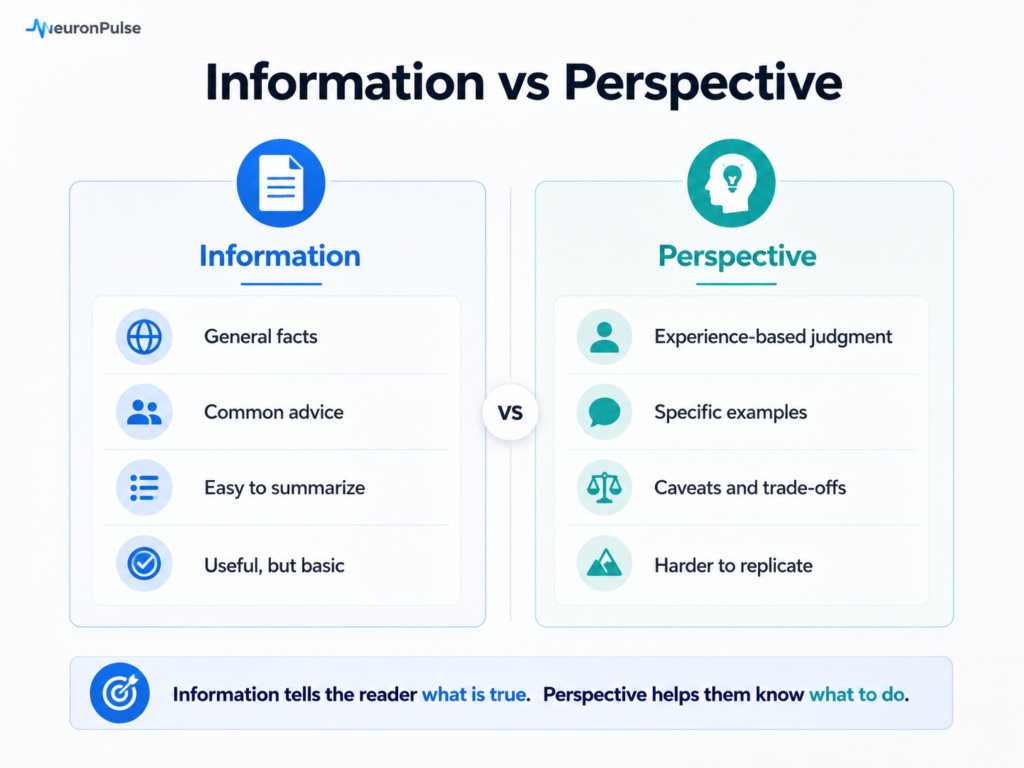
So we can have all the information in the world at our fingertips but that doesnt mean it has a perspective that really matters. This is the difference between you and the LLM.
Information tells the reader what is generally true. This is perfect, we need information and so does the reader.
Perspective helps the reader understand what to do with that information. This is equally as important or maybe even more so.
Here is a simple travel example.
Information
Travelers should spend time in Cusco before visiting Machu Picchu because of the altitude.
That is useful, but it is general.
Perspective
For many first-time Peru travelers, I prefer sending them to the Sacred Valley before Cusco when the itinerary allows it. The Sacred Valley is lower in altitude, the route to Machu Picchu feels smoother, and travelers often adjust better than if they fly into Cusco and immediately spend their first nights there.
That second version is stronger because it contains judgment. It does not just repeat a fact. It explains a planning preference based on experience.
Here is an AI search example.
Information
Add FAQs to make your content more useful for AEO.
Perspective
FAQs only help when they answer real follow-up questions. If the FAQ section repeats the article or exists just to squeeze in keywords, it can make the page feel bloated and more AI-generated, not more useful.
Again, the second version is stronger because it adds judgment.
The goal is not to make every paragraph opinionated. The goal is to know when plain information is not enough.
One real world example I recently experience was with Google ads. I asked gemini to review my performarce for a campaign that needed improving. The LLM analyzed and suggested I remove some negative keywrods from my list because contextually it was preventing my ads to appear for related searches. I knew in my mind this was wrong because I’ve tried this suggested change before and had bad results with it.
In a way, Gemini was correct. The negative keyword was blocking related keywords that were close to the topic. However, they were for informational search and would never generate a lead. The LLM also failed to understand that I already had a blog post ranking on the first page of Google for the very keyword.
That’s lived experience and the perspective of a seasoned marketer.
Why Human Perspective Matters for AI Search
AI search raises the bar for content. If a user asks a question and an AI system can summarize the general answer, your content needs a reason to be selected, cited, trusted, or clicked. I’ll make this easy:
Most online websites are going to have perfect or near-perfect article structure, general facts, grammatically correct syntax, the best title, keywords, etc. That’s not in 5 years, that’s now.
Your content needst to stand out somehow to counter the perfectly structured articles floating around now. So what can make your content original:
That reason may come from:
- original research
- clear expertise
- better examples
- practical frameworks
- trusted sourcing
- unique experience
- a more useful explanation
- a sharper point of view
- An un edited photograph
- Adding explainer videos
This is why generic content has a problem.
If your page says the same thing as ten other pages, it gives readers and search systems very little reason to prefer it. Even if it is technically correct, it may not be distinctive.
Human perspective can make a page more useful because it adds context that general summaries often miss.
For example:
- A travel advisor can explain why a route looks good on paper but feels rushed in real life.
- A finance writer can explain when the standard “three to six months” emergency fund advice may not be enough.
- A marketer can explain why a tactic works for a SaaS blog but feels wrong on a luxury travel page.
- A product reviewer can explain what changed after using the tool for two weeks, not just what the feature list says.
Those details make the content harder to replace with a generic answer. So how do we now structure our human-proof content? Well, I’m glad you asked. We do so with a HUMAN Framework.
The HUMAN Framework for Original Content
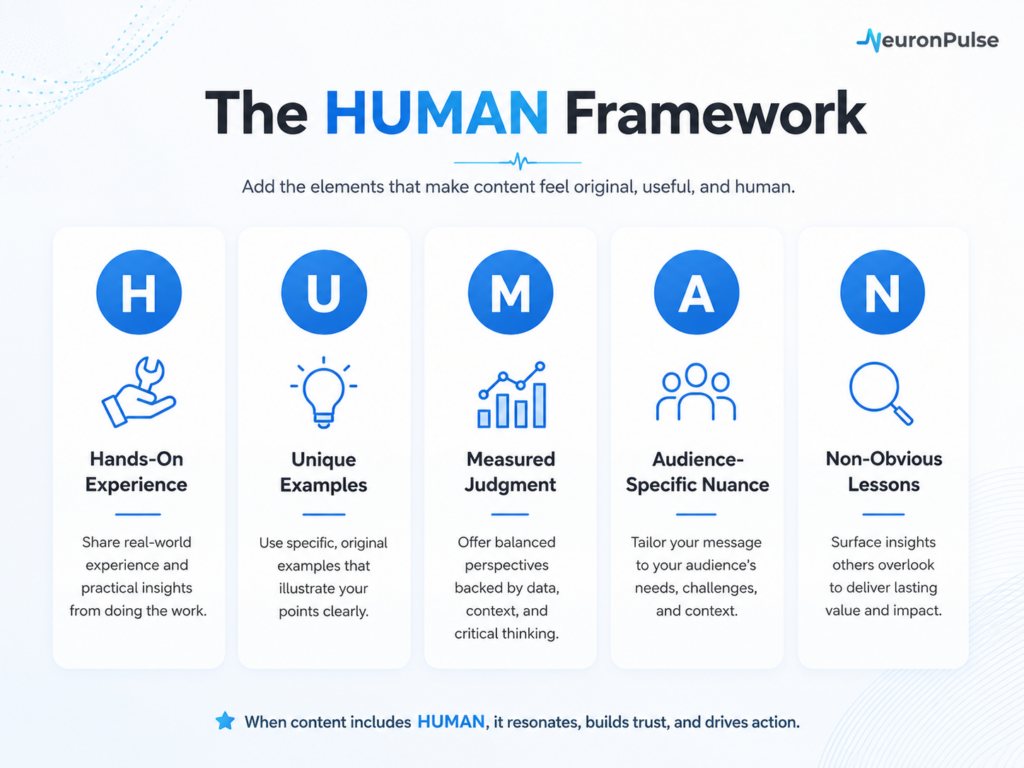
To make content easier to create, edit and put together, use the HUMAN Framework. It is a simple way to check whether your content has enough human perspective.
H — Hands-On Experience
Hands-on experience means showing what you have actually done, seen, tested, or observed. We want to see that you “actually did the thing” if you are talking about doing the thing.
This could include:
- a client situation
- a real workflow
- a campaign result
- a planning decision
- a content edit you made
- a tool you tested
- a customer objection you heard
- a mistake you corrected
Generic content says:
Use internal links to improve topical authority.
Hands-on content says:
After publishing a new workflow article, I usually go back to the older definition articles and add internal links from the most relevant sections. That helps the new piece become part of the cluster instead of sitting as an isolated post.
That is more useful because it shows the process. A person is giving a real reason as to why they use internal links, when he checks and what the purpose of doing so is.
U — Unique Examples
Examples are one of the fastest ways to make content feel original.
But the examples need to be specific because an LLM can also give you endless examples to use.
Weak example:
For example, a business can use AI to improve marketing.
Better example:
For example, a local accounting firm could turn a generic “tax planning tips” article into a stronger answer-ready page by adding sections for freelancers, small business owners, and retirees. Each audience has different questions, so one generic answer is not enough.
The better example gives the reader something to picture.
If your article has no examples, it may still be correct. But it will probably feel thin, and its a missed opportunity to not show your “human proof”.
M — Measured Judgment
Measured judgment means saying what you actually think, without turning the article into a hot take.
It is the difference between:
This tactic is important.
and:
This tactic is useful, but only when it improves the reader’s experience. If it makes the page longer without adding clarity, I would skip it.
That kind of judgment is valuable because readers do not only want options. They want help deciding. Your personal input on a process, service, or tool is important and can be a deciding factor for many readers. This does not mean being completely negative about something.
Measured judgment often uses phrases like:
- I would use this when…
- I would avoid this if…
- This works best for…
- The trade-off is…
- In practice, this matters more than…
- The mistake I see most often is…
These phrases make the content feel like it came from someone who has thought about the problem. Readers will appreciate it, and LLMs will see it as lived experience/proof of being human.
A — Audience-Specific Nuance
Different audiences need different explanations.
A beginner does not need the same answer as an expert. A small business owner does not need the same strategy as an enterprise SEO team. A traveler planning a honeymoon does not need the same information as a backpacker.
Generic content ignores those differences and specific content adapts to them.
For example:
A 2,500-word AI search audit guide may be useful for marketers, but too much for a small business owner who just wants to know why their site is not appearing anywhere. For that reader, a checklist, a short explanation, and a simple next step may work better.
Audience nuance helps your article feel more precise. Writing for a specific audience will make your content easier to understand, easier to parse for LLMs, and allow you to speak directly to an audience searching for specific pieces of information.
It also helps prevent robotic content because it forces you to think about the person reading. This article is mostly directed at people trying to understand how to position their content in the LLM age, usually with some SEO experience. Would it be easily understood if it were shown to someone looking to learn how to write a short story?
N — Non-Obvious Lessons
Non-obvious lessons are the details that only appear after experience. We’ve all made mistakes at some point or another. LEarning from our mistakes is what can make us better at our jobs or life in general. So what if we apply or at least mention these lessos in our content. Something like “Running is great for weight loss, but 5 miles a day can ruin your joints without using a proper running form”.
We give a reason as yo why something might not work the way we originally intented it to. This is another “lived experience”.
They are the things that make the reader think:
“That is useful. I had not thought about it that way.”
Examples:
- FAQs can make a page worse if they repeat the article.
- A direct answer is not always the best first sentence in travel content.
- A content workflow can improve quality, but it can also make every article sound the same if you do not vary the rhythm.
- A checklist is useful only if it helps someone make a decision, not if it is just a summary of the article.
- The best article to optimize first is not always the one with the most traffic. It may be the one sitting in position 8–20 with clear intent.
These are the kinds of insights that separate expert content from a generic summary. So even in the era of AI tools, we can use our previous mistakes to our advantage.
How to Add Human Perspective to an Article
You do not need to rewrite your entire content strategy. Start by adding perspective in places where the article feels too general or thin. Look for gaps in your content that would allow for nuance, perspective, examples, etc.
Here are practical ways to do it.
1. Add a Real Example
A real example makes advice easier to understand. One can look up most sections of an article and think about adding an example somewhere. I have an example below for your reference:
Generic:
Add specific examples to your article.
Better:
If you are writing about emergency funds, do not only say “save three to six months of expenses.” Explain that a freelancer with irregular income may need a larger cushion than a salaried employee with stable benefits.
The second version gives context. It helps to explore the idea a little bit more and gives us more helpful content.
It also shows that the advice changes depending on the situation so it also shows nuance.
2. Explain a Mistake You Learned From
Mistakes are valuable because they create trust.
You do not need to overshare. Just explain what people often get wrong. Give an example of a mistake you made that helped you learn something useful.
Example:
One mistake I made early with AEO-style content was making every intro too direct. That worked for technical articles, but it felt flat for travel content. In travel, the reader often needs a little atmosphere because they are not just collecting information. They are imagining the trip.
That kind of comment gives the reader a useful distinction. It also shows that the recommendation is not theoretical. I really did try a more AEO style content campaign and results were mixed because potential travelers want to fall in love with a destination or an activity. AEO-style content with its direct answers proved to be the wrong direction unless some editing took place.
3. Include a “What I Would Do” Recommendation
Readers appreciate clear judgment. If you can help, then make better decisions through your content with recommendations, readers will probably share the content with others. LLMs love to find personal recommendations from users and cite them in results like Google AI overviews.
Example:
If I were updating an old article with impressions but no clicks, I would not rewrite the whole thing first. I would check the queries in Google Search Console, rewrite the intro to match the strongest query, add answer blocks under the main headings, and strengthen internal links from related posts.
That is more useful than saying:
Improve your article based on performance data.
The difference is specificity. Telling your audience the steps they can take (with an AEO structure in this case) can be an amazing addition to your content.
4. Show the Decision-Making Process
Strong content often explains why a recommendation changes.
Example:
If the article is a definition piece, I would answer directly in the first paragraph. If it is a destination guide, I would still answer early, but I would allow more descriptive language because the reader needs to feel interested in the place.
That helps the reader understand the logic, not just the instruction.
5. Add a Niche-Specific Caveat
Caveats make content more trustworthy.
Generic advice often sounds too absolute.
Example:
Add tables when the reader is comparing options.
Better:
Add tables when the reader is comparing options, but avoid forcing a table into a narrative article where emotion or story matters more. A table can make a travel itinerary easier to scan, but it may weaken a destination introduction if it replaces the sense of place.
That caveat shows editorial judgment. In my opinion caveats and nuance + AI tools will dominate AI search results for the next few years.
6. Include Screenshots, Data, or Observations
Original visuals and data make content harder to replicate. Don’;’t underestimate screenshots of your tools, photographs of travel destinations, hard data sheets you can share, client reviews, etc.
You can include:
- screenshots from your process
- before-and-after examples
- GSC observations
- content audit notes
- tool test results
- anonymized client examples
- internal checklists
Even small observations can help.
Example:
In GSC, I often pay close attention to pages with impressions but weak average positions. Those pages are already being tested, so they usually give better clues than brand-new articles with no data.
That is more useful than saying:
Use analytics to improve content.
7. Compare Theory vs Reality
This is one of the best ways to add perspective.
Example:
In theory, every article should answer the main question immediately. In reality, some niches need a softer opening. A finance article usually benefits from direct clarity. A travel article may need one or two lines of atmosphere before the answer, because the reader is also buying into a destination.
That is an expert distinction.
It keeps the article from sounding like a rigid formula.
Examples Of Human Perspective Content by Niche
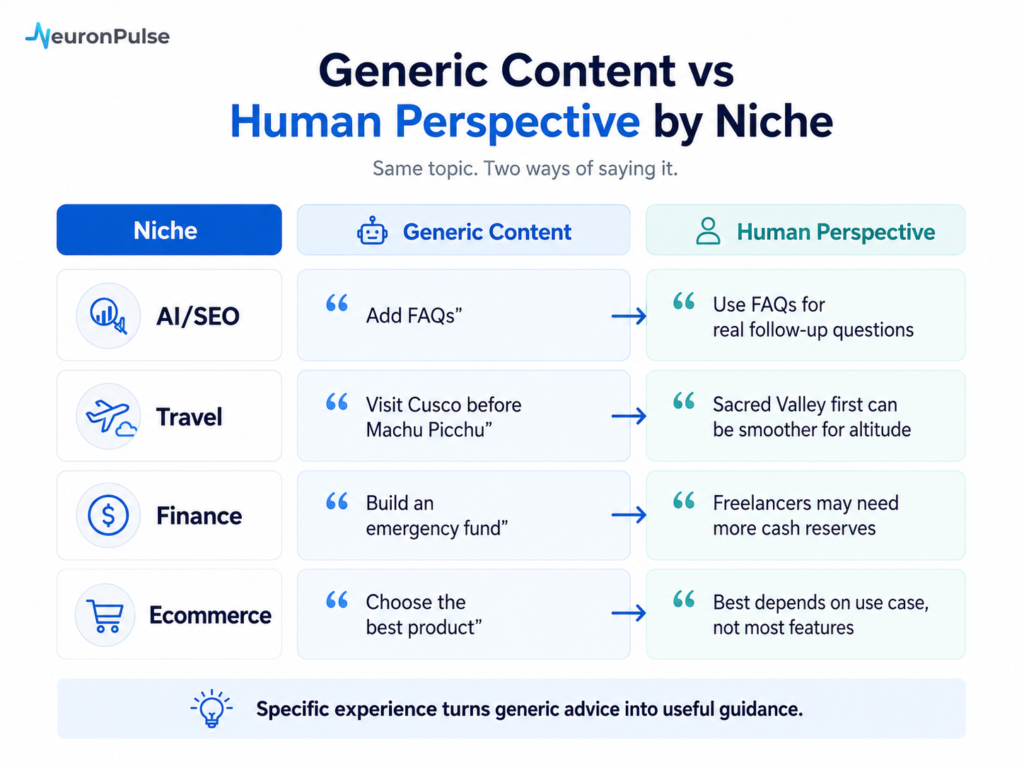
Human perspective becomes clearer when you compare generic and specific examples. Let’s go over some niches nd how we can improve the “Human-Proof” factor in each.
AI and SEO
Generic
Add FAQs to improve AEO.
Human perspective
FAQs help only when they answer real follow-up questions. If the FAQ section repeats what the article already explained, it adds length without adding value. I would use FAQs to handle objections, edge cases, and practical questions the reader may still have after the main article.
Travel
Generic
Visit Cusco before Machu Picchu.
Human perspective
For many first-time travelers, I would rather send them to the Sacred Valley before Cusco when the itinerary allows it. The Sacred Valley is lower in altitude, it shortens the route toward Machu Picchu, and it often makes the first two days of the trip feel smoother.
Finance
Generic
Build an emergency fund.
Human perspective
The right emergency fund is not always three to six months. A single person with a stable salary and low expenses may be comfortable with less. A freelancer, parent, or business owner with irregular income may need more cash because their risk is different.
Ecommerce
Generic
Choose the product that fits your needs.
Human perspective
The best product is not always the one with the most features. If a buyer only uses the product twice a month, the simpler version may be the better recommendation because it has fewer things to break, costs less, and still solves the actual problem.
Local Services
Generic
Choose a provider with good reviews.
Human perspective
Reviews matter, but I would also look for signs that the provider handles your specific situation. A law firm with many reviews may not be the best fit if your case is unusual. A smaller firm with relevant experience may be more useful than the highest-rated general option.
Health and Wellness
Generic
Talk to your doctor before starting a new supplement.
Human perspective
That advice is correct, but it is more useful when you explain why. Supplements can interact with medications, affect lab results, or be inappropriate for certain conditions. The warning matters more for someone pregnant, managing thyroid issues, or taking blood thinners than for a generally healthy person taking a basic multivitamin.
How to Tell If Your Content Sounds Too Generic
Sometimes it is hard to see generic writing in your own article. If you are like me, I don’t like anyone reading my content before I hit publish (this is of course a mistake). So if you need to check if you content is too generic or maybe even boring, check the bullet point examples below.
Here are signs the content needs more human perspective:
- The advice could apply to almost any niche.
- The article has no examples.
- Every section sounds like a summary.
- The intro starts with a broad trend statement.
- There are no trade-offs or caveats.
- The content never says what to do first.
- The article explains what something is but not how it works in practice.
- The writing sounds polished but empty.
- The conclusion repeats the intro.
- A reader would leave knowing the topic but not knowing what to do.
A simple test:
Could an AI tool produce a similar article with a basic prompt?
If the answer is yes, add more specificity, examples, judgment, or original observations. If AI can replicate your article than it is not original enough to stand out in the web today. Creating content that is structured for AI overview, ChatGPT results or citations on perplexity is a skill that AI cannot easily copy.
What Not to Do
Human perspective helps, but it needs to be used carefully. Do not fake experience. Readers can tell when a writer adds “in my experience” without actually saying anything specific. Remember, we are looking for the writer to “actually do that thing, and be an expert on it” not just write about it.
Weak:
In my experience, content quality is very important.
Better:
In my experience, the easiest way to improve a weak article is not to add more words. It is to find the point where the reader expected an answer and give them one sooner.
That second version contains a real point.
Also avoid forced opinions.
Not every section needs a strong take. Some topics simply need clarity. The goal is to add perspective where it improves the article, not to make every paragraph sound provocative.
Avoid:
- fake personal stories
- vague “expert” claims
- hot takes without reasoning
- over-personalizing simple topics
- adding anecdotes that do not help the reader
- pretending to have tested something you have not tested
- using “I” constantly when the article should focus on the reader
Human perspective should serve the content.
It should make the article more useful, not more self-centered.
Human Perspective Does Not Mean Ignoring SEO
This is important. SEO is still the best way to make sure the basics of your online content are met. Adding human perspective does not mean abandoning SEO structure.
You still need:
- clear headings
- search intent alignment
- direct answers
- internal links
- useful examples
- readable formatting
- credible sources when needed
- a logical article structure
The point is to combine structure with originality. A well-structured article without perspective can feel generic, boring and a waste of time. A personal article without structure can feel scattered, with flares of ideas rocketing about but too difficult to fully understand. The strongest content has both. It answers clearly, then adds the kind of insight that makes the reader trust the source.
Human Perspective Checklist
Before publishing, ask:
| Question | Why It Matters |
|---|---|
| Does the article include a real example? | Makes the advice easier to understand |
| Does it include a judgment call? | Shows the reader what matters most |
| Does it explain what people often get wrong? | Adds practical value |
| Does it include niche-specific nuance? | Prevents generic advice |
| Does it show when the advice changes? | Builds trust |
| Does it include a caveat? | Avoids overgeneralizing |
| Does it include original observations or data? | Makes the article harder to replicate |
| Could a generic AI prompt produce the same article? | Tests originality |
Use this checklist after the first draft, not before.
The first draft is for getting ideas down. The second draft is where you add perspective.
A Simple Prompt to Add Human Perspective
As if we weren’t using AI enough. There are prompts that can save you valuable hours of your day to help you with this very thing. You can use AI to help find places where your article is too generic.
Try this prompt:
Review this article and identify sections that sound too generic or summary-like. For each section, suggest where I could add human perspective, such as a real example, a judgment call, a niche-specific caveat, a practical warning, or a what-I-would-do recommendation. Do not rewrite the full article. Focus on where the content needs more originality and experience.Then use your own judgment on the results. AI can identify weak spots, but you need to provide the real perspective as the resident expert. That is the part it cannot fully invent for you because it has not lived that experience.
Final Takeaway
AI has made it easier to create content that is clear, organized, and technically correct. That also means technically correct content is no longer enough. If your article only summarizes common information, it can blend into everything else. To stand out, it needs human perspective: experience, examples, judgment, nuance, caveats, and original observations.
The goal is not to write strangely just to prove a human was involved. The goal is to make the article more useful than a generic summary. Clear answers help readers understand. Human perspective gives them a reason to trust you. Your content needs to meet both those criteria in today’s internet.