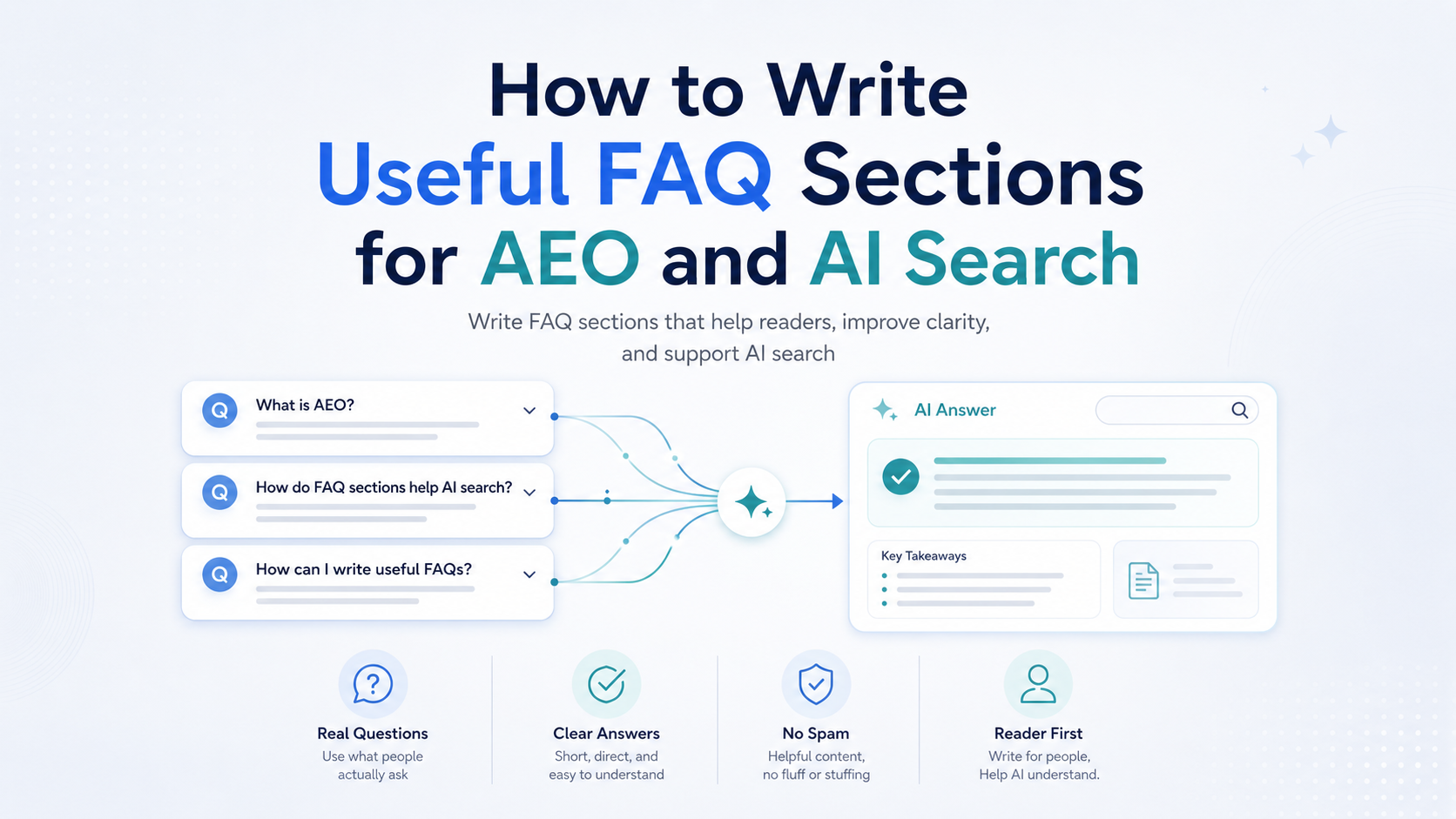
How to Write Useful FAQ Sections for AEO and AI Search
FAQ sections used to be treated like an easy SEO add-on.
Write a few questions, add FAQ schema, and maybe Google would reward the page with extra visibility in the search results. That tactic is mostly gone. Google reduced FAQ rich results in 2023, limiting them mainly to well-known, authoritative government and health websites, and Google’s current FAQPage documentation still frames FAQ rich results around those kinds of sites. In fact, Google recently reports removing or has removed the remaining FAQ rich-result support from Search features/reporting in 2026.
But that does not mean FAQ sections are useless. It means the reason to use FAQs has changed.
A good FAQ section is not there to “hack” the search results. It is there to answer the questions a reader still has after reading the main article. When written well, FAQs can make a page clearer, easier to scan, more complete, and more useful for answer-driven search experiences.
For AEO, GEO, and AI search, the value of FAQs is not the markup. The value is the clarity of the questions and answers. So in essence, don’t create FAQs for markup purposes; instead, focus on making them a useful complement to your piece of content.
Why FAQ Sections Still Matter
FAQ sections still matter because readers rarely have just one question or there are still micro pieces of helpful content that can complement your already existing blog posts. FAQs can also be a section where you add questions that are closely related to the article but not quite close enough to make it as a subheading.
Someone reading an article about AI search may first ask:
What is AEO?
But after that, they may wonder:
Is AEO the same as SEO?
Does FAQ schema still work?
Can FAQs help with AI Overviews?
How many FAQs should I add?
Should I put FAQs at the bottom of every article?
A strong article answers the main topic in the body. A strong FAQ section handles the follow-up questions that would otherwise interrupt the flow.
So in my opinion, that makes FAQs useful for three main reasons.
First, they help the reader. A good FAQ section reduces friction because it answers doubts quickly. It is a short answer to a question that is not important enough to be part of the table of contents. So it doesn’t cut the flow of information of the article to the reader.
Second, they help the page feel more complete. If the article explains a process but leaves common objections unanswered, the reader may not trust the advice.
Third, they support answer-ready content. Google says AI Overviews provide AI-generated snapshots with key information and links to dig deeper, and its site-owner guidance for AI features focuses on helping Google understand and access useful web content. FAQs can support that goal when they clarify real questions instead of adding keyword-stuffed filler.
FAQ Content Is Not the Same as FAQ Schema
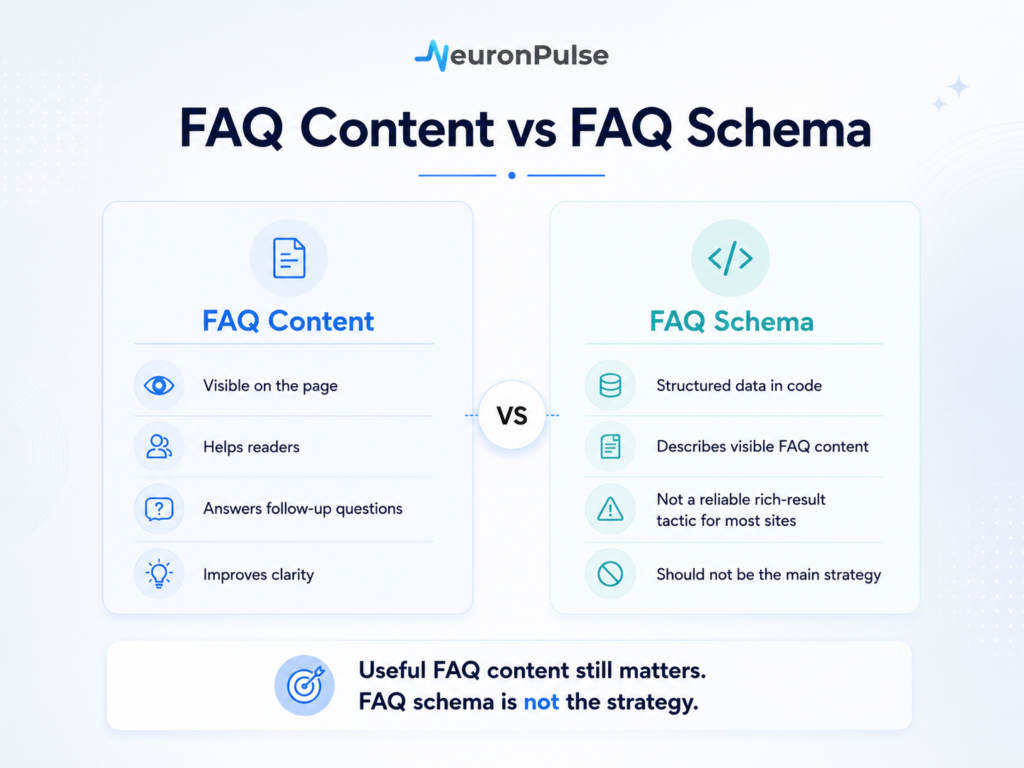
This distinction matters in the eyes of AI search, traditional SEO results as human readers.
FAQ content is the visible question-and-answer section on the page. You can add FAQ content without the necessity of making them in schema format.
FAQ schema is structured data added to the code to help search engines understand that visible FAQ content.
For most regular websites, FAQ schema is no longer a reliable way to get rich-result visibility in Google. Google announced in 2023 that FAQ rich results would only be shown for well-known, authoritative government and health websites, and its current FAQPage documentation repeats that availability limitation.
Why did Google decide to do this? That’s anyone’s guess. In my opinion FAQ schema was being abused. Google might have begun to see FAQ sections as a type of schema spam. If FAQ schema was not “demoted” in a sense, AI search results might be too crowded. For a couple of years, everyone was adding FAQ schema to their content even if it didn’t need it.
So do not build an FAQ strategy around the hope of getting expandable FAQ snippets in Google. That’s gone for now, and it probably won’t ever come back.
The focus should be in having an FAQ section where necessary and we need it around usefulness.
A page can have a valuable FAQ section even if it never produces an FAQ rich result. The questions can still help readers make decisions, understand the topic, and find quick answers. In many cases, that is more important than the schema. Remember that your content does not have to be coded in schema for LLMs to cite your content.
A practical rule:
Write FAQs for readers first. Add schema only when it accurately matches visible FAQ content and makes sense for the site. Never treat FAQ schema as the main strategy.
What Makes an FAQ Section Useful?
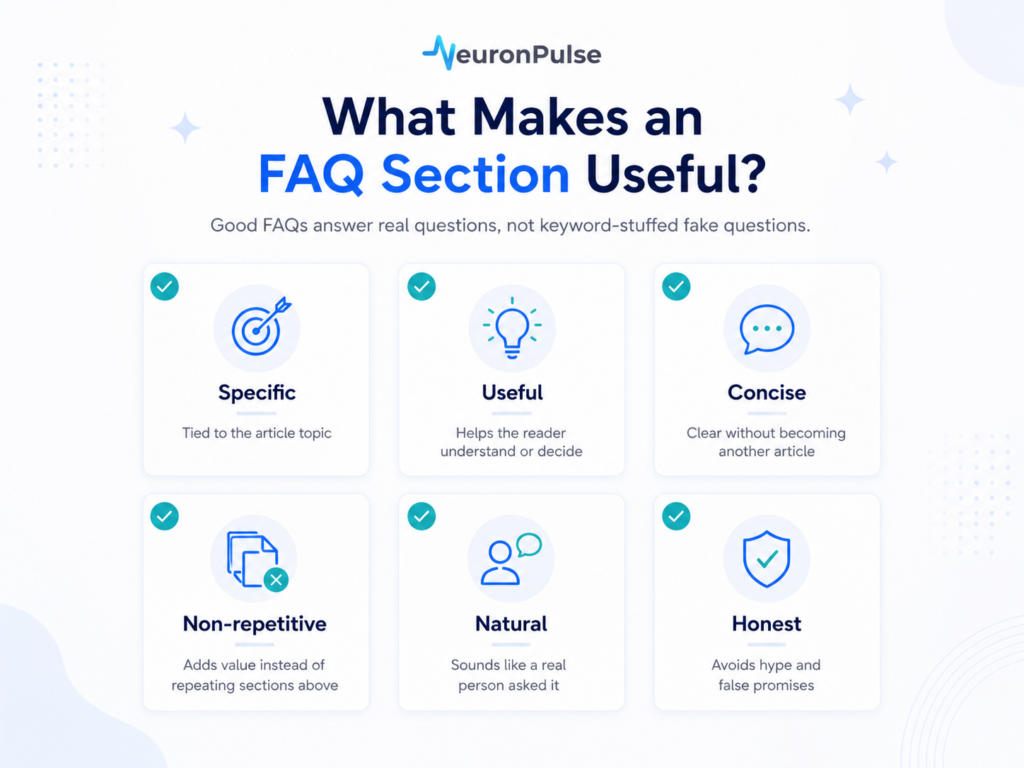
A useful FAQ section answers questions the reader is likely to have after reading the article. So we need to think of items that have not been answered, or only partially answered in our content.
That sounds simple, but many FAQ sections fail because the questions are not real. They are written for keywords, not readers. Adding more sections of content so we can stuff keywords is what someone would call old SEO tactics. That does not work anymore, or at the very least, it doesn’t work effectively enough to warrant making your content look spammy.
A weak FAQ section often includes questions like:
- What is the best solution?
- Why is this important?
- How can I get started?
- What should I know?
Those questions may be fine in some cases, but they are often too generic or don’t really answer any follow-up questions the user might have about the topic. They could appear on almost any page.
A stronger FAQ section is more specific:
- Does FAQ schema still help regular websites?
- Should I add FAQs to every blog post?
- How long should FAQ answers be?
- Can FAQs help with AI search if Google no longer shows FAQ rich results?
- Should FAQs repeat points from the article or answer new questions?
Those questions feel more useful because they come from real uncertainty.
A good FAQ section should be:
| Quality | What It Means |
|---|---|
| Specific | The question is tied to the article topic |
| Useful | The answer helps the reader make a decision or understand the topic |
| Concise | The answer is clear without becoming another full article |
| Non-repetitive | It does not simply restate the same sections above |
| Natural | The wording sounds like something a person would actually ask |
| Honest | It avoids overpromising, especially around rankings or AI visibility |
The best FAQ sections feel like a helpful conversation after the main article.
Where Should FAQs Go in an Article?
Most FAQ sections work best near the end of an article.
That placement makes sense because FAQs usually answer follow-up questions after the main explanation, checklist, or workflow has already been covered.
But as with everything in life, there are exceptions.
If the article is long, you can add a smaller FAQ-style section inside the body. For example, a guide about AI search audits could include a short section called:
Questions to Ask Before You Audit a Page
That can work well because the questions are part of the workflow.
In general:
| Page Type | Best FAQ Placement |
|---|---|
| Blog article | Near the end, after the main content |
| How-to guide | After the steps or checklist |
| Comparison article | After the comparison table and analysis |
| Service page | Near the bottom, before or after the CTA |
| Product page | Near buying objections, shipping details, or specifications |
| Long guide | Small question sections inside the article plus final FAQ |
Avoid putting a huge FAQ block too early. If the reader sees ten questions before getting the main explanation, the page can feel cluttered. In this case the user might not feel the need to read beyond the FAQs.
How to Find Real FAQ Questions
The easiest way to write better FAQs is to stop inventing them from scratch. Sure, we can think of questions a user might have, but at this stage we have access to tons of data that can give is exactly what we, and the user, are looking for. It is also a great way to find ideas for sections when structuring your articles for AI answers.
Use real sources of questions.
Start with:
- Google Search Console queries
- People Also Ask results
- customer emails
- sales calls
- support tickets
- Reddit and forum discussions
- comments on YouTube or LinkedIn
- competitor pages
- your own article sections
- objections you hear repeatedly
For example, if you are writing about FAQ sections for AEO, real questions might include:
- Does FAQ schema still matter?
- Are FAQs good for AI search?
- How many FAQs should I add?
- Should every article have an FAQ section?
- Can FAQs make content look spammy?
- Should I use the same question in the article body and FAQ?
- Should FAQ answers be short or detailed?
These are better than generic questions because they reflect actual decisions a content editor has to make.
A simple method:
- Read the article.
- Write down what the reader may still be unsure about.
- Check GSC or search results for related questions.
- Choose the questions that genuinely improve the page.
- Cut anything that feels like filler.
The point is not to add every possible question. The point is to add the right questions. Personally, I’m a big proponent of checking on Google Search Console. You can find tons of good information by just parsing through the queries. Assuming your website isn’t new of course.
How Many FAQs Should You Add?
There is no perfect number. It’s really just up to whatever the writer thinks answers the most immediate follow up questions.
For most articles, 4 to 8 useful FAQs is enough.
A short article may only need three. A detailed guide may need ten or more. A service page may need FAQs that handle objections, pricing questions, timeline concerns, or process questions.
The number matters less than the usefulness. A page with five strong FAQs is better than a page with fifteen weak ones. I don’t recommend going over 15 FAQs unless your article somehow warrants it. I can’t see many scenarios where an article needs more than 15 or 20 FAQs.
Use this as a practical guide to help you as a reference:
| Article Type | Suggested FAQ Count |
|---|---|
| Short blog post | 3–5 |
| Standard article | 5–8 |
| Long guide | 8–12 |
| Service page | 5–10 |
| Product or ecommerce page | Depends on buyer objections |
| Technical documentation | As many as needed, if organized well |
If the FAQ section starts to feel longer than the article itself, that is a sign the main content may need restructuring.
Some FAQ answers might deserve their own section in the article. Others may deserve a separate article entirely.
How to Write FAQ Answers That Sound Natural
A good FAQ answer should be clear, direct, and useful. It should not sound like a legal disclaimer, a keyword list, or a chatbot response. Try to add your own style into the FAQ section. Don’t forget to include human-proof sentences, sections, titles, etc. This is important because even if you are not using AI to create your content, certain filters might “think” you are. If you are looking to optimize content for Google AI overviews, then youre going to need to sound human and be helpful at the same time.
A strong answer usually follows this pattern:
Direct answer → brief explanation → practical detail if needed
For example:
Weak FAQ answer
Do FAQs help with AI search?
Yes, FAQs help with AI search because AI search is important and FAQs provide useful answers for users and search engines.
This is a circular explanation and ultimately thin and useless. Don’t just add FAQs for the sake of adding FAQS. Now let’s take a look at the better answer.
Better FAQ answer
Do FAQs help with AI search?
FAQs can help when they answer real follow-up questions clearly. They make the page easier to scan and can give AI systems cleaner question-and-answer context, but they do not guarantee citations, rankings, or AI Overview inclusion.
This is better because it gives a realistic answer.
Having real answers is key, especially in AI search content. Readers are already tired of exaggerated claims. Saying “this can help, but it does not guarantee results” builds more trust than pretending there is a magic tactic.
Today, there is no real magic tactic that will get traffic to your online property. You can’t “hack” and spamming content is not going to do much either. The only “real sauce” is coming up with and putting together good, clear content. So if you want to us FAQs remember that useful FAQ sections for AEO are there to add value to the user.
Should FAQ Answers Repeat the Article?
Sometimes, but not too much. A FAQ can briefly restate an important idea if readers are likely to look for the quick version. But if every FAQ repeats a section above, the page feels padded. ,
A better approach is to use FAQs for:
- objections
- edge cases
- clarifications
- quick definitions
- practical limits
- next-step questions
For example, if the article already explains how to write FAQs, the final FAQ should not simply ask:
How do you write FAQs?
That is too broad and repetitive. We just spent 10 minutes explaining how to write FAQs in this article. Why would it be helpful to answer the same question in the FAQs about how to write Useful FAQ questions for AEO and AI Search? IT would just look spammy and like if we were going around in circles.
A better question would be:
Should FAQ answers be short or detailed?
That adds a specific clarification.
The main article should teach. The FAQ section should clean up the remaining doubts.
FAQ Examples by Niche
Different niches need different FAQ styles. A finance FAQ should not sound like a travel FAQ. A healthcare FAQ should not sound like an ecommerce FAQ.
The format may be similar, but the tone changes.
Finance example
How much should I keep in an emergency fund?
Most people aim for three to six months of essential expenses, but the right amount depends on income stability, dependents, debt, and risk tolerance. A freelancer with irregular income may need a larger cushion than someone with a stable salary.
This works because it gives the common answer, then adds nuance so the reader has time to think.
Travel example
How many days do you need in Peru?
Most first-time travelers do well with 7 to 10 days if they want to see Lima, Cusco, the Sacred Valley, and Machu Picchu without rushing. Add more time if you want to include the Amazon, Lake Titicaca, Arequipa, or the Colca Canyon.
This answer is practical and helps the reader plan their trip.
Ecommerce example
Is the higher-priced version worth it?
The higher-priced version is worth it if you need the extra storage, longer battery life, or heavier-duty materials. If you only need the product for occasional use, the standard version may be the better value.
This helps the buyer decide instead of pushing the expensive option.
Local service example
How soon can I schedule an appointment?
Availability depends on the service, location, and season. For urgent needs, call directly instead of using a general contact form so the team can confirm the fastest available time.
This answers the practical concern without overpromising.
AI/search example
Do I need FAQ schema for AEO?
Not necessarily. FAQ schema is no longer a reliable rich-result tactic for most websites, but visible FAQ content can still help readers and improve page clarity. Use schema only when it accurately matches real FAQ content on the page.
This keeps the advice grounded.
Common FAQ Mistakes
So what are some mistakes people are making when creating FAQs? Some of these we’ve already gone over so lets list them out below for more clarity.
Mistake 1: Writing Questions Nobody Would Ask
If the question sounds like it was invented for SEO, cut it.
Weak FAQ:
Why is our company the best choice for innovative solutions?
Better FAQ:
How long does the audit usually take?
Real questions are usually more practical and less promotional. Real questions also elicit real answers and make everything more organic.
Mistake 2: Using FAQs to Stuff Keywords
A FAQ section should not repeat the target keyword in every question.
Weak:
What is the best AEO FAQ strategy for AEO FAQ optimization?
Better:
How do I know which questions belong in the FAQ section?
Natural language takes the win over robotic sentences.
Mistake 3: Repeating the Article Instead of Extending It
If the FAQ only repeats the same points, it adds length but not value. Use FAQs to answer what the article did not fully cover.
Mistake 4: Making Answers Too Long
If an FAQ answer needs 500 words, it may deserve its own section or article. Why would an FAQ question need as many words as a section in the article itself to answer? If you find that the FAQ answer is too long, maybe it should be under a subheading as part of the article, or as it’s own piece of content with its own FAQs added in.
Keep FAQs concise unless the page is documentation or a detailed support resource.
A Practical FAQ Writing Workflow
Here is a simple way to create a useful FAQ section without making it spammy.
Step 1: Read the article like a skeptical reader
Ask:
What would someone still be unsure about?
Write down those questions. It doesn’t matter how many; we can pick the best ones later on.
Step 2: Check real search and customer data
Look at GSC, People Also Ask, emails, comments, sales objections, and competitor pages. Do not copy questions blindly. Use them to understand what people actually care about.
Step 3: Choose only the strongest questions
Keep the questions that add clarity. Remove questions that repeat the article or exist only to include keywords.
Step 4: Answer directly
Start each FAQ answer with the answer. Add a short explanation only if needed.
Step 5: Check the tone
Make sure the answers sound helpful, not robotic or promotional.Use your own voice to create the FAQ section just like you did with the article.
Step 6: Decide whether schema is appropriate
If the page has a genuine visible FAQ section, FAQ Page markup may still accurately describe the content, but most regular websites should not expect FAQ rich-result visibility from it. Google’s current documentation limits FAQ rich results to well-known, authoritative government-focused or health-focused websites.
Useful FAQ Section Checklist
Before publishing, review the FAQ section with this checklist.
| Question | Why It Matters |
|---|---|
| Are these real questions? | Prevents fake, SEO-only FAQs |
| Does each answer add something useful? | Avoids filler |
| Are the answers concise? | Improves readability |
| Is the language natural? | Prevents robotic tone |
| Do the FAQs avoid repeating the article? | Keeps the page lean |
| Are claims realistic? | Builds trust |
| Is schema used only when appropriate? | Avoids relying on outdated tactics |
| Would a reader be glad this section exists? | Keeps the focus on usefulness |
The last question is the most important.
If the reader would not care about the FAQ, it probably does not belong.
Turning a Weak FAQ Section Into a Useful One
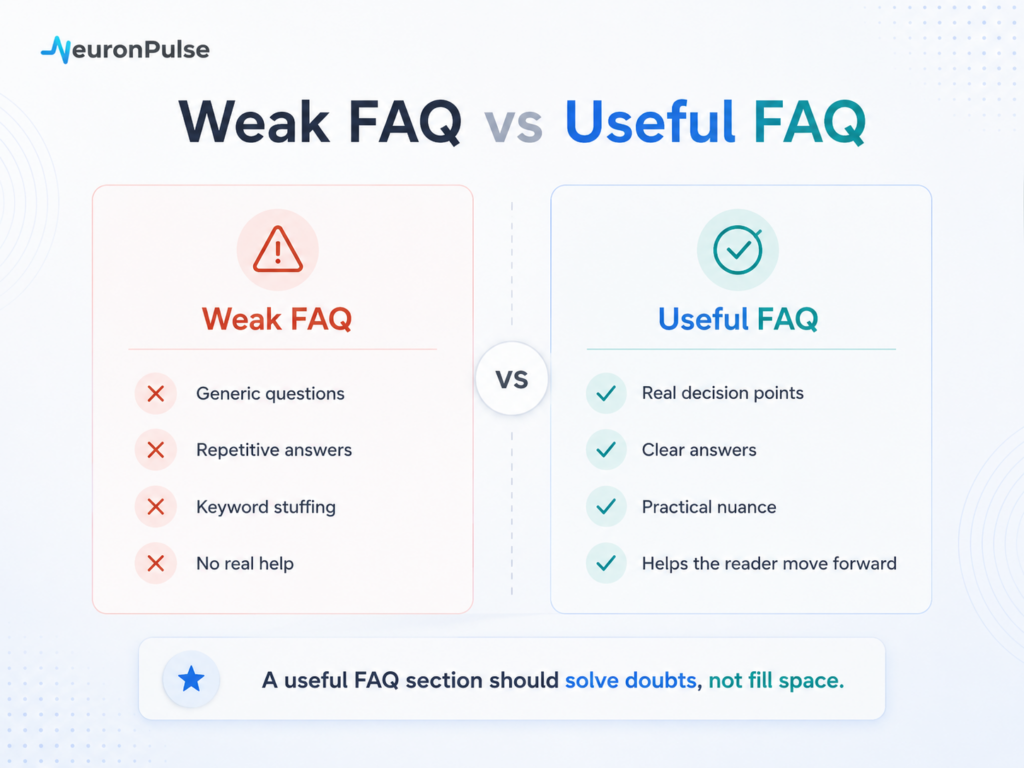
Let’s say an article is about how to choose a financial advisor. Below, I have three FAQs I would consider weak. Before reading the section with the better FAQs lets try and exercise and see if you can improve on them on your own.
Weak FAQ section
What is a financial advisor?
A financial advisor is someone who gives financial advice.
Why is a financial advisor important?
A financial advisor is important because finances are important.
How do I choose the best financial advisor?
You should choose the best financial advisor for your needs.
This section adds almost nothing.
Better FAQ section
Should I choose a fee-only or commission-based financial advisor?
A fee-only advisor is paid directly by the client, while a commission-based advisor may earn money from products they sell. The better option depends on your needs, but fee structure is important because it can affect incentives.
What questions should I ask before hiring a financial advisor?
Ask about credentials, fees, investment philosophy, fiduciary responsibility, communication frequency, and whether they have experience with your specific goals.
Do I need a financial advisor if I only have a small portfolio?
Not always. Some people can start with basic budgeting, retirement accounts, and low-cost index funds. A financial advisor may become more useful when your situation includes taxes, estate planning, business income, inheritance, or retirement decisions.
This version is stronger because the questions reflect real decision points.
That is what good FAQs do. They do not just fill space. They help the reader move forward.
Final Takeaway
FAQ sections still matter, but not for the old reason. IF you want to add FAQs, and you should, do it for the end user who will find them helpful. If you are doing it purely for search results in AI or traditional search than it just won’t work the way you want it to.
The old mindset was:
Add FAQs to get FAQ rich results.
The better mindset is:
Add FAQs when they make the page more useful.
Google has reduced the visibility of FAQ rich results for most websites, so FAQ schema should not be treated as an easy SEO win. But visible FAQ content can still improve the reading experience, answer follow-up questions, clarify edge cases, and support answer-driven content.
FAQ About FAQ Sections for AEO and AI Search
FAQ sections can still help the page by improving clarity, answering related questions, and supporting user experience. However, FAQ schema is no longer a reliable rich-result tactic for most websites.
Google’s current FAQPage documentation says FAQ rich results are only available for well-known, authoritative government-focused or health-focused websites. Most regular websites should not expect FAQ schema to create FAQ rich results.
They can be useful when they answer real questions clearly. FAQs create a clean question-and-answer format, which can make content easier to understand, but they do not guarantee AI citations or inclusion in AI-generated answers.
Most standard articles only need 4 to 8 strong FAQs. Long guides may need more, while shorter articles may only need a few.
Usually, yes. FAQs often work best near the end because they answer follow-up questions after the main topic has already been explained.
Yes, in most cases. A good FAQ answer should be direct and concise. If the answer requires a long explanation, consider turning it into a full section or separate article.
Yes. FAQs sound spammy when they repeat keywords unnaturally, answer fake questions, duplicate the article, or make exaggerated SEO claims.
Use real questions from Google Search Console, customer emails, sales calls, People Also Ask results, forums, comments, and common reader objections. Then choose the questions that genuinely improve the page.