AEO Content Optimization Workflow: How to Update Existing Articles for AI Answers
Most websites already have content that could perform better with the right updates. The problem is that many older articles were written for traditional search results, not for answer-driven experiences like Google AI Overviews, ChatGPT Search, Perplexity, and voice search. The workflow I’ve put together below shows you how to take an existing article and make it clearer, more structured, more trustworthy, and more useful for both readers and AI systems. Remember that no matter how good your piece of content is, if it isn’t showing up on traditional search + AI answer results, then nobody is reading it.
What Is an AEO Content Optimization Workflow?
An AEO content optimization workflow is a step-by-step process for improving an existing article so it answers questions more clearly and performs better in answer-driven search experiences.
Traditional content updates often focus on basic SEO tasks:
Add keywords, update the title, improve the meta description, add a few internal links, and republish.
Those steps can help, but they are not enough for an AI search overhaul.
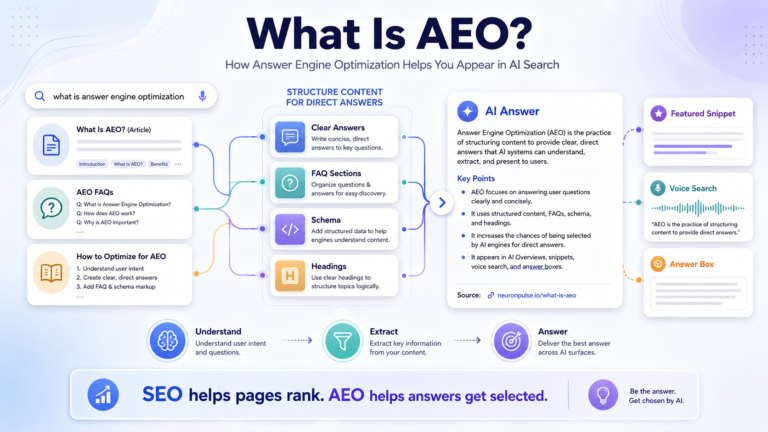
AEO, or Answer Engine Optimization, asks a more practical question:
Is this article clear enough, structured enough, and trustworthy enough to be used as an answer?
Search behavior is changing because users are no longer relying only on traditional lists of blue links. They are increasingly getting direct answers, summaries, recommendations, and source-backed explanations from AI-powered search tools.
Google AI Overviews can summarize key information at the top of the search results and include links for users who want to explore the topic further. ChatGPT Search can answer current questions while pointing users toward relevant web sources. Perplexity is built around the idea of an answer engine, where users receive a synthesized response supported by citations.
That changes the role of your content.
An article is no longer competing only for a traditional ranking position. It may also be evaluated as a possible source for an AI-generated answer. If the article is vague, outdated, poorly structured, or missing trust signals, it becomes harder for AI systems to understand why that page should be used.
This is why existing articles need to be updated for AEO. The goal is not just to add more keywords or make the article longer. The goal is to make the content clearer, easier to verify, easier to summarize, and more useful for the reader.
A strong AEO update helps an article answer the right question faster, support its claims with better context, and give both people and AI systems a clearer reason to trust it.
So the goal is not just to “refresh” an old article.
The goal is to make the article more useful for people and easier for AI systems to understand, summarize, cite, and recommend.
Why Existing Articles Need to Be Updated for AI Search
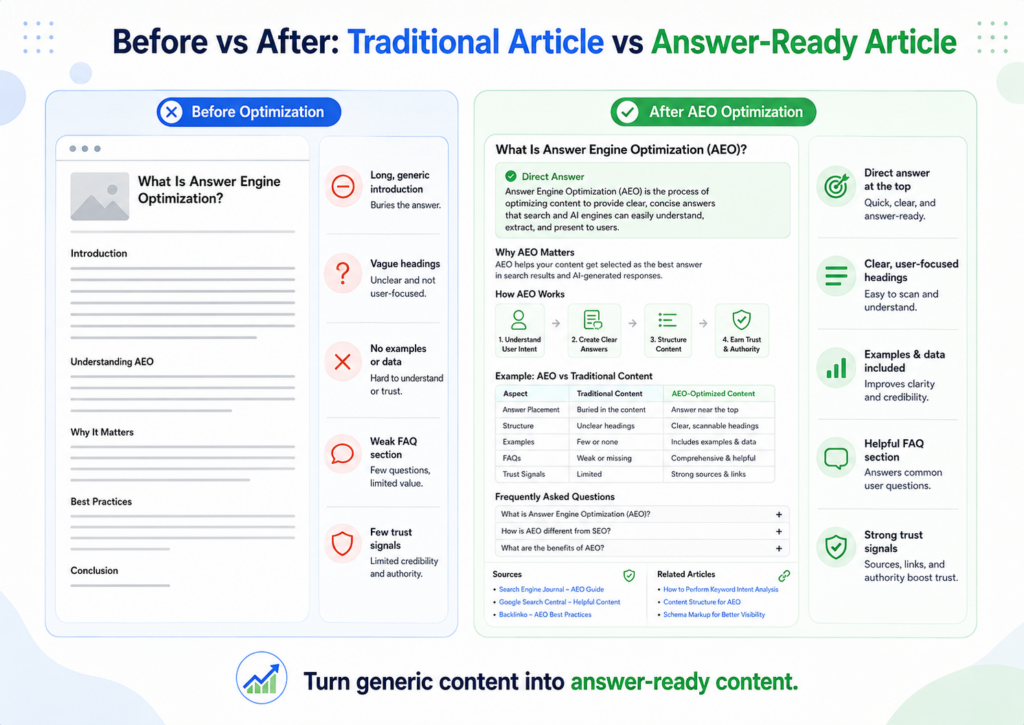
Most older blog posts were not written for an answer-driven search. I have a travel business with commercial/money urls and support pages that ranked very well in Google search up to a year and a half ago. Then my articles began to get less impressions, fewer clicks and less leads overall. Even refreshing the articles with new content like photographs, was not enough to regain traffic from these URLs.
The issue is that user behavior has changed, and they spend time asking more specific questions on LLms. They see AI overviews and realize that the questions have been answered and in turn, don’t visit my website anymore. The only solution is to now revamp the old content so that Google AI overviews, ChatGPT search, and other LLMs see me as a source to be cited.
If your content isn’t updated to reach all of the new platforms at our disposal, then your articles are dead in the water.
They may rank for some keywords, but they often have problems like:
- long introductions before the answer
- vague headings
- thin sections
- no clear definitions
- outdated examples
- no comparison tables
- weak or missing FAQs
- unsupported claims
- poor internal linking
- no visible author or update signals
That might have been acceptable when the goal was simply to rank for a keyword. In the past, we had plenty of content + keyword density + a few inbound links be enough to rank and dominate search results. Today, the landscape is a bit more complicated.
AI search systems often work differently. They are trying to answer a user’s question, summarize information, and sometimes cite sources. If your article does not make the answer obvious, another page may be easier to use.
That does not mean every article needs to become a rigid FAQ page. It means your content should be easier to understand.
The best content refreshes do three things:
- Make the answer clearer.
- Make the article more useful.
- Make the page more trustworthy.
That is the core of this workflow.
When Should You Optimize an Existing Article for AEO?
Not every article deserves immediate attention. Some article smight still be doing well and can be cited in LLMs with their current structure. To know which URLs are doing well, we can use tools like Google Search Console. Some URLs will seem obvious candidates to optimize for AEO results.
Start with pages that already show signs of potential.
Good candidates include:
| Article Type | Why It Is Worth Updating |
|---|---|
| Articles with impressions but few clicks | Google understands the topic, but the page may not be compelling or competitive enough |
| Articles ranking between positions 8–30 | Small improvements may move them into stronger visibility |
| Old posts with outdated information | Freshness and accuracy may be holding them back |
| Definition articles | These often work well for answer-driven search |
| Comparison articles | Tables, answer blocks, and FAQs can improve clarity |
| How-to guides | Step-by-step formatting can make them more useful |
| Articles supporting a service page | Better structure can support conversions and internal linking |
| Pages with weak intros | A stronger opening answer can improve both user experience and AI-readiness |
For NeuronPulse, this workflow would apply to articles like:
- What Is LLM SEO?
- What Is AEO?
- AEO vs SEO
- How to Optimize for ChatGPT Search
- How to Optimize for Google AI Overviews
- How to Optimize for Perplexity
- The LLM SEO Checklist
For a travel site, it could apply to articles like:
- Best Time to Visit Hawaii
- How Many Days Do You Need in Peru?
- How to Visit Torres del Paine in Chile
- 7-Day Peru Itinerary
- Galapagos Islands Vacation Packages
The topic can change. The workflow stays useful.
The AEO Content Optimization Workflow
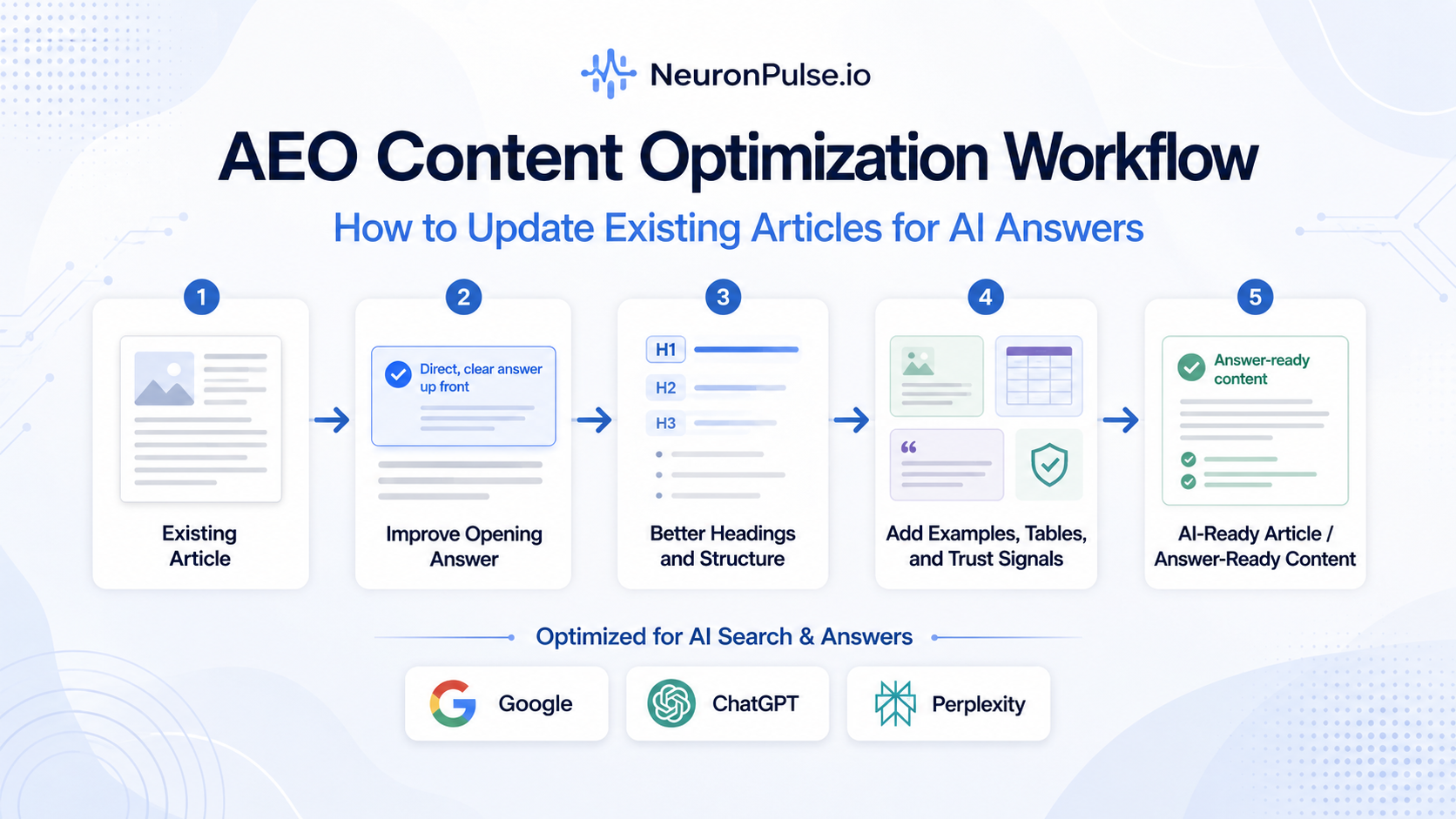
The goal of this workflow is to turn an existing article into a clearer, answer-ready resource. You are not simply adding keywords or making the article longer. You are reviewing the page from the perspective of a reader, a search engine, and an AI answer system: What is the page trying to answer, how quickly does it answer it, and why should it be trusted?
Step 1: Choose the Right Article to Optimize
Start with data, not guesswork.
Open Google Search Console and look for pages with:
- impressions but low clicks
- average positions between 8 and 50
- keywords that match the page topic
- declining impressions or clicks
- queries phrased as questions
- queries showing comparison intent
- queries that might trigger AI Overviews or featured snippets
A page with no impressions at all may still need work, but it is harder to diagnose. A page with impressions already has evidence that Google sees some relevance. So, check for pages with a low CTR, see where they stand. After checking GSC I noticed there was a URL that should be working as a support page for my travel blog.
The issue was that it had thousands of impressions/day but little to no clicks. Basically, the page was ranking in positions 30+ in search results so it was appearing but not in any meaningful ranking spots. After revamping the url to be more AEO-friendly, It started to see daily clicks about 21 days later.
The page always had good content, it was information-heavy and was very relevant to a particular keyword. All it took was a change in structure, switching up the headings, changing the writing style, and in about a day, it was a piece of content that was more in tune with AI overviews.
What to check in GSC
For each candidate article, review:
- top queries
- average position
- impressions
- click-through rate
- countries
- devices
- date range trends
- whether queries match the article’s actual content
Example
If an article titled What Is AEO? gets impressions for:
- answer engine optimization
- what is AEO
- AEO SEO
- AEO vs SEO
- answer engine optimization examples
Then the article should probably include sections for each of those ideas.
If it only defines AEO but does not explain examples or compare it to SEO, there is a content gap, and your article needs more information.
Step 2: Identify the Main Question
Every optimized article needs one clear main question. This is where many content refreshes go wrong. The writer adds more sections, more keywords, and more FAQs without deciding what the page is really supposed to answer. AEO is interesting because it focuses on simply trying to answer a question. Instead of thinking of adding new sections, first look at the article and see if it answers the user’s query intent. Here is a good exercise,
Before editing, write this down:
This article should answer: [main question]
Examples:
| Article | Main Question |
|---|---|
| What Is AEO? | What does answer engine optimization mean and how does it work? |
| AEO vs SEO | What is the difference between optimizing to rank and optimizing to answer? |
| How to Optimize for Perplexity | How can a website become more useful as a source in Perplexity? |
| LLM SEO Checklist | What should I check before publishing AI-search-ready content? |
| AI Search Visibility Audit | How do I know if my website is ready for AI search? |
Once the main question is clear, the article becomes easier to improve.
Quick test
If the article cannot be summarized in one sentence, it may be trying to do too much. We often make the mistake of making content that covers too many areas without first focusing on one main idea to answer. The one-sentence test is a good way to keep you grounded when putting together an article.
“This article is about learning to repurpose old SEO optimized content to AEO optimized content”
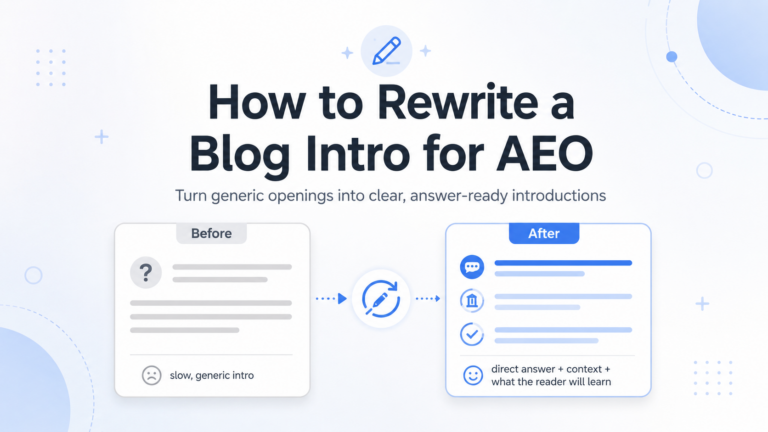
Step 3: Rewrite the Opening Answer
This is usually the highest-impact edit. Make sure to answer the question within the first few lines of the article.
Many articles begin with filler:
In today’s digital landscape, businesses must adapt to changing technology…
That kind of opening is common, but it wastes the most valuable part of the page.
Instead, answer the question directly. Give the answer directly and clearly, then add whatever information section that should go underneath.
Weak opening
Search engine optimization has changed a lot in recent years as artificial intelligence continues to impact how businesses approach digital marketing.
Stronger opening
AEO, or Answer Engine Optimization, is the process of structuring content so search engines and AI tools can use it to answer specific user questions. It builds on SEO, but focuses more on clarity, direct answers, and answer-ready formatting.
The stronger opening is better because it gives the reader the answer immediately. It is a clear and direct to-the-point answer. This is what LLMs love to use when citing sources.
What to include in the opening
A good opening answer usually includes:
- the main definition or answer
- why it matters
- who it affects
- what the reader will learn
- a natural mention of the main keyword
Do not overdo it
You do not need to stuff every target phrase into the first paragraph. The opening should sound natural. AEO optimization is about clarity, not keyword repetition.
Step 4: Improve the Headings
Headings are not just formatting. They are the article’s roadmap.
When reviewing an existing article, read only the H2s and H3s.
Ask:
Would a reader understand the article by scanning these headings?
If the answer is no, rewrite them.
Weak headings
- Introduction
- Overview
- Benefits
- Important Things
- More Tips
- Conclusion
Stronger headings
- What Is AEO?
- How Is AEO Different From SEO?
- Why AEO Matters in AI Search
- How to Optimize Existing Content for Answers
- Common AEO Content Mistakes
- AEO Content Optimization Checklist
Strong headings make the article easier for humans to scan and easier for search systems to interpret. Make sure to make your headings directly about the information in the article. Some headings can and should be in question form.
Use question-based headings when appropriate
Remember,, people are asking questions so your headings should be made in a similar fashion. Question headings are especially useful for:
- definitions
- comparisons
- FAQs
- beginner guides
- troubleshooting content
- AI search topics
Examples:
- How Do You Optimize an Article for AEO?
- Does AEO Help With Google AI Overviews?
- Can Existing Articles Be Updated for ChatGPT Search?
- What Makes Content Easier for AI Systems to Cite?
Do not force every heading into a question. But when a section answers a direct question, make that question visible. So your entire article doesn’t have to be an FAQ sheet. Make questions where it makes sense.
Step 5: Add Answer Blocks
An answer block is a short, self-contained explanation that directly answers a question.
It usually appears right after a heading.
Example:
An AEO content refresh improves an existing page by making the answer clearer, the structure easier to scan, and the content more useful for search engines, AI tools, and readers.
That paragraph can stand alone. It is useful for readers who skim. It is also easier for AI systems to summarize accurately.
Where to add answer blocks
Add answer blocks under important sections like:
- What is this?
- Why does it matter?
- How does it work?
- What is the difference?
- What should I do first?
- What mistakes should I avoid?
Bad answer block
AEO is really important for many different reasons, and businesses should think about it as part of their strategy.
This is vague and can be said about anything. “Staples are really important, businesses should think about adding staples as part of their strategy”
The sentence above sounds ridiculous when you change the subject, yet it is the same sentence.
Better answer block
AEO matters because more search experiences now provide direct answers before users click a result. If your article is not clear, structured, and trustworthy, it may be less likely to appear in answer-driven formats.
This version explains the reason clearly. It is specific to the subject.
Step 6: Add Examples, Tables, and Checklists
This is where most existing articles can improve quickly. If your article only explains the concept, it may still feel thin. Anyone can write and explanation but we can go a little further. Add practical elements that help the reader apply the advice.
Use:
- before-and-after examples
- comparison tables
- mini checklists
- screenshots
- templates
- common mistake sections
- practical workflows
- decision tables
Example: before and after
Weak sentence:
You should make your article clearer for AI search.
Better rewrite:
Instead of starting an article with a broad introduction, add a direct answer near the top. For example, a page about “AEO vs SEO” should explain the difference in the first few lines before going into background, examples, and strategy.
That is more useful because it shows the reader what to do. Now we add a table to make the article more enticing for users and more cite worthy for AI properties.
Table example
| Weak Content Element | AEO Improvement |
|---|---|
| Long generic intro | Direct answer in the first few lines |
| Vague headings | Question-based headings |
| No examples | Before-and-after examples |
| Unsupported claims | Credible sources and citations |
| No structure | Tables, lists, and summaries |
| Weak ending | Checklist and next steps |
Checklist example
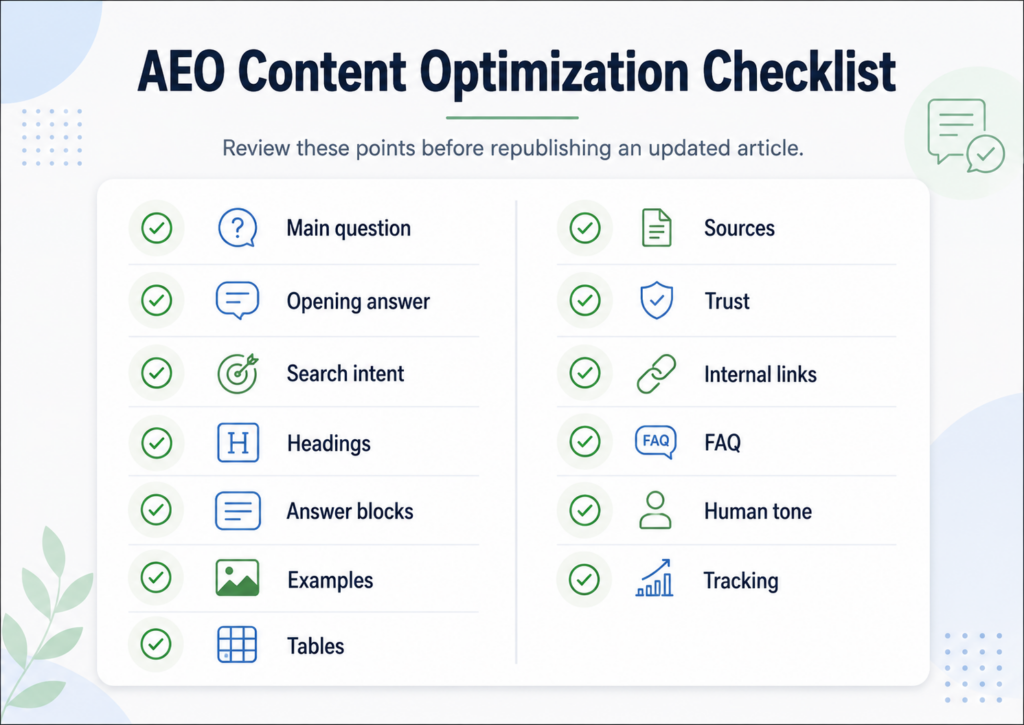
Before republishing, ask:
- Does the article answer the main question early?
- Are the headings clear?
- Are there examples?
- Is there a table where comparison is needed?
- Are important claims supported?
- Are internal links added?
- Is the FAQ useful?
- Does the article sound human?
AEO is not just about adding more words. It is about making the article more useful. By making it more useful, we tend to make the article better. Funny how that seems to work out. Make good content that people will want to read, and AI results might want to cite it as well.
Step 7: Add Sources and Trust Signals
For AI search topics, trust matters.
When you update an article, review any claims that involve platforms, search features, crawlers, or technical recommendations.
For example, if you discuss Google AI Overviews, cite Google’s documentation. Google says AI Overviews provide a snapshot of key information with links to explore more on the web, and Google Search Central has a specific guide for AI features and websites.
If you discuss ChatGPT Search, cite OpenAI. OpenAI says ChatGPT Search can provide fast, timely answers with links to relevant web sources, and its crawler documentation says OAI-SearchBot is used to surface websites in ChatGPT search features.
If you discuss Perplexity, cite Perplexity. Perplexity describes itself as an AI-powered answer engine that provides trusted, real-time answers.
Trust signals to add
- author name
- author bio
- updated date
- credible citations
- screenshots
- methodology
- original examples
- internal links to related guides
- clear brand positioning
Example author trust signal
Written by Michael, founder of NeuronPulse, where he writes about AI search, LLM SEO, AEO, GEO, content strategy, PPC, Media buys, AI Agents, and practical AI workflows.
A real author signal makes the page feel less anonymous. People and AI want to make sure there is a face behind the content.
Step 8: Strengthen Internal Links
AEO optimization should always include internal linking. Internal links provide a road map for AI to read, index, and cite your content. It is also a way for human readers to continue to engage with content they find interesting. In terms of AEO and SEO, internal linking is an important part of making content clusters.
When you update an article, ask:
What should the reader read next?
Do not only add links for SEO. Add links that help the reader continue naturally.
For example, an article about AEO content optimization should link to:
- What Is AEO?
- AEO vs SEO
- What Is LLM SEO?
- GEO vs AEO vs LLM SEO
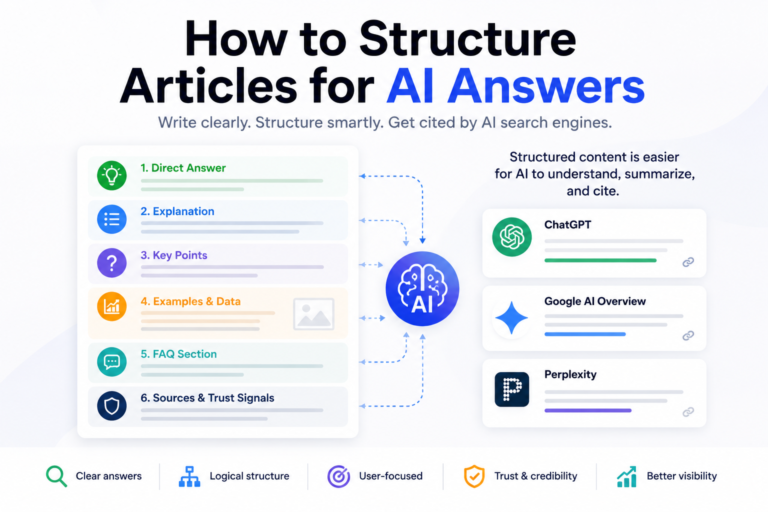
- How to Structure Articles for AI Answers
- The LLM SEO Checklist
- AI Search Visibility Audit
- The LLM SEO Article Workflow
Use contextual anchor text
Weak:
Click here.
Better:
Use our LLM SEO checklist before republishing the article.
Better:
If you are creating a new article from scratch, follow our LLM SEO article workflow.
Internal links help users, support topical authority, and make the cluster easier to understand.
Step 9: Add or Improve the FAQ Section
FAQs are useful, but only when they answer real follow-up questions.
Do not add an FAQ section just because “AEO likes FAQs.” That creates bloated content.
A good FAQ section should handle questions that did not fit naturally into the main body.
For this topic, useful FAQs might include:
- What is AEO content optimization?
- Can I optimize old articles for AI search?
- Does adding FAQs help with AI Overviews?
- Should I rewrite the whole article or update sections?
- How often should I refresh content?
- Can AI help with AEO optimization?
- What should I update first?
FAQ rule
If the FAQ answer repeats a section exactly, cut it or rewrite it.
FAQs should add clarity, not clutter. Don;t add an FAQ just to say to have an FAQ, make sure it is useful to the reader.
Step 10: Edit for Human Flow
This step matters more than people think.
Many AEO-optimized articles become technically structured but boring. They have headings, FAQs, and tables, but they read like a template. A boring article is an article that gets low engagement.
Before republishing, read the article out loud.
Look for:
- repeated phrases
- robotic transitions
- too many bullet lists
- sections that say the same thing
- generic claims
- missing examples
- unnatural keyword usage
- abrupt heading changes
Human editing questions
Ask:
- Would I actually read this?
- Does this sound like a person wrote it?
- Is there a point of view?
- Does each section add something new?
- Are examples specific?
- Is the article too similar to other posts on the site?
- Is the advice practical?
The goal is not to make the article sound casual. The goal is to make it sound useful, clear, and human. Remember that we are writing for humans but with a structure that is friendly towards AI.
Step 11: Republish and Track Results
Once the article is updated, do not just republish and forget it.
Track performance.
Use Google Search Console to monitor:
- impressions
- queries
- average position
- CTR
- new long-tail keywords
- pages gaining or losing visibility
- whether the article is being tested for new queries
Also manually check relevant AI search tools:
- Does Perplexity cite your page?
- Does ChatGPT Search surface your page?
- Does Google show an AI Overview for the target query?
- Which competitors are cited?
- Did the article start appearing for new question-based queries?
Wait before judging
Do not expect results in 24 hours.
A content refresh often needs several weeks to show meaningful changes. Check the article after:
- 7 days
- 28 days
- 60 days
- 90 days
If impressions increase but clicks do not, review title, meta description, and whether the page is ranking high enough to earn traffic.
If impressions appear for new queries, that is useful data. You may need to add a section that better answers those queries.
After rewriting an article as a rule of thumb, I tend to wait 2-3 weeks to record changes in impressions and traffic before doing any more editing. SEO was slow in the past, and AEO takes its sweet time now.
AEO Content Optimization Checklist
Use this before republishing an updated article.
| Area | Question |
|---|---|
| Main question | Is the article clearly answering one primary question? |
| Opening | Does the page answer the question in the first few lines? |
| Intent | Does the article match what the searcher actually wants? |
| Headings | Are headings specific, useful, and easy to scan? |
| Answer blocks | Are key sections supported by direct explanations? |
| Examples | Are there practical examples or before-and-after rewrites? |
| Tables | Are comparisons or processes easier to understand visually? |
| Sources | Are important claims supported by credible references? |
| Trust | Is the author, brand, and update context clear? |
| Internal links | Does the article link to related cluster pages? |
| FAQ | Does the FAQ answer real follow-up questions? |
| Human tone | Does the article sound natural and useful? |
| Tracking | Is there a plan to review performance after publishing? |
Before and After: AEO Content Refresh Example
Let’s say you have an article titled:
What Is LLM SEO?
Before
The article starts with:
Artificial intelligence is changing the world of search. Businesses need to understand new technologies and adapt their content strategies to remain visible in the future of digital marketing.
This is not terrible, but it is generic. It delays the answer.
After
The article starts with:
LLM SEO is the process of optimizing your website so large language models can understand, summarize, cite, and recommend your content in AI-powered search experiences. It builds on traditional SEO, but places more emphasis on clear answers, entity clarity, trust signals, topical authority, and source-worthy content.
This version gives the answer immediately.
Then the article can explain:
- how LLM SEO differs from traditional SEO
- how it connects to AEO and GEO
- what AI search platforms look for
- how to optimize an article
- what mistakes to avoid
- what checklist to use
That is a stronger AEO refresh because it improves clarity without making the article robotic.
How Often Should You Refresh Articles for AEO?
It depends on the topic.
Fast-moving topics should be reviewed more often.
| Topic Type | Suggested Refresh Frequency |
|---|---|
| AI search platforms | Every 1–3 months |
| SEO best practices | Every 3–6 months |
| Tool reviews | Monthly or quarterly |
| Definitions | Every 6–12 months |
| Evergreen tutorials | Every 6–12 months |
| Legal, medical, or financial topics | Review frequently and carefully |
| Travel logistics | Seasonally or when rules/prices change |
For AI search topics, a quarterly review is a good baseline. If Google, OpenAI, Perplexity, or Gemini releases a major update, review related articles sooner.
Common AEO Optimization Mistakes
Mistake 1: Adding more content without improving clarity
More words do not automatically make a better article. If the main answer is still buried, the update failed.
Mistake 2: Stuffing questions into headings
Question-based headings are useful, but they should feel natural. Do not force every heading into a question if it makes the article awkward.
Mistake 3: Adding generic FAQs
FAQs should answer real doubts. If they repeat the article, they are just clutter.
Mistake 4: Ignoring internal links
Updating the article but not connecting it to the rest of the cluster is a missed opportunity.
Mistake 5: Over-optimizing until the article sounds robotic
AEO is about clear answers, not mechanical writing. Human tone still matters.
Mistake 6: Updating the date without updating the content
Changing the date is not a refresh. A real refresh improves accuracy, usefulness, structure, or trust.
Final Takeaway
An AEO content optimization workflow helps you turn existing articles into stronger answer-ready resources.
The process is straightforward:
- Choose the right article.
- Identify the main question.
- Rewrite the opening answer.
- Improve headings.
- Add answer blocks.
- Add examples, tables, and checklists.
- Add sources and trust signals.
- Strengthen internal links.
- Improve FAQs.
- Edit for human flow.
- Republish and track results.
The goal is not to make every article look the same.
The goal is to make each article clearer, more useful, more trustworthy, and easier to understand.
That is what gives your content a better chance in Google, ChatGPT Search, Perplexity, Google AI Overviews, and the broader AI search ecosystem.
FAQ About AEO Content Optimization
AEO content optimization is the process of improving content so it answers user questions more clearly and can perform better in answer-driven search experiences such as featured snippets, AI Overviews, voice search, ChatGPT Search, and Perplexity.
Yes. Existing articles can often be improved by adding a clear opening answer, better headings, examples, tables, sources, internal links, and useful FAQs.
Not exactly. SEO content optimization focuses on improving search visibility, rankings, and relevance. AEO content optimization focuses more on answer clarity, structure, and usefulness in direct-answer environments. The two should work together.
Start with sections. Rewrite the opening, headings, weak explanations, outdated claims, and missing examples first. If the article has no clear structure or no longer matches search intent, a full rewrite may be better.
FAQs can help when they answer real follow-up questions. They are less useful when they repeat the article or exist only to add keywords.
AEO principles can help because they make content clearer, more structured, and easier to understand. However, no content update can guarantee inclusion in Google AI Overviews.
Yes, indirectly. Clear, trustworthy, well-structured content is better prepared for AI systems that summarize, cite, or recommend web sources. But visibility also depends on crawlability, authority, relevance, and platform-specific systems.
Some changes may be noticed within days, but meaningful SEO and AI search movement usually takes weeks or months. Track performance in Google Search Console and review AI search visibility manually over time.
Recommended internal links to add
- What Is AEO?
- AEO vs SEO
- What Is LLM SEO?
- GEO vs AEO vs LLM SEO
- How to Structure Articles for AI Answers
- The LLM SEO Checklist
- AI Search Visibility Audit
- The LLM SEO Article Workflow
- How to Optimize for ChatGPT Search
- How to Optimize for Google AI Overviews
- How to Optimize for Perplexity