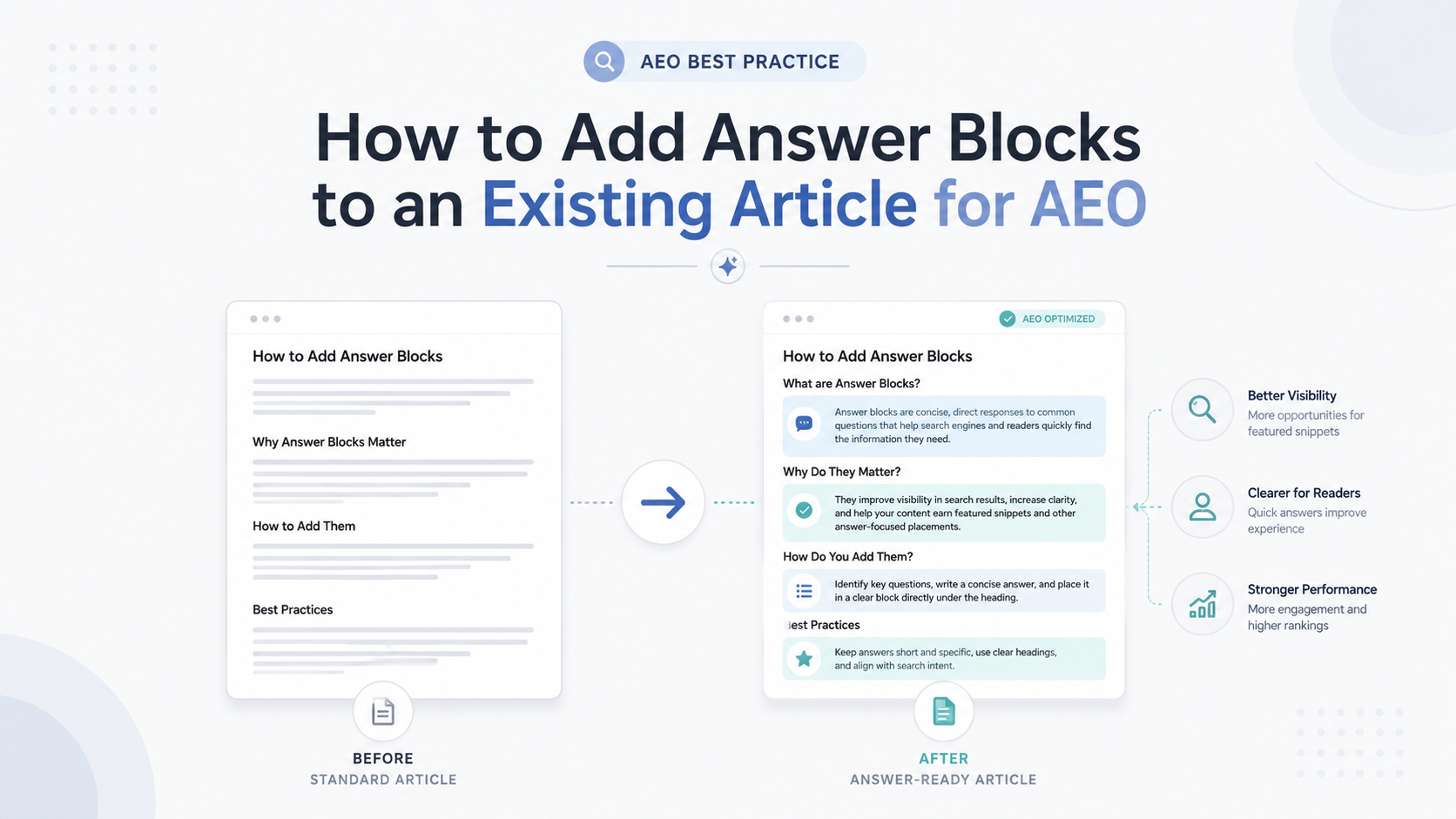
How to Add Answer Blocks to an Existing Article for AEO
Introduction
Most older blog posts were written like essays. They build up slowly, explain the background, and eventually get to the answer. It’s what Google and other search engines were looking for in content for a very long time. We wrote something, added keywords, and made it long by filling it with important information. According to Google, the task was to be a niche expert and the content should reflect this.
That can still work for some topics, but it is not always ideal for answer-driven search. Longer content with several lines will underperform nowadays in comparison to search intent-driven answers. This doesn’t necessarily mean the answer is shorter, it means it needs to quickly answer a question.
When someone asks a specific question, they usually want a clear answer quickly. If your article buries the answer under a ton of content, readers may leave before they find it. Search engines and AI-powered tools may also have a harder time identifying the clearest answer on the page.
That is where answer blocks can help.
An answer block is a short, focused section that directly answers a specific question inside an article. It does not replace the full article. It simply gives the reader a clear answer before the deeper explanation.
In this guide, you’ll learn what answer blocks are, where to add them, how to write them naturally, and how to use them to improve existing articles for AEO, AI search, and human readers.
What Is an Answer Block?
An answer block is a short, self-contained paragraph or section that gives a direct answer to a specific question.
It usually appears near the top of an article or directly under an important heading.
For example, if the section heading is:
What Is an Emergency Fund?
A strong answer block might be:
An emergency fund is money set aside to cover unexpected expenses, such as medical bills, car repairs, job loss, or urgent home repairs. Most people use an emergency fund as a financial safety net so they do not have to rely on credit cards, loans, or retirement savings when something unexpected happens.
That block works because the reader gets the answer immediately. The rest of the section can then explain:
- How much to save
- Where to keep the money
- How to build the fund over time.
Think of an answer block as the “quick answer” version of a section. The part where both the reader and the LLM can quickly reference for the answer.
It helps readers who want the short version, while still giving you room to explain the topic properly afterward.
Why Answer Blocks are Important For AEO
Answer blocks matter because search is becoming more direct, more conversational, and more answer-focused.
Google AI Overviews will provide AI-generated snapshots with important information and links for users to explore more. Google also says pages must be indexed and eligible to appear in Google Search with a snippet to be eligible as supporting links in AI Overviews or AI Mode.
At the moment we also have ChatGPT Search which can provide fast, timely answers with links to relevant web sources, including articles and blog posts.
Having access to answer so quickly and efficiently changes how content needs to be structured. The AI needs to be able to go through a lot of data so structuring your content around having “easily found answers” makes sense if we are talking about traffic or being cited.
A traditional article might be written like this:
background → context → explanation → answer
An AEO-friendly article often works better like this:
answer → context → explanation → examples
The answer block handles that first step.
It tells the reader:
“You are in the right place. Here is the answer. Now let’s go deeper.”
That is useful for people, and it also makes the page easier to interpret. It is a change, and Google has already taken steps to ensure content meets a certain criteria with the September 2025 Perspective update.
The Difference Between an Answer Block and a Normal Paragraph
A normal paragraph can explain anything. An answer block has a specific job: answer the question clearly. Remember, now we have to think about “feeding” AI information in the smoothest way possible. So we reserve the idea of an answer block specifically to quickly and efficiently answer the question.
Here is the difference.
Normal paragraph
Many businesses are beginning to think about AEO because search behavior is changing and users are looking for faster answers across different platforms.
This is fine, but it does not directly answer a question. It is more of an essay-style response that is “warming up” the user for the real answer later on.
Answer block
AEO helps content become easier to use in direct-answer search experiences. It does this by making the main answer clear, organizing sections around user questions, and using formats like short explanations, FAQs, tables, and examples.
The second version is stronger because it gives the reader a usable explanation right away.
A good answer block should be:
- specific
- concise
- easy to understand
- connected to the heading
- useful without needing five more paragraphs
- natural enough that it does not sound robotic
It should not feel like a random bold paragraph stuffed into the article. It should feel like the section’s clearest answer.
Essay style answer: “Today we are here to talk about the answer”
Answer block style answer: “This is the answer.”
An answer block style is easier to skim and find the answer.
Where Should You Add Answer Blocks?
You do not need an answer block under every heading. If you did that your content would probably look robotic and honestly, not every section needs an answer block.
Use them where the reader is likely to want a quick explanation before the details.
Good places for Answer blocks include:
- under the main article introduction
- below definition headings
- below comparison headings
- at the start of step-by-step sections
- before a checklist
- under FAQ-style headings
- in sections explaining mistakes or best practices
- before a technical explanation
For example, answer blocks work well under headings like:
- What Is AEO?
- What Is an Answer Block?
- Why Do Answer Blocks Matter?
- How Do You Optimize Existing Content for AI Search?
- What Is the Difference Between AEO and SEO?
- How Long Should an Answer Block Be?
- Does Schema Help With AEO?
They are less useful under headings that are already straightforward or purely narrative.
For example, a section like “My Experience Visiting The Eiffel Tower” may not need a direct answer block. A more natural story or example might work better. This is why writing styles sometimes need to be niche-specific.
That is the key: use answer blocks to improve clarity, not to make every section feel identical.
A Simple Rule: Add the Answer Before the Explanation
The easiest way to write answer blocks is to flip the usual writing order. Many articles explain first and answer later. Formal writing tends to tell a story before finally coming up with the conclusion towards the end of the content. Think of LLMs as anxious readers that “need to know” the conclusion of the story right away.
For AEO, try answering first and explaining second.
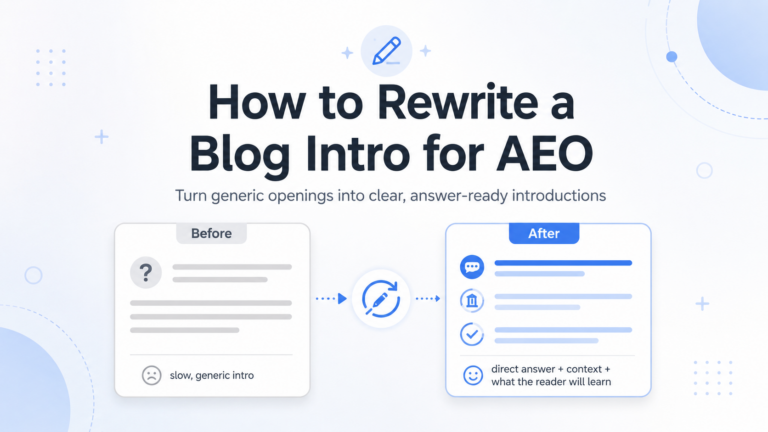
Old structure
AEO has become more important because of changes in search behavior, the rise of AI tools, and the growth of direct-answer search experiences. As a result, many marketers are beginning to rethink how their content is structured.
Better structure
AEO matters because users are increasingly getting direct answers from search engines and AI tools before they click through to a website. Content that answers clearly, uses helpful structure, and shows trust is better prepared for this environment.
The second version gets to the point faster. It’s not shorter, it just explains the answer in a better manner.
Then you can follow with more context:
This does not mean every article needs to become short or robotic. It means the article should make its best answer easier to find.
That combination works well: direct answer first, human explanation second.
What Makes a Good Answer Block?
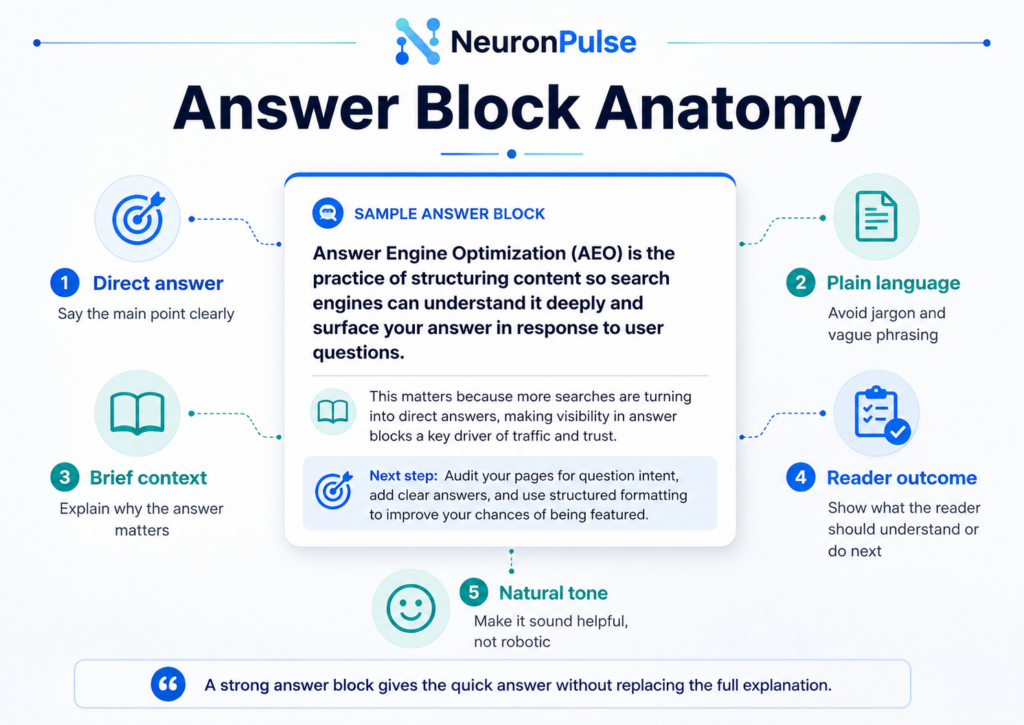
A good answer block should feel like a helpful mini-answer, not a dictionary entry. Make the answer block 2-5 lines or 1-3 sentences long if you are worried about length. If it is longer than that, then it isn’t an answer block anymore, or you need to practice condensing the answer better.
Here are the main ingredients.
| Element | What It Does |
|---|---|
| Direct answer | Gives the reader the point immediately |
| Plain language | Makes the answer easy to understand |
| Specific wording | Avoids vague, generic explanations |
| Context | Explains why the answer matters |
| Natural tone | Keeps the article from sounding robotic |
| Follow-up path | Leads into the rest of the section |
Here is a simple format:
[Topic] is [clear explanation]. It matters because [brief reason]. In practice, this means [what the reader should do or understand].
Example:
An answer block is a short section that directly answers a specific question inside an article. It matters because readers and AI search systems both benefit from clear, easy-to-identify answers. In practice, answer blocks work best under headings where the reader expects a quick explanation before the details.
That is direct, but it still sounds human.
How to Add Answer Blocks to an Existing Article
Before adding answer blocks, remember the goal: you are not decorating the article. You are making the article easier to understand by adding an answer that is right in front of the reader and the AI.
Here is the workflow.
Step 1: Find the Questions Already Inside the Article
Start by scanning the article’s headings to find potential changes. Look for sections that either already ask a question or imply one.
For example:
| Existing Heading | Implied Question |
|---|---|
| Benefits of AEO | Why does AEO matter? |
| SEO vs AEO | What is the difference between SEO and AEO? |
| Best Practices | What should I actually do? |
| Common Mistakes | What should I avoid? |
| Tools | Which tools can help? |
| Content Structure | How should the article be organized? |
Many articles already contain questions, but they are hidden behind vague headings. Sometimes when we write, we are already answering a question we were thinking about. The main idea is to jot down the questions as a heading.
The first step is to make those questions clearer.
Instead of:
Benefits of AEO
Use:
Why Answer Blocks Matter for AEO
Instead of:
Best Practices
Use:
What Makes a Good Answer Block?
Better headings make answer blocks easier to write. They also provide a way to better structure your content.
Step 2: Write the Short Answer in Plain English
Once you know the question, answer it in one to three sentences, two to five lines. Do not try to sound impressive with your answer; try to be useful.
For example:
Question
What is an answer block?
Answer block
An answer block is a short section that directly answers a question inside an article. It usually appears near the top of a page or under an important heading so readers can understand the main point before reading the details.
That is enough.
The goal is not to explain everything in the block. The goal is to give the reader a clear starting point. Once that first task is fulfilled, you can add more information and context in the following paragraph.
Step 3: Add the Deeper Explanation After the Block
After the answer block, add the supporting explanation. This is where the writer can flex their writing skills but still within structured content.
This is where you can include:
- examples
- nuance
- screenshots
- comparisons
- caveats
- step-by-step details
- internal links
- citations
The answer block gives clarity. The follow-up content gives depth and context.
Example structure
## What Is an Answer Block?

[Answer block]

Now let’s look at how this works in practice...
This structure is simple, but it works well. It also prevents the article from becoming too thin. The answer block is not the whole section; instead, think of it as the doorway into the section.
Step 4: Use Formatting Carefully
Answer blocks should stand out, but they should not look like ads.
That being said, we can make them look obvious to the reader by implementing them in a format that differentiates them from the rest of the text.
You can format them with:
- bold text
- a short paragraph
- a callout box
- a shaded background
- a “Quick answer” label
- a short summary block
For example:
Quick answer:
An answer block is a short section that directly answers a specific question inside an article. It helps readers understand the point quickly before moving into examples, context, and detail.
That works well.
But avoid making every answer block look too loud. If every section has a giant callout, the page becomes visually exhausting. Remember to only use answer blocks where necessary.
Use formatting to guide the reader, not shout at them.
Step 5: Keep the Voice Natural
This is where a lot of AEO content goes wrong and where the idea of sounding robotic comes from.
Writers add answer blocks, but every one sounds like:
“X is the process of Y that enables Z…”
That structure is useful sometimes, but it gets repetitive fast. Human readers will get bored and click off your site.
Vary the rhythm.
Formula-style answer
AEO is the process of structuring content so it can answer user questions directly.
More natural answer
AEO helps your content get to the answer faster. Instead of making readers dig through a long introduction, it organizes the page so the main point is easy to find and trust.
Both can work. The second one sounds more human and also answers the questions quickly.
Use a mix to keep your readers enganged and interested in the content.
Step 6: Add Examples So the Block Does Not Feel Thin
An answer block is useful, but an example makes it stronger.
After the block, show what you mean. We don’t have to make 10,000-word blog posts, but we should be able to make a search intent, answer-driven piece of content that meets minimal requirements.
Example:
A good answer block gives the reader the short version before the full explanation. It should be clear enough to stand on its own, but not so long that it replaces the section.
Then add:
Weak version
Answer blocks are important because they help with content and search.
Better version
Answer blocks help readers quickly understand the main point of a section. They also make it easier for search engines and AI tools to identify what the section is answering.
This kind of before-and-after example makes the advice easier to apply, and your answer is not just one simple sentence.
Step 7: Review the Whole Article for Repetition
After adding answer blocks, read the article again. Now that you’ve edited the article to add answer blocks and you can read it out loud, how does it sound to you? Did you answer the questions, and does the article seem pleasant to read through?
This step matters, and we should spend time reading what we’ve put together. Many people skip this step because they don’t like to read what they’ve written.
If every section now starts with the same type of paragraph, the page may become clearer but less enjoyable to read. We want clarity in our writing, but we also want the reader to stay engaged until the end.
Look for repeated phrases like:
- “X is the process of…”
- “This matters because…”
- “In today’s…”
- “The goal is…”
- “It helps readers and AI systems…”
Those phrases are fine occasionally. They become a problem when they appear in every section.
AEO should make the article clearer, not more mechanical.
Before and After: Adding an Answer Block
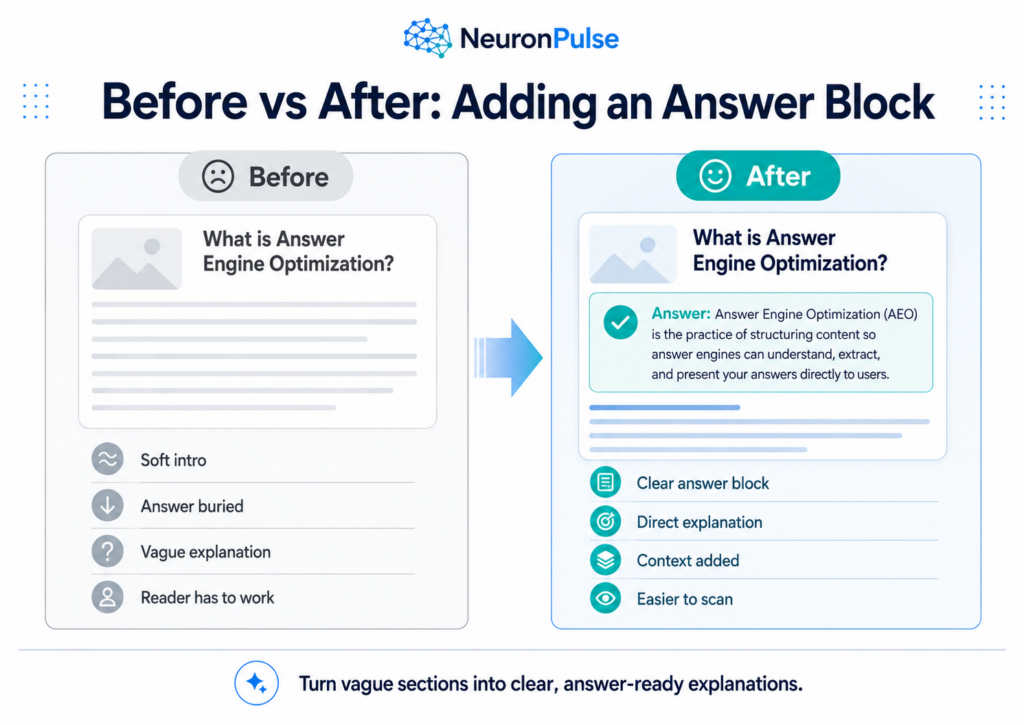
Ok, so hypothetically you have an existing section titled:
Why Internal Links Matter
Before
Internal links are a common SEO tactic used by many websites. They can help people navigate the site and can also support search engine optimization when used correctly.
This is not wrong, but it isn’t a strong enough answer. It does not show the reader we have intent when trying to answer the query.
After
Internal links matter because they help readers find related content and help search engines understand how pages on your site connect. For AEO, internal links also support topical authority by showing that your article is part of a larger, organized content cluster.
Now the section has a clear answer.
You can still follow with more detail:
For example, an article about answer blocks should naturally link to pages about AEO, AI-ready article structure, content optimization workflows, and the LLM SEO checklist.
That makes the section more practical.
Answer Block Templates by Content Type
Different article types need different answer blocks. Just like different niches might require a different writing style. It’s never really a once size fits all.
Here are several templates you can adapt as you see fit.
Definition Article
Use this for “what is” content.
[TERM] is [simple definition]. It matters because [reason]. In practice, it helps [reader outcome].Example:
AEO is the process of structuring content so it can answer user questions directly in search engines, AI tools, and answer engines. It matters because search experiences increasingly provide answers before users click. In practice, AEO helps your content become clearer, easier to scan, and more useful as a source.
Comparison Article
Use this for “X vs Y” content.
[X] focuses on [goal], while [Y] focuses on [goal]. The main difference is [simple contrast].Example:
SEO focuses on helping pages rank in search results, while AEO focuses on helping content answer user questions directly. The main difference is that SEO optimizes for visibility, while AEO optimizes for answer clarity.
How-To Article
Use this for instructional content.
To [complete task], start by [first step], then [second step]. The goal is to [desired outcome].Example:
To add answer blocks to an existing article, start by identifying the main question behind each important section. Then write a short answer under the heading before adding examples, context, or deeper explanation.
Checklist Article
Use this when the reader needs a review process.
A good [checklist] should help you review [main areas]. Use it to find [problems] before [action].Example:
An AEO checklist should help you review whether a page answers clearly, uses useful headings, includes examples, shows trust, and links to related content. Use it before republishing an article so the update improves clarity instead of just adding more words.
Service Page
Use this for business or service content.
[Service] helps [audience] solve [problem] by [method]. It is useful when [situation].Example:
An AI search visibility audit helps businesses understand whether their website is ready for ChatGPT Search, Perplexity, Google AI Overviews, and other answer-driven platforms. It is useful when a site has content but lacks clear structure, topical authority, or visibility in AI search tools.
Local Business Page
Use this for local SEO or service-area pages.
[Service] in [location] helps [audience] with [problem]. The best choice depends on [important factors].Example:
A financial advisor in Miami can help individuals and families plan investments, retirement, taxes, and long-term savings. The best advisor depends on your goals, risk tolerance, budget, and whether you need ongoing planning or a one-time consultation.
This type of block gives a quick answer without sounding like a generic directory page.
Answer Block Mistakes
Mistake 1: Making the Block Too Long
An answer block should not become a mini article. If the block is five paragraphs long, it is no longer a quick answer, or you have not practiced answering the question correctly. If you say the answer out loud and you can’t respond in one breath, is it really a quick answer?
Mistake 2: Adding Answer Blocks Everywhere
Not every section needs one.
Use answer blocks where they clarify the point. If a section is narrative, emotional, or example-driven, a normal opening may work better.
Mistake 3: Writing Like a Glossary
AEO content still needs to sound human.
If every block begins with “X is the process of…,” the article will feel mechanical.
Mistake 4: Giving the Answer Without Support
A block gives the short answer. The section still needs examples, explanation, or context.
Do not stop at the block. Make sure to add additional information afterward, think of the following section as a “support block”.
Mistake 5: Ignoring the Reader’s Intent
Answer blocks should match the reader’s question.
If the reader wants a comparison, give a comparison. If they want a step, give a step. If they want reassurance, give reassurance. We are creating blocks to match the user’s intent as closely as possible.
Answer Block Optimization Checklist
Before publishing, review each answer block:
| Question | Why It Matters |
|---|---|
| Does it answer the section heading? | Keeps the block aligned with the reader’s expectation |
| Is it short enough to scan? | Makes the answer easy to understand quickly |
| Is it specific? | Avoids generic filler |
| Does it use plain language? | Helps both beginners and advanced readers |
| Does it lead into deeper explanation? | Prevents the section from feeling thin |
| Does it sound natural? | Avoids robotic AEO writing |
| Is it supported when needed? | Builds trust for important claims |
| Does it vary from other blocks? | Keeps the article from feeling repetitive |
My Final Takeaway on Answer Blocks
Answer blocks are one of the simplest ways to improve an existing article for AEO.
They help you take a slow, vague, or overly broad section and give it a clearer point. That makes the content easier for readers to scan and easier for answer-driven search systems to interpret into their results. If you want to appear for Google AI overviews than start here. The same thing with ChatGPT results, perplexity, etc.
The best answer blocks do not make an article robotic. They make it more helpful.
Use them under important headings, keep them concise, support them with examples, and vary the tone so the article still feels natural.
A good answer block tells the reader:
“Here is the answer. Now let’s make it useful.”
FAQ About Answer Blocks for AEO
An answer block is a short section that directly answers a specific question inside an article. It usually appears near the top of a page or under an important heading.
Most answer blocks should be one to three short paragraphs. The goal is to answer clearly without replacing the full explanation.
No. Use answer blocks where they make the article clearer. Some sections work better with a story, example, image, or normal explanation.
They can help because they make the page easier to understand and summarize. However, answer blocks alone do not guarantee visibility in AI search results.
Not exactly. A featured snippet is something Google may show in search results. An answer block is a formatting and writing technique you control on your own page.
They can be bolded, placed in a callout, or introduced with a “Quick answer” label. The format matters less than the clarity of the answer.
Yes. Adding answer blocks to old articles is often one of the easiest ways to improve clarity without rewriting the entire page.
Choose one important heading in an existing article. Ask what question that section should answer. Then write a clear two-sentence answer directly below the heading.